
Catalogue Search | MBRL


Are you sure you want to remove the book from the shelf?

{{itemTitle}}
11
result(s) for
"Exempelen"
Sort by:

Devils, women, and Jews : reflections of the other in medieval sermon stories
Analyzes and illustrates the demonization of women and Jews in medieval sermon stories, retelling over one hundred of these tales in modern English. Contemporary misogyny and antisemitism have their roots in the demonization of women and Jews in medieval Christendom. In church art and mass preaching, the construct of the devil as an outcast from heaven and the source of all evil was linked both to the conception of women as sensual and malicious figures betraying man’s soul on its arduous journey to salvation and to the notion of Jews as treacherous dissidents in the Christian landscape. These stereotypes, widely disseminated for over three hundred years, persist today.
The exemplum, or cautionary story incorporated into preachers’ manuals and popular homilies, was an important mode of religious teaching for clerical and lay folk alike. Sermon narratives drawn from Hindu mythology, Arab storytelling, and secular folktales entertained all classes of medieval society while dispensing theological and cultural instruction.
In Devils, Women, and Jews, the vital genre of the medieval sermon story is, for the first time, made accessible to specialists and nonspecialists alike. Rendered in modern English, the tales provide an invaluable primary resource for medievalists, anthropologists, psychologists, folklorists, and students of women’s studies and Judaica. Critical introductions and explanatory headnotes contextualize the tales, and comprehensive endnotes and a bibliography allow readers to follow up analogue and subject studies in their own areas of interest.
eBook

Almuosa
Der Beitrag gilt den Bruchstücken und Leimabklatschen einer um 1300 entstandenen Handschrift aus dem westmitteldeutschen, wohl rheinfränkischen Sprachraum, die als Einbandverstärkung der Inkunabel Mainz, Gutenberg-Museum, StB Ink 626, dienten. Sie überliefern Reste eines sonst nicht bekannten höfischen Erzähltextes in fortlaufenden Versen. Etwa die Hälfte der ca. 250 noch erkennbaren Verse sind beschädigt, die erhaltenen Partien bilden keinen Zusammenhang. Die Handlung des fragmentierten Textes lässt sich daraus nicht rekonstruieren, doch handelt es sich um eine geistlich geprägte Erzählung wohl größeren Umfangs, die den Behelfstitel ‘Almuosa’ erhalten soll. Mögliche Parallelen mit anderen religiösen Erzählungen, besonders mit ‘Der arme Ritter’ und dem Stoff vom Mädchen namens Maria (Tubach Nr. 3450: “Name of Mary invoked”), werden diskutiert. Der Artikel enthält eine diplomatische Transkription und den Versuch einer versweisen Anordnung der erhaltenen Stücke in einer hypothetischen Reihenfolge.
This article examines the fragments and offset impressions of a West Middle German, probably Rhenish Franconian, manuscript from around 1300 that were used to reinforce the binding of the incunable Mainz, Gutenberg Museum, StB Ink 626. They contain the remains of an otherwise unknown courtly narrative in verse, written out continuously. About half of the approximately 250 lines that can still be identified are damaged; a contiguous text cannot be discerned. While the storyline of the fragmented narrative cannot be reconstructed on the basis of this material, it can be identified as a religiously accentuated tale, probably of some length, which is given the makeshift title ‘Almuosa’. Possible parallels with other religious narratives are discussed, especially with ‘The Poor Knight’ and the ‘Girl called Mary’ material (Tubach no. 3450: “Name of Mary invoked”). The article contains a diplomatic transcription as well as an attempt to arrange the preserved sections, set out line by line, in a hypothetical order.
Journal Article
Almuosa
Der Beitrag gilt den Bruchstücken und Leimabklatschen einer um 1300 entstandenen Handschrift aus dem westmitteldeutschen, wohl rheinfränkischen Sprachraum, die als Einbandverstärkung der Inkunabel Mainz, Gutenberg-Museum, StB Ink 626, dienten. Sie überliefern Reste eines sonst nicht bekannten höfischen Erzähltextes in fortlaufenden Versen. Etwa die Hälfte der ca. 250 noch erkennbaren Verse sind beschädigt, die erhaltenen Partien bilden keinen Zusammenhang. Die Handlung des fragmentierten Textes lässt sich daraus nicht rekonstruieren, doch handelt es sich um eine geistlich geprägte Erzählung wohl größeren Umfangs, die den Behelfstitel ‘Almuosa’ erhalten soll. Mögliche Parallelen mit anderen religiösen Erzählungen, besonders mit ‘Der arme Ritter’ und dem Stoff vom Mädchen namens Maria (Tubach Nr. 3450: “Name of Mary invoked”), werden diskutiert. Der Artikel enthält eine diplomatische Transkription und den Versuch einer versweisen Anordnung der erhaltenen Stücke in einer hypothetischen Reihenfolge.
This article examines the fragments and offset impressions of a West Middle German, probably Rhenish Franconian, manuscript from around 1300 that were used to reinforce the binding of the incunable Mainz, Gutenberg Museum, StB Ink 626. They contain the remains of an otherwise unknown courtly narrative in verse, written out continuously. About half of the approximately 250 lines that can still be identified are damaged; a contiguous text cannot be discerned. While the storyline of the fragmented narrative cannot be reconstructed on the basis of this material, it can be identified as a religiously accentuated tale, probably of some length, which is given the makeshift title ‘Almuosa’. Possible parallels with other religious narratives are discussed, especially with ‘The Poor Knight’ and the ‘Girl called Mary’ material (Tubach no. 3450: “Name of Mary invoked”). The article contains a diplomatic transcription as well as an attempt to arrange the preserved sections, set out line by line, in a hypothetical order.
Journal Article
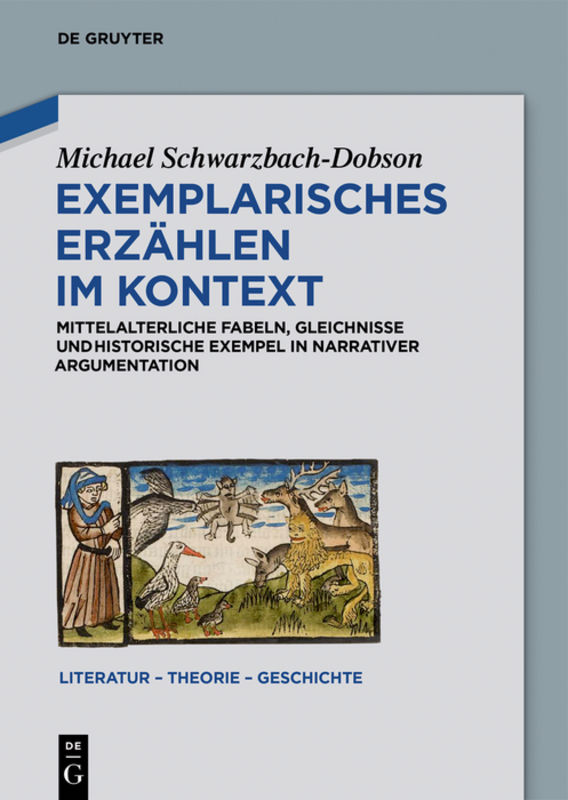
Exemplarisches Erzählen Im Kontext
Dieser Band widmet sich den rhetorischen Funktionen exemplarischer Kurzerzählungen - Fabel, Gleichnis, historisches Exempel - im Mittelalter.Untersucht wird dabei im engeren Sinn, wie mittelhochdeutsche Kurzerzählungen in verschiedenen Kontexten, etwa Chroniken oder didaktischen Texten, als Argumente fungieren.
eBook

Das unerhörte Rätsel der Haut: Der geschundene Esel zwischen Immanenz und Transzendenz
Zu den rätselhaftesten Motiven der mittelalterlichen Eselsliteratur gehört jenes vom Esel, der, um von der Sündhaftigkeit seiner Herrin abzulenken, seiner Haut verlustig geht und diese selbst zu Markte tragen muss. Das in mehreren Textfassungen und mehrfach illustrierte
Exempel stellt ein Bindeglied zwi schen den Motivkomplexen vom Esel als gequälter Kreatur und von den Esel-Mensch-Metamorphosen dar und erlaubt damit eine Deutung als Projektionsfläche verschiedener innerweltlicher und transzendenter Wahrnehmungsmodelle, in deren Zentrum das Integumentum
als eigentliches Thema steht.
Journal Article
Die Paradigmatik des Esels im enzyklopädischen Schrifttum des Mittelalters und der frühen Neuzeit
Der Beitrag verfolgt Formen paradigmatischer Deutung des Esels im Feld enzyklopädischen Schrifttums. Ausgangspunkt ist die dreifache Funktion des Topos als Argument, Struktur und Inhalt (Barthes), die sich in die Enzyklopädie einschreibt. ,,Am Beispiel des Esels\" wird
vorgeführt, auf welch unterschiedliche Weise die Exemplarizität des Esels im Verlauf der Geschichte gefasst werden kann: als historisches Exempel, als Fallbeispiel etymologischer Ableitung, als Allegorie, als heilsgeschichtliches Zeugnis, als grammatisches Beispiel und kulturelles
Paradigma, schließlich im weitesten Sinn sogar als ,,exemplarische Ausnahme\".
Journal Article


Innovative Learning Environments
How to design a powerful learning environment so that learners can thrive in the 21st century? OECD’s Innovative Learning Environments (ILE) is an ambitious international study that responds to this challenging question. The study earlier released the influential publication The Nature of Learning: Using Research to Inspire Practice. This companion volume is based on 40 in-depth case studies of powerful 21st century learning environments that have taken the innovation journey.
Innovative Learning Environments presents a wealth of international material and features a new framework for understanding these learning environments, organised into eight chapters. Richly illustrated by the many local examples, it argues that a contemporary learning environment should:Innovate the elements and dynamics of its “pedagogical core”.Become a “formative organisation” through strong design strategies with corresponding learning leadership, evaluation and feedback.Open up to partnerships to grow social and professional capital, and to sustain renewal and dynamism.Promote 21st century effectiveness through the application of the ILE learning principles.In conclusion it offers pointers to how this can be achieved, including the role of technology, networking, and changing organisational cultures. This report will prove to be an invaluable resource for all those interested in schooling. It will be of particular interest to teachers, education leaders, parents, teacher educators, advisors and decision-makers, as well as the research community.
“Much has been written about learning environments, and about innovation but nowhere will you find such a deep and cogent portrayal of the key principles as in the OECD's report, Innovative Learning Environments. Learners, pedagogical core, learning environments, partnerships, sustainability - it's all captured in this remarkable volume.”
(Michael Fullan, OC, Professor Emeritus, OISE, University of Toronto)
“Everyone in education is talking about innovation. What is different here is that the best of what we know about learning is at the centre and is richly illustrated with real cases to answer the question, ‘What will this look like?’”
(Helen Timperley, Professor, Faculty of Education, University of Auckland)
“From OECD's The Nature of Learning to Innovative Learning Environments, this second ILE volume inspires and guides all who are committed to creating , enacting and sustaining powerful learning. To know that this is possible - that we can and are creating ‘schooling for tomorrow’ today - is the gift of this book.”
(Anthony Mackay: Co-Chair, Global Education Leaders Program; Chair, Innovation Unit UK)
“What impresses me about this work is the clarity about the links between complex goals, processes and outcomes through a focus on innovative learning environments across the globe. Innovative Learning Environments manages both to bring alive the lived realities of very different people at the same time as distilling principles and key messages.\"
(Philippa Cordingley, Chief Executive, Centre for the Use of Research and Evidence in Education (CUREE), UK)
“As societies experience unprecedented and unpredictable change, schools and education systems are at the nexus of hope for the future. OECD’s report Innovative Learning Environments documents how educators in a number of countries are engaging in bold and forward-thinking innovations to renew, re-imagine and re-invent contexts for teaching and learning, and, most importantly, provides inspiration to take the journey.”
(Professor Lorna Earl, President 2011-2013, International Congress for School Effectiveness and Improvement)
eBook