
Catalogue Search | MBRL


Are you sure you want to remove the book from the shelf?

{{itemTitle}}
603,325
result(s) for
"Exhibition"
Sort by:

The Home, Nations and Empires, and Ephemeral Exhibition Spaces
This book explores ephemeral exhibition spaces between 1750 and 1918. The chapters focus on two related spaces: the domestic interior and its imagery, and exhibitions and museums that display both national/imperial identity and the otherness that lurks beyond a country's borders. What is revealed is that the same tension operates in these private and public realms; namely, that between identification and self-projection, on the one hand, and alienation, otherness and objectification on the other. In uncovering this, the authors show that the self, the citizen/society and the other are realities that are constantly being asserted, defined and objectified. This takes place, they demonstrate, in a ceaseless dynamic of projection versus alienation, and intimacy versus distancing.
eBook


Trends in organisation of interactive exhibition spaces. A modern example of revising the interaction of the exhibition space and the visitor
The paper explores exposition/exhibition spaces on the basis of interactivity and analyses the principles of interaction between a museum visitor and the exhibition space. The authors describe several cases of interactive exhibition environment. The main task of the architect is to create an environment in which one not only receives information but also can interact with it, change its structure, control the forms and methods of communication with it and thus be involved in the process of creating and changing the environment.
Journal Article


The Video Installation Rejeitorio: Inspirations, Work, Exhibitions, and Public Reception
Rejeitorio is an interactive video installation mediated by digital technology that points to the urgency of preserving the São Francisco River, especially after the dam collapse in the city of Brumadinho (Brazil), which resulted in the contamination of one of its tributaries with toxic tailings. The video installation features 2D animations that alternate according to the presence or absence of the public within the demarcated space. This paper addresses its exhibition, reception by the public, and related works in aesthetic, media, or operational terms. This is an expanded version of a paper presented at the 10th International Conference on Digital and Interactive Arts (ARTECH 2021).
Journal Article


Beauford Delaney and James Baldwin
Beauford Delaney and James Baldwin: Through the Unusual
Door examines the thirty-eight-year relationship between
painter Beauford Delaney (born in Knoxville, 1901; died in Paris,
1979) and writer James Baldwin (born in New York, 1924; died in
Saint-Paul-de-Vence, France, 1987) and the ways their ongoing
intellectual exchange shaped each other’s creative output
and worldview. This full-color publication documents the
groundbreaking exhibition organized by the Knoxville Museum of
Art (KMA) and is drawn from the KMA’s extensive Delaney
holdings, from public and private collections around the country,
and from unpublished photographs and papers held by the
Knoxville-based estate of Beauford Delaney. This book seeks to
identify and disentangle the skein of influences that grew over
and around a complex, lifelong relationship with a selection of
Delaney’s works that reflects the powerful presence of
Baldwin in Delaney’s life. While no other figure in
Beauford Delaney’s extensive social orbit approaches James
Baldwin in the extent and duration of influence, none of the
major exhibitions of Delaney’s work has explored in any
depth the creative exchange between the two. The volume also
includes essays by Mary Campbell, whose research currently
focuses on James Baldwin and Beauford Delaney within the context
of the civil rights movement; Glenn Ligon, an internationally
acclaimed New York-based artist with intimate knowledge of
Baldwin’s writings, Delaney’s art, and American
history and society; Levi Prombaum, a curatorial assistant at the
Solomon R. Guggenheim Museum who did his doctoral research at
University College London on Delaney’s portraits of James
Baldwin; and Stephen Wicks, the Knoxville Museum of Art’s
Barbara W. and Bernard E. Bernstein Curator, who has guided the
KMA’s curatorial department for over 25 years and was
instrumental in building the world’s largest and most
comprehensive public collection of Beauford Delaney’s art
at the KMA.
Beauford Delaney and James Baldwin: Through the Unusual
Door examines the thirty-eight-year relationship between
painter Beauford Delaney (born in Knoxville, 1901; died in Paris,
1979) and writer James Baldwin (born in New York, 1924; died in
Saint-Paul-de-Vence, France, 1987) and the ways their ongoing
intellectual exchange shaped each other’s creative output
and worldview. This full-color publication documents the
groundbreaking exhibition organized by the Knoxville Museum of
Art (KMA) and is drawn from the KMA’s extensive Delaney
holdings, from public and private collections around the country,
and from unpublished photographs and papers held by the
Knoxville-based estate of Beauford Delaney. This book seeks to
identify and disentangle the skein of influences that grew over
and around a complex, lifelong relationship with a selection of
Delaney’s works that reflects the powerful presence of
Baldwin in Delaney’s life. While no other figure in
Beauford Delaney’s extensive social orbit approaches James
Baldwin in the extent and duration of influence, none of the
major exhibitions of Delaney’s work has explored in any
depth the creative exchange between the two. The volume also
includes essays by Mary Campbell, whose research currently
focuses on James Baldwin and Beauford Delaney within the context
of the civil rights movement; Glenn Ligon, an internationally
acclaimed New York-based artist with intimate knowledge of
Baldwin’s writings, Delaney’s art, and American
history and society; Levi Prombaum, a curatorial assistant at the
Solomon R. Guggenheim Museum who did his doctoral research at
University College London on Delaney’s portraits of James
Baldwin; and Stephen Wicks, the Knoxville Museum of Art’s
Barbara W. and Bernard E. Bernstein Curator, who has guided the
KMA’s curatorial department for over 25 years and was
instrumental in building the world’s largest and most
comprehensive public collection of Beauford Delaney’s art
at the KMA.
eBook
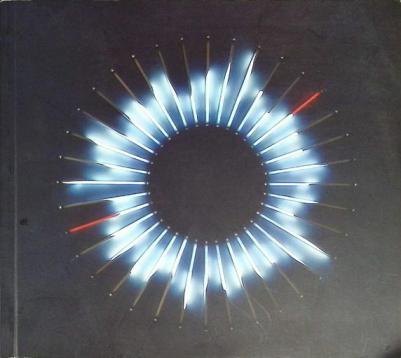
Iris was a pupil james clar 5 November-8 December 2012
\"Iris was a pupil\" is the documentation of a site-specific solo exhibition by James Clare, marking a significant moment in the artist's exploration of minimalist sculpture and the \"physics of the object.\" Held in late 2012, the exhibition showcased Clare's ability to transform industrial materials—such as steel, rubber, and glass—into delicate, tension-based compositions. The title of the exhibition, a playful linguistic pun, reflects the artist’s interest in the mechanics of perception (the iris of the eye) and the relationship between the teacher (form) and the student (viewer).
BOOK
