
Catalogue Search | MBRL


Are you sure you want to remove the book from the shelf?

{{itemTitle}}
292
result(s) for
"Expedities."
Sort by:

Arrian
\"Arrian (Flavius Arrianus), of the period ca. AD 95-175, was a Greek historian and philosopher of Nicomedia in Bithynia. Both a Roman and an Athenian citizen, he was governor of the Roman province of Cappadocia 132-137, and repelled an invasion of the Alani in 134. He retired then to Athens (where he was archon in 148-149) and later to Nicomedia. Arrian's Anabasis of Alexander in seven books is the best account we have of Alexander's adult life. Indica, a description of India and of Nearchus's voyage therefrom, was to be a supplement. A student of Epictetus, Arrian took notes at his lectures and published them (in eight books of which we have four, The Discourses) and also the Encheiridion or Manual of Epictetus. Both works are available in the Loeb Epictetus edition.\"--Jacket

The Euphrates Expedition
First published in 1992.This book invites the reader to cast the mind a hundred and fifty years back to a short span of time between 1829 and 1842.This was an exciting period when Britain's might, demonstrated to the world at Trafalgar and Waterloo, was fortified by leadership in steam technology and was given a new direction by the liberal.
eBook

The Last Giant of Beringia
The intriguing theory of a land bridge linking Siberia and Alaska during the coldest pulsations of the Ice Ages had been much debated since the idea was first proposed in 1589. But proof of the land bridge-now named Beringia after eighteenth-century Danish explorer Vitus Bering-eluded scientists until an inquiring geologist named Dave Hopkins emerged from rural New England and set himself to the task of solving the mystery. This compelling blend of science, biography, and history follows the life story of the eclectic Hopkins as he solves this mystery-and creates an international stir that solidified his place in history. An account that is both thrilling and accessible,The Last Giant of Beringiais popular science writing at its best.
eBook
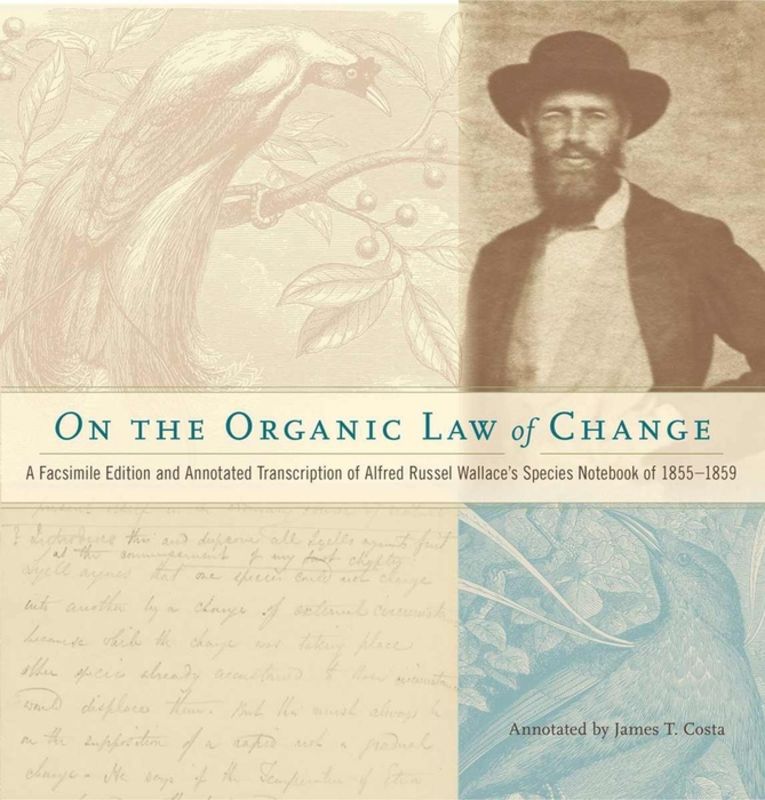
On the organic law of change : a facsimile edition and annotated transcription of Alfred Russel Wallace's Species notebook of 1855-1859
A giant of the discipline of biogeography and co-discoverer of natural selection, Alfred Russel Wallace was the most famous naturalist in the world when he died in 1913. To mark the centennial of Wallace's death, James Costa offers an elegant edition of the \"Species Notebook\" of 1855-1859, which Wallace kept during his legendary expedition in peninsular Malaysia, Indonesia, and western New Guinea. Presented in facsimile with text transcription and annotations, this never-before-published document provides a new window into the travels, personal trials, and scientific genius of the co-discoverer of natural selection. In one section, headed \"Note for Organic Law of Change\"--an extended critique of geologist Charles Lyell's anti-evolutionary arguments--Wallace sketches a book he would never write, owing to the unexpected events of 1858. In that year he sent to Charles Darwin an essay announcing his discovery of the mechanism for species change: natural selection. Darwin's friends Lyell and the botanist Joseph Hooker proposed a \"delicate arrangement\": a joint reading at the Linnean Society of his essay with Darwin's earlier private writings on the subject. Darwin would publish On the Origin of Species in 1859, to much acclaim; pre-empted, Wallace's first book on evolution waited two decades, but by then he had abandoned his original concept. On the Organic Law of Change realizes in spirit the project Wallace left unfinished, and asserts his stature as not only a founder of biogeography and the preeminent tropical biologist of his day but as Darwin's equal among the pioneers of evolution.
eBook

Three Armies in Britain
This work reexamines the political and military aspects of the Revolution of 1399. It argues that Henry of Lancaster was not the \"all conquering\" hero of 1399 and that Richard II worked with all his faculties to outmaneuver his cousin politically rather than simply accept his fate and deposition with resignation.
eBook

Halley's Quest
For most people, Edmond Halley is best known for accurately predicting
the periodic appearance of the comet that ultimately would bear
his name. But his greatest achievement may have been overlooked-
indeed few people know that it was Halley who solved the riddle of
accurate navigation for all sea-going vessels.
As seventeenth-century scientists gradually
came to believe that the inside of
the Earth was magnetized they were
puzzled by the fact magnetic north
not only varied slightly from place to
place, but gradually changed over
time, suggesting a slow variation of
the Earth's magnetic field. But if the
Earth was permanently magnetized,
how could its magnetism vary?
Edmond Halley, Britain's Astronomer Royal, ingeniously proposed that the Earth
contained a number of spherical shells, one inside the other, each magnetized
differently, each slowly rotating in relation to the others.
This brilliant deduction earned Halley the command of a small sailing ship,
the 52-foot Paramore , and with it, a royal mandate. Halley was to sail forth \"to
stand so far into the South, till you discover the Coast of the Terra Incognita.\"
But more importantly, determine the variation between true and magnetic
north in order to more accurately calculate longitude-a feat that would
improve Britain's navigational skills and ensure its dominance of the high seas.
Halley's Quest takes readers on a trilogy of sea voyages, each of which proved
to be as novel and revealing as it was difficult and controversial. But more than
a yarn of risk and adventure, the story at the core of the book is a deeply personal
and intellectual tale that captures the science and the spirit of an almost
forgotten episode in the history of navigation. Once branded a heretic by the
Church and denied a prestigious scholarly chair at Oxford University, Halley ultimately
changed the course of science, producing charts that described more
accurate ways to navigate and documenting new geophysical phenomena
ranging from ocean patterns to the motion of Jupiter's moons. This delightful
book emphasizes the drama of Halley's mission and the passion of an era hungry
for the stories science had to tell.
eBook

The Last Great Quest
The story of Captain Scott's last Antarctic expedition is one of the greatest adventure stories ever told. Captain Robert Falcon Scott, Lieutenant Henry Bowers, Petty Officer Edgar Evans, Captain Lawrence Oates, and Dr Edward Wilson all died on the return trek from the South Pole, starved and frozen, only eleven miles from a supply camp. In Novembe.
eBook


African Exploits
Born and raised in Halifax, Nova Scotia, Stairs (1863-1892) attended the Royal Military College in Kingston before being commissioned in the British army. Wearied of peacetime soldiering, he volunteered in 1887 to participate in Sir Henry M. Stanley's final trans-African expedition to rescue Emin Pasha, the last of \"Chinese\" Gordon's lieutenants in the Sudan. The expedition emerged almost three years later in Zanzibar, a reluctant Pasha in tow, having left a trail of havoc and suffering behind it.
eBook
