
Catalogue Search | MBRL


Are you sure you want to remove the book from the shelf?

{{itemTitle}}
615
result(s) for
"Experimental poetry."
Sort by:


The Academic Avant-Garde
The surprising story of the relationship between experimental poetry and literary studies.In The Academic Avant-Garde, Kimberly Quiogue Andrews makes a provocative case for the radical poetic possibilities of the work of literary scholarship and lays out a foundational theory of literary production in the context of the university. In her examination of the cross-pollination between the analytic humanities and the craft of poetry writing, Andrews tells a bold story about some of today's most innovative literary works. This pathbreaking intervention into contemporary American literature and higher education demonstrates that experimental poetry not only reflects nuanced concern about creative writing as a discipline but also uses the critical techniques of scholarship as a cornerstone of poetic practice. Structured around the concepts of academic labor (such as teaching) and methodological work (such as theorizing), the book traces these practices in the works of authors ranging from Claudia Rankine to John Ashbery, providing fresh readings of some of our era's most celebrated and difficult poets.
eBook

You are the phenomenology
\"You Are the Phenomenology is a cross-genre book--a blend of poetry, songs, lyric prose, and invented forms--that explores the everyday junctures of perception, compassion, and multiplicity. How might our powers of association create shared experiences without distorting the contexts from which those experiences emerge? One of the volume's innovative forms is a poetic series called \"Quadrilaterals\"--four-line poems that present the reader with various ways to leap associative gaps: Quadrilateral : Pinch in Your Heel Soars the mackled sound, kites ago : A Polish boy thinks with accordions, adopts a stammer : When were we first older than we wanted to be : That was our city, our chisel, the corbeil from which we ate\" -- Provided by publisher.
Book
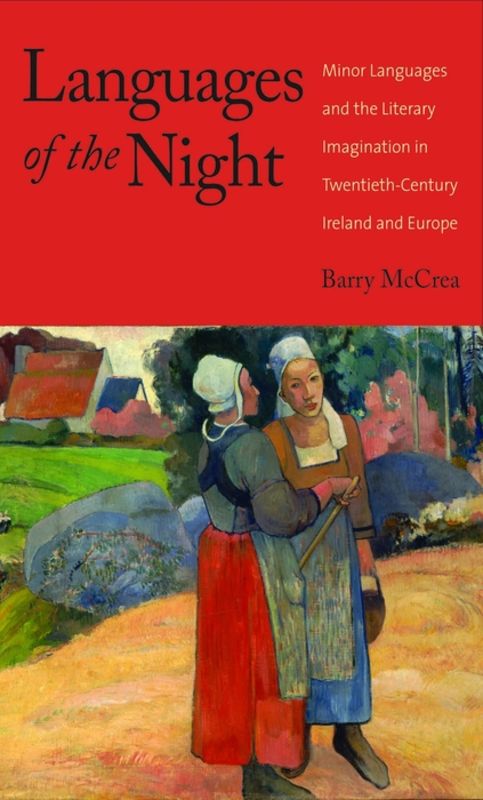
Languages of the Night
In the first decades of the twentieth century, rural populations throughout Europe changed the language they used in everyday life, abandoning their traditional vernaculars-such as French patois, local Italian dialects, and the Irish language-in favor of major metropolitan languages such as French, Italian, and English. .In this book, Barry McCrea argues that the sudden linguistic homogenization of the European countryside was a key impulse in the development of literary modernism. The decline of rural vernaculars caused these languages to become the objects of powerful longings and projections. Seán Ó Ríordáin in Ireland and Pier Paolo Pasolini in Italy reshaped minor languages for use as private idioms of poetry; the revivalist idealization of Irish as a lost utopian language deeply affected the work of James Joyce; the disappearing dialects of northern France seemed to Marcel Proust to offer an escape from time itself.Drawing on a broad range of linguistic and cultural examples to present a major reevaluation of the sources and meanings of European literary modernism, Barry McCrea shows how metropolitan literary culture was fundamentally shaped by the vanishing vernaculars of the European countryside.
eBook


Time in Time
Edgar Allan Poe, arguing that brevity and intensity were the essence of poetry, declared there was no such thing as a long poem. It can also be said there is no difference between a short and a long poem except duration: a measure of time. Time in Time examines what the difference really is, and investigates the interplay of short and long forms in contemporary poetry. Moving beyond the opposition of lyric and experimental schools, Time in Time constructs a history of recent North American efforts to bring about a more open poetic form. Contributors explore ways in which the work of Louis Zukofsky, William Carlos Williams, Jackson Mac Low, George Oppen, Hannah Weiner, A.R. Ammons, Marjorie Perloff, Erín Moure, Ron Silliman, and Kenneth Goldsmith reconceives, reframes, and sometimes interknits the possibilities of short and long poems. In doing so, the collection offers insight into the affiliative networks and inter-generational lines of avant-gardism on the continent. Attuned to the surprising reversals and unstable categories of the period, Time in Time illuminates the ongoing encounter of literary creativity with the limits and possibilities of form. Contributors include Adam Dickinson (Brock University), Kerry Doyle (York University), Rachel Blau DuPlessis (Temple University), Steve McCaffery (SUNY Buffalo), Erín Moure (Montreal), Michael O'Driscoll (University of Alberta) Jennifer Russo (City University of New York Graduate Center), and J. Mark Smith (Grant MacEwan University).
eBook


The Hand at Work
Focusing on the gestures of giving, touching, showing and handcrafting, this study examines key scenes of tactile interaction between subject and artifact. The readings of this book call for a revision of an optically obscured aesthetics and poetics to include haptic experience as an often overlooked but pivotal part of the making as well as the perception of literature and the arts.
eBook