
Catalogue Search | MBRL


Are you sure you want to remove the book from the shelf?

{{itemTitle}}
42
result(s) for
"Explorers Europe History."
Sort by:


Heroes of empire
During the decades of empire (1870–1914), legendary heroes and their astonishing deeds of conquest gave imperialism a recognizable human face. Henry Morton Stanley, Pierre Savorgnan de Brazza, Charles Gordon, Jean-Baptiste Marchand, and Hubert Lyautey all braved almost unimaginable dangers among “savage” people for their nation’s greater good. This vastly readable book, the first comparative history of colonial heroes in Britain and France, shows via unforgettable portraits the shift from public veneration of the peaceful conqueror to unbridled passion for the vanquishing hero. Edward Berenson argues that these five men transformed the imperial steeplechase of those years into a powerful “heroic moment.” He breaks new ground by linking the era’s “new imperialism” to its “new journalism”—the penny press—which furnished the public with larger-than-life figures who then embodied each nation’s imperial hopes and anxieties.
eBook

Magellan : over the edge of the world, the true story of the terrifying first circumnavigation of the globe
\"A middle grade adaptation of Bergreen's adult title of the same name, about Magellan's historic voyage around the globe\"-- Provided by publublisher.
Book

Oh Capitano!
The story of Celso Cesare Moreno, one of the most famous of the emigrant Italian elites or \"prominenti.\" Moreno traveled the world lying, scheming, and building an extensive patron/client network to to establish his reputation as a middleman and person of significance. Through his machinations, Moreno became a critical player in the expansion of western trade and imperialism in Asia, the trafficking of migrant workers and children in the Atlantic, and the conflicts of Americans and natives over the fate of Hawaii, and imperial competitions of French, British, Italian and American governments during a critically important era of imperial expansion.
eBook


Encountering Water in Early Modern Europe and Beyond
Both the Christian Bible and Aristotle's works suggest that water should entirely flood the earth. Though many ancient, medieval, and early modern Europeans relied on these works to understand and explore the relationships between water and earth, sixteenth-century Europeans particularly were especially concerned with why dry land existed. This book investigates why they were so interested in water's failure to submerge the earth when their predecessors had not been. Analyzing biblical commentaries as well as natural philosophical, geographical, and cosmographical texts from these periods, Lindsay Starkey shows that European sea voyages to the southern hemisphere combined with the traditional methods of European scholarship and religious reformations led sixteenth-century Europeans to reinterpret water and earth's ontological and spatial relationships. The manner in which they did so also sheds light on how we can respond to our current water crisis before it is too late.
eBook

Livingstone’s ‘Lives
Dr. David Livingstone, the Victorian ‘missionary-explorer’, has attracted more written commentary than nearly any other heroic figure of the nineteenth century. In the years following his death, he rapidly became the subject of a major biographical tradition and indeed he continues to sustain an academic trade as well. Yet, out of the extensive discourse that has installed itself around him, no single unified image of Livingstone emerges. Rather, he has been represented in diverse ways and put to work in a variety of socio-political contexts. This book interrogates the heterogeneous nature of Livingstone’s legacy and explores the plurality of identities that he has posthumously acquired. Investigating Livingstone’s own self-staging, his Victorian commemoration, his imperialist and Scottish reputations, and his afterlife in postcolonial fiction and drama, it offers the first full exploration of his many incarnations over a lengthy chronological period. In approaching Livingstone’s ‘lives’ this book adopts a metabiographical methodology, namely, a biography of biographies. This framework, which weds the insights of reception theory and postmodern historical enquiry, does not aim to uncover the true nature of the subject but is rather concerned with the malleability and ideological embeddedness of biographical representation. Instead of staking yet another claim to Livingstone’s ‘real’ identity, in the manner of his many biographers, this study in metabiography reveals the political motivations of his many recreations and focuses on what he has been made to mean.
eBook
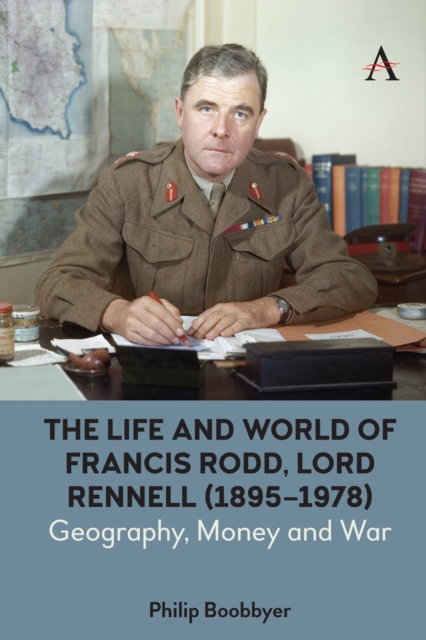
The Life and World of Francis Rodd, Lord Rennell (1895-1978)
This book is a biographical study of the geographer/explorer and banker Francis Rodd, the second Lord Rennell of Rodd (1895-1978). Rodd’s life is interesting for the way it connected the worlds of geography, international finance, politics, espionage, and wartime military administration. He was famous in the 1920s for his journeys to the Sahara and his study of the Tuareg, People of the Veil (1926). A career in banking included a stint at the Bank of England, before he became a Partner in the merchant bank Morgan Grenfell—where remained for most of his working life (1933-1961). During the war he worked for the Ministry of Economic Warfare (1939=40), before getting closely involved in the sphere of military government (civil affairs). In 1942, he was War Office’s Chief Political Officer in East Africa. He was then appointed head of the first Allied Military Government in occupied Europe (Chief Civil Affairs Officer of AMGOT). In civil affairs, he was drawn to the principles of indirect rule. A generalist in an age of growing specialisation, he was also a mixture of traditionalist and moderniser. A product of Eton and Balliol College, Oxford, and elevated to the peerage in 1941, he was well-connected socially, and his life is a window onto British society at a time of great change.
eBook

The Last Blank Spaces
The challenge of opening Africa and Australia to British imperial influence fell to a coterie of proto-professional explorers who sought knowledge, adventure, and fame but often experienced confusion, fear, and failure. The Last Blank Spaces follows the arc of these explorations, from idea to practice, intention to outcome, myth to reality.
eBook