
Catalogue Search | MBRL


Are you sure you want to remove the book from the shelf?

{{itemTitle}}
308,537
result(s) for
"Extinct"
Sort by:


Sepphoris II
Sepphoris was an important Galilean site from Hellenistic to early Islamic times. This multicultural city is described by Flavius Josephus as the \"ornament of all Galilee,\" and Rabbi Judah the Prince (ha-Nasi) codified the Mishnah there around 200 CE. The Duke University excavations of the 1980s and 1990s uncovered a large corpus of clay oil lamps in the domestic area of the western summit, and this volume presents these vessels. Richly illustrated with photos and drawings, it describes the various shape-types and includes a detailed catalog of 219 lamps.
The volume also explores the origins of the Sepphoris lamps and establishes patterns of their trade, transport, and sale in the lower city's marketplace. A unique contribution is the use of a combined petrographic and direct current plasma-optical emission spectrometric (dcp-oes) analysis of selected lamp fabrics from sites in Israel and Jordan. This process provided valuable information, indicating that lamps found in Sepphoris came from Judea, the Decapolis, and even Greece, suggesting an urban community fully engaged with other regional centers. Lamp decorations also provide information about the cosmopolitan culture of Sepphoris in antiquity. Discus lamps with erotic scenes and mythological characters suggest Greco-Roman influences, and menorahs portrayed on lamps indicate a vibrant Jewish identity.
eBook


The Sacrificial Economy
In the mid-first millennium B.C., the Eanna temple at Uruk sacrificed a minimum of nine lambs every day in its basic routine of offerings to its gods; in addition to these, special occasions and festivals demanded the sacrifice of as many as 90 lambs in a single day. All told, the Eanna sacrificed about 4,300 lambs per year. There were more than 120 herdsmen connected to the Eanna at any given time, and the temple expected there to be tens of thousands of sheep and goats under their responsibility. These herdsmen delivered male lambs to the Eanna for sacrifice, and the temple had an internal infrastructure for the care, maintenance, and ritual expenditure of these lambs; they also delivered wool, which the Eanna sold mostly in bulk quantities. This book aims to analyze the economic organization of this entire system of sheep and goat maintenance and utilization, to explore the economic and social relationships between the Eanna and its herdsmen, and to integrate the study of the Eanna's animal economy into the developing picture of the Neo-Babylonian temple economy as a whole. Kozuh's careful examination of the bookkeeping records, the management records, and legal documents connected with this substantial enterprise sheds new light on an arcane area of first-millennium Mesopotamian life that will be sure to enlighten our understanding of the daily life, economy, and social structure of this region.
eBook


Women of Assur and Kanesh
Vivid sources for reconstructing the lives of Assyrian
women
In this collection Cécile Michel translates into English texts
related to wives and daughters of merchants and to their activities
in nineteenth-century BCE Aššur and Kaneš. Discovered in
excavations of the Old Assyrian private archives at Kültepe
(ancient Kaneš) in Central Anatolia, these letters sent from Aššur
reflect the preeminent role of Assyrian women within the family and
in the domestic economy, as well as their contribution to
long-distance trade. Contracts and other legal texts excavated at
Kültepe attest to Assyrian and Anatolian women as parties in
marriage and divorce contracts, last wills, loans, and purchase
contracts. These unique finds paint a vivid portrait of women who
aspire to be socially respected and provide a rare opportunity to
reconstruct their daily lives as both businesswomen and
housewives.
Features
More than three hundred letters and documents transliterated
and translated with commentary
An overview of the study of women and gender in
Assyriology
A reconstruction of women's roles as textile producers,
investors, and creditors within a long-distance commercial
network
Cécile Michel is Senior Researcher at the
National Center for Scientific Research (CNRS, France) and
Professor at Hamburg University (Germany). She is a member of the
international group of scholars in charge of the decipherment of
the 23,000 tablets found at Kültepe (ancient Kaneš) and of the
Kültepe archaeological team. She is the coeditor of and contributor
to The Role of Women in Work and Society in the Ancient Near
East (2016), Textile Terminologies from the Orient to the
Mediterranean and Europe, 1000 BC to 1000 AD (2017), and
Mathematics, Administrative and Economic Activities in Ancient
Worlds (2020).
eBook
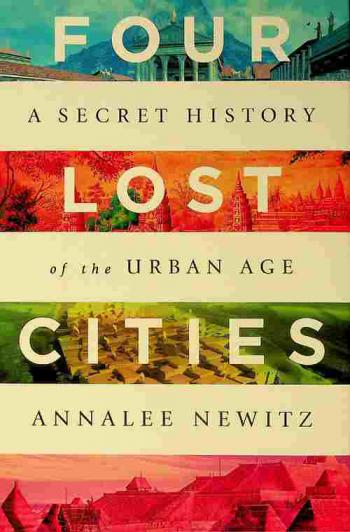
Four lost cities : a secret history of the urban age
\"A quest to explore some of the most spectacular ancient cities in human history--and figure out why people abandoned them. In Four Lost Cities, acclaimed science journalist Annalee Newitz takes readers on an entertaining and mind-bending adventure into the deep history of urban life. Investigating across the centuries and around the world, Newitz explores the rise and fall of four ancient cities, each the center of a sophisticated civilization: the Neolithic site of Çatalhöyük in Central Turkey, the Roman vacation town of Pompeii on Italy's southern coast, the medieval megacity of Angkor in Cambodia, and the indigenous metropolis Cahokia, which stood beside the Mississippi River where East St. Louis is today. Newitz travels to all four sites and investigates the cutting-edge research in archaeology, revealing the mix of environmental changes and political turmoil that doomed these ancient settlements. Tracing the early development of urban planning, Newitz also introduces us to the often anonymous workers--slaves, women, immigrants, and manual laborers--who built these cities and created monuments that lasted millennia. Four Lost Cities is a journey into the forgotten past, but, foreseeing a future in which the majority of people on Earth will be living in cities, it may also reveal something of our own fate\"-- Provided by publisher.

Sepphoris I
Sepphoris, \"the ornament of all Galilee\" according to Josephus, was an important Galilean site during the Hellenistic, Roman, and Byzantine periods and into early Islamic times. It served as Herod Antipas's capital of Galilee in the late first century B.C.E. and the early first century C.E., and the Sanhedrin (the supreme Jewish judicial authority) was located there for a time in the third century C.E. Extensive excavations on the western acropolis—probably the location of many of the Jewish occupants of this multicultural city—by the Duke University-Hebrew University project in the mid- to late 1980s and the Duke excavations of the 1990s produced a remarkable assemblage of ceramic wares.
This book provides an overview of the history and chronology of the site. It then presents a detailed examination of the pottery. Featuring 55 plates with line-drawings as well as some photos of the various ceramic types, this important publication will be essential for all studies of the archaeology of early Judaism and Christianity in the Holy Land.
eBook

The Chora of Metaponto 5
The fifth volume in the Institute of Classical Archaeology’s series on rural settlements in the countryside (chora) of Metaponto presents the excavation of a Greek farmhouse, illuminating the lifeways of fourth-century BC farmers of modest means.
eBook