
Catalogue Search | MBRL


Are you sure you want to remove the book from the shelf?

{{itemTitle}}
13,556
result(s) for
"Extinction, Biological"
Sort by:

Agricultural intensification and climate change are rapidly decreasing insect biodiversity
Major declines in insect biomass and diversity, reviewed here, have become obvious and well documented since the end of World War II. Here, we conclude that the spread and intensification of agriculture during the past half century is directly related to these losses. In addition, many areas, including tropical mountains, are suffering serious losses because of climate change as well. Crops currently occupy about 11% of the world’s land surface, with active grazing taking place over an additional 30%. The industrialization of agriculture during the second half of the 20th century involved farming on greatly expanded scales, monoculturing, the application of increasing amounts of pesticides and fertilizers, and the elimination of interspersed hedgerows and other wildlife habitat fragments, all practices that are destructive to insect and other biodiversity in and near the fields. Some of the insects that we are destroying, including pollinators and predators of crop pests, are directly beneficial to the crops. In the tropics generally, natural vegetation is being destroyed rapidly and often replaced with export crops such as oil palm and soybeans. To mitigate the effects of the Sixth Mass Extinction event that we have caused and are experiencing now, the following will be necessary: a stable (and almost certainly lower) human population, sustainable levels of consumption, and social justice that empowers the less wealthy people and nations of the world, where the vast majority of us live, will be necessary.
Journal Article
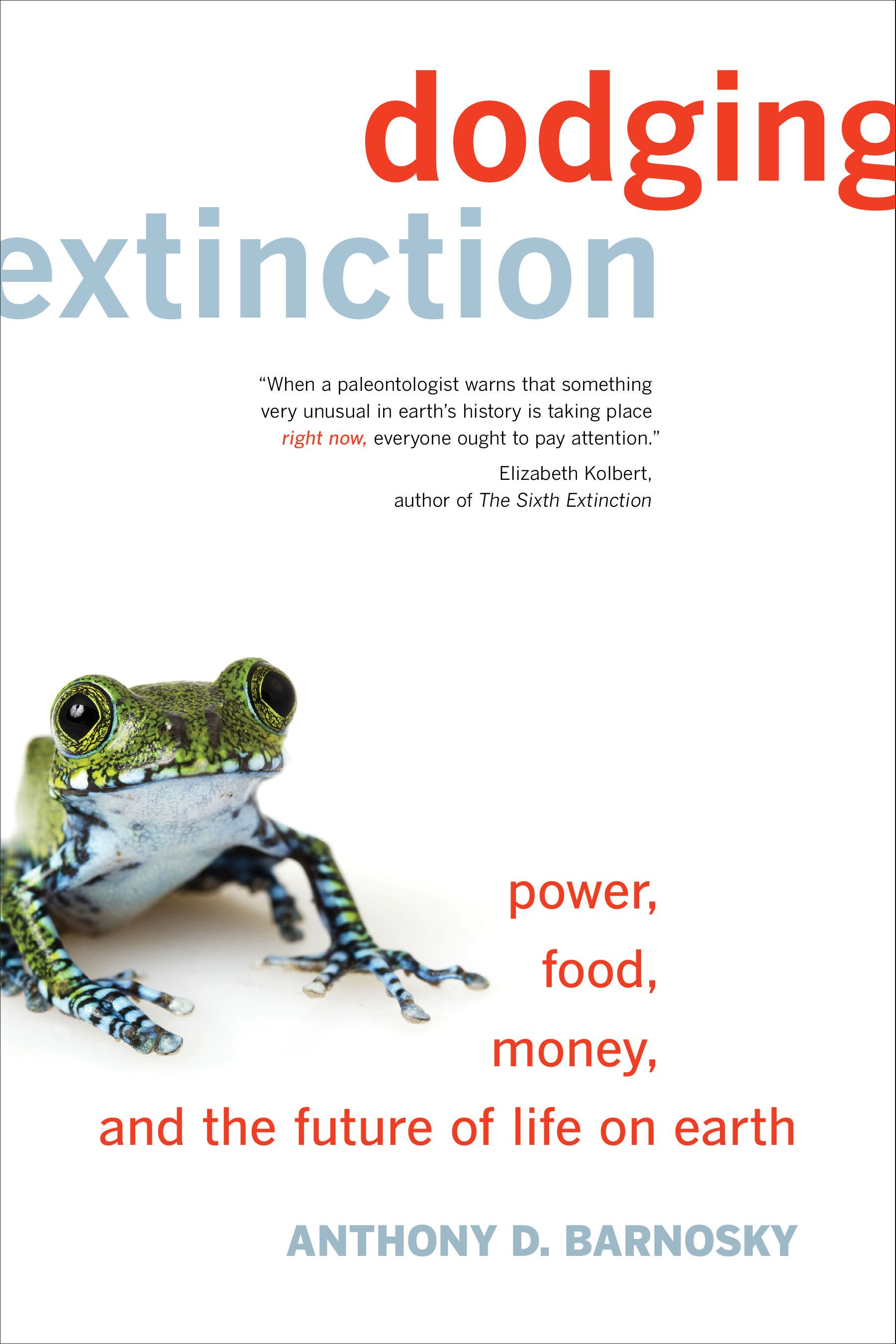
Dodging extinction
Paleobiologist Anthony D. Barnosky weaves together evidence from the deep past and the present to alert us to the looming Sixth Mass Extinction and to offer a practical, hopeful plan for avoiding it. Writing from the front lines of extinction research, Barnosky tells the overarching story of geologic and evolutionary history and how it informs the way humans inhabit, exploit, and impact Earth today. He presents compelling evidence that unless we rethink how we generate the power we use to run our global ecosystem, where we get our food, and how we make our money, we will trigger what would be the sixth great extinction on Earth, with dire consequences. Optimistic that we can change this ominous forecast if we act now, Barnosky provides clear-cut strategies to guide the planet away from global catastrophe. In many instances the necessary technology and know-how already exist and are being applied to crucial issues around human-caused climate change, feeding the world's growing population, and exploiting natural resources. Deeply informed yet accessibly written, Dodging Extinction is nothing short of a guidebook for saving the planet.
eBook

Unveiling a new oceanic anoxic event at the Norian/Rhaetian boundary (Late Triassic)
The latest Triassic was characterised by protracted biotic extinctions concluding in the End-Triassic Extinction (~ 200 Ma) and a global carbon cycle perturbation. The onset of declining diversity is closely related to reducing conditions that spread globally from upper Sevatian (uppermost Norian) to across the Norian-Rhaetian boundary, likely triggered by unusually high volcanic activity. We correlate significant organic carbon cycle perturbations to an increase of CO
2
in the ocean–atmosphere system, likely outgassed by the Angayucham igneous province, the onset of which is indicated by the initiation of a rapid decline in
87
Sr/
86
Sr and
188
Os/
187
Os seawater values. A possible causal mechanism involves elevated CO
2
levels causing global warming and accelerating chemical weathering, which increased nutrient discharge to the oceans and greatly increased biological productivity. Higher export production and oxidation of organic matter led to a global O
2
decrease in marine water across the Norian/Rhaetian boundary (NRB). Biotic consequences of dysoxia/anoxia include worldwide extinctions in some fossil groups, such as bivalves, ammonoids, conodonts, radiolarians.
Journal Article

Evolutionary conservation genetics
Conservation genetics focuses on understanding the role and requirement of genetic variation for population persistence. However, considerable debate now surrounds the role of genetic factors (as opposed to non-genetic factors such as habitat destruction, etc.) in population extinction, and a synthesis is now timely. Can extinction be explained by habitat destruction alone or is lack of genetic variation a part of the explanation? The book reviews the arguments for a role of genetics in the present biodiversity crisis. It describes the methods used to study genetic variation in endangered species and examines the influence of genetic variation in the extinction of species. To date, conservation genetics has predominantly utilized neutral genetic markers, e.g., microsatellites. However, with the recent advances in molecular genetics and genomics it will soon be possible to study ‘direct gene action’, following the fate of genetic variation at the level of DNA, through expression, to proteins in order to determine how such phenotypes fare in populations of free living organisms. This book explores these exciting avenues of future research potential, integrating ecological quantitative genetics with the new genome science. It is now more important than ever that we ask relevant questions about the evolutionary fate of endangered populations throughout the globe and incorporate our knowledge of evolutionary processes and the distribution of genetic diversity into effective conservation planning and action.
eBook
Biological annihilation via the ongoing sixth mass extinction signaled by vertebrate population losses and declines
The population extinction pulse we describe here shows, from a quantitative viewpoint, that Earth’s sixth mass extinction is more severe than perceived when looking exclusively at species extinctions. Therefore, humanity needs to address anthropogenic population extirpation and decimation immediately. That conclusion is based on analyses of the numbers and degrees of range contraction (indicative of population shrinkage and/or population extinctions according to the International Union for Conservation of Nature) using a sample of 27,600 vertebrate species, and on a more detailed analysis documenting the population extinctions between 1900 and 2015 in 177 mammal species. We find that the rate of population loss in terrestrial vertebrates is extremely high—even in “species of low concern.” In our sample, comprising nearly half of known vertebrate species, 32% (8,851/27,600) are decreasing; that is, they have decreased in population size and range. In the 177 mammals for which we have detailed data, all have lost 30% or more of their geographic ranges and more than 40% of the species have experienced severe population declines (>80% range shrinkage). Our data indicate that beyond global species extinctions Earth is experiencing a huge episode of population declines and extirpations, which will have negative cascading consequences on ecosystem functioning and services vital to sustaining civilization. We describe this as a “biological annihilation” to highlight the current magnitude of Earth’s ongoing sixth major extinction event.
Journal Article
Vertebrates on the brink as indicators of biological annihilation and the sixth mass extinction
The ongoing sixth mass species extinction is the result of the destruction of component populations leading to eventual extirpation of entire species. Populations and species extinctions have severe implications for society through the degradation of ecosystem services. Here we assess the extinction crisis from a different perspective. We examine 29,400 species of terrestrial vertebrates, and determine which are on the brink of extinction because they have fewer than 1,000 individuals. There are 515 species on the brink (1.7% of the evaluated vertebrates). Around 94% of the populations of 77 mammal and bird species on the brink have been lost in the last century. Assuming all species on the brink have similar trends, more than 237,000 populations of those species have vanished since 1900. We conclude the human-caused sixth mass extinction is likely accelerating for several reasons. First, many of the species that have been driven to the brink will likely become extinct soon. Second, the distribution of those species highly coincides with hundreds of other endangered species, surviving in regions with high human impacts, suggesting ongoing regional biodiversity collapses. Third, close ecological interactions of species on the brink tend to move other species toward annihilation when they disappear—extinction breeds extinctions. Finally, human pressures on the biosphere are growing rapidly, and a recent example is the current coronavirus disease 2019 (Covid-19) pandemic, linked to wildlife trade. Our results reemphasize the extreme urgency of taking much-expanded worldwide actions to save wild species and humanity’s crucial life-support systems from this existential threat.
Journal Article
Recent responses to climate change reveal the drivers of species extinction and survival
Climate change may be a major threat to biodiversity in the next 100 years. Although there has been important work on mechanisms of decline in some species, it generally remains unclear which changes in climate actually cause extinctions, and how many species will likely be lost. Here, we identify the specific changes in climate that are associated with the widespread local extinctions that have already occurred. We then use this information to predict the extent of future biodiversity loss and to identify which processes may forestall extinction. We used data from surveys of 538 plant and animal species over time, 44% of which have already had local extinctions at one or more sites. We found that locations with local extinctions had larger and faster changes in hottest yearly temperatures than those without. Surprisingly, sites with local extinctions had significantly smaller changes in mean annual temperatures, despite the widespread use of mean annual temperatures as proxies for overall climate change. Based on their past rates of dispersal, we estimate that 57–70% of these 538 species will not disperse quickly enough to avoid extinction. However, we show that niche shifts appear to be far more important for avoiding extinction than dispersal, although most studies focus only on dispersal. Specifically, considering both dispersal and niche shifts, we project that only 16–30% of these 538 species may go extinct by 2070. Overall, our results help identify the specific climatic changes that cause extinction and the processes that may help species to survive.
Journal Article

High-precision timeline for Earth’s most severe extinction
The end-Permian mass extinction was the most severe loss of marine and terrestrial biota in the last 542 My. Understanding its cause and the controls on extinction/recovery dynamics depends on an accurate and precise age model. U-Pb zircon dates for five volcanic ash beds from the Global Stratotype Section and Point for the Permian-Triassic boundary at Meishan, China, define an age model for the extinction and allow exploration of the links between global environmental perturbation, carbon cycle disruption, mass extinction, and recovery at millennial timescales. The extinction occurred between 251.941 ± 0.037 and 251.880 ± 0.031 Mya, an interval of 60 ± 48 ka. Onset of a major reorganization of the carbon cycle immediately precedes the initiation of extinction and is punctuated by a sharp (3‰), short-lived negative spike in the isotopic composition of carbonate carbon. Carbon cycle volatility persists for ∼500 ka before a return to near preextinction values. Decamillenial to millennial level resolution of the mass extinction and its aftermath will permit a refined evaluation of the relative roles of rate-dependent processes contributing to the extinction, allowing insight into postextinction ecosystem expansion, and establish an accurate time point for evaluating the plausibility of trigger and kill mechanisms.
Journal Article
Mammal diversity will take millions of years to recover from the current biodiversity crisis
The incipient sixth mass extinction that started in the Late Pleistocene has already erased over 300 mammal species and, with them, more than 2.5 billion y of unique evolutionary history. At the global scale, this lost phylogenetic diversity (PD) can only be restored with time as lineages evolve and create new evolutionary history. Given the increasing rate of extinctions however, can mammals evolve fast enough to recover their lost PD on a human time scale? We use a birth–death tree framework to show that even if extinction rates slow to preanthropogenic background levels, recovery of lost PD will likely take millions of years. These findings emphasize the severity of the potential sixth mass extinction and the need to avoid the loss of unique evolutionary history now.
Journal Article