
Catalogue Search | MBRL


Are you sure you want to remove the book from the shelf?

{{itemTitle}}
18
result(s) for
"Extraterrestrial anthropology Fiction."
Sort by:


Life as a cosmic phenomenon facing human culture
We present perspectives from six panellists on “Life as a cosmic phenomenon facing human culture”, contrasting our experience and knowledge of life as found on Earth with the vastness of the Universe and the fact that Earth-centric and/or anthropocentric views have repeatedly proven untenable. How does an outwards view of projecting Earth-based experience into the cosmos combine with the inwards view of the potential detection of life beyond Earth telling us who we are?
Journal Article

Immersion in Alien Worlds
The Alien Worlds project teaches ethnographic skills using the societies of dystopian, postapocalyptic, and science fiction texts as imagined field sites and targets for analysis. These exercises and assignments, which illustrate principles of qualitative fieldwork, were developed when COVID-19 precautions made it impossible to assign tasks that involved in-person social interaction. Preliminary findings from use in 2020–2021 Introduction to Cultural Anthropology (n = 140) and Science Fiction and Society (n = 10) classes suggest that science fiction may have an ongoing place in beginning and intermediate social science courses, as it provides an entertaining, low-stakes way for students to practice observation and analysis. The original project is designed to span at least six weeks or the course of a semester, but variations for shorter and stand-alone assignments are provided in addition to ways that it can be adapted to suit the needs of different audiences. Though it will not replace all in-person field experience for advanced sociology and anthropology students, it provides a bridge between classroom content and hands-on interaction that encourages a growth mindset in learning.
Journal Article

Stanley Weinbaum: We've Met The Aliens and They Are Us
The often endearing \"furniture\" or background aliens - say the biopods and walking lawns of \" AMartian Odyssey\" or the Jack Ketch, Friendly, and Pharisee trees, the uniped, and the blind mass of \"doughnut\" protoplasm in the thickly populated \"Parasite Planet\" - were path-breaking and encouraged most of the following writers, from Vance and early Lem on. A final alien intelligence is found around a mound-city of mud, in the shape of a series of barrel-like creatures with a tight diaphragm on top capable of booming out words and rows of eyes around it, running with little copper carts to load chunks of rock and plants.
Journal Article
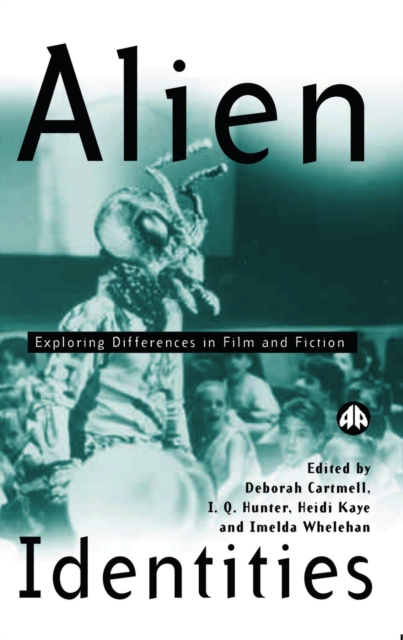
Alien identities : exploring difference in film and fiction
A lively and stimulating look at representations, mutations and adaptations of 'the alien' in literature, film and television. Using notions of the alien and alienation in a broadly defined sense, the contributors cover early science fiction, from the gothic aliens of Dracula and H.G. Wells, to the classic fifties Cold War sci-fi movies, such as War of the Worlds, twentieth-century reworkings of various 'alien' metaphors, such as the Fly movies and the Alien series, and comic variations on the theme such as Mars Attacks. Moving beyond the conventional genre boundaries of the alien, particular essays look, too, at 'race' as an alien condition, and at the use of illness and disease as a metaphor for alienation in modern film and fiction. Alien Identities is a timely, carefully themed and much-needed study of an increasingly popular subject.
eBook

Olatunde Osunsanmi and Living the Transatlantic Apocalypse
American-born, Nigerian-identified Olatunde Osunsanmi has written and directed films that might be classified as traditional European/American sf. On the Internet Movie Database, a Nigerian member, IDEASmi, places Osunsanmi sixth on a list of nine “Nigerian Directors to Watch Out For”: “Olatunde Osunsanmi was born on October 23, 1977 in the UNITED STATES. He is known for his work onThe Fourth Kind(2009),Smokin’ Aces 2: Assassins’ Ball(2010) andThe Cavern(2005).”¹ An up-and-coming name, Osunsanmi is also the screenwriter/ director of the apparently overly innovativeDark Moon, shelved by Warner Brothers in October 2010 within weeks of being
Book Chapter
THE AUTEUR RENAISSANCE, 1968–1980
2001: A Space Odyssey(Stanley Kubrick, 1968),Star Wars(George Lucas, 1977), andClose Encounters of the Third Kind(Steven Spielberg, 1977) were among the films that initiated a 1970s cinematic trend in believable fantasy accomplished through intensified special and visual effects production, giving rise to significant changes in effects technology and economics.¹ The so-called “Auteur Renaissance” filmmakers’ emphasis in the 1960s and 1970s onvéritéstyles, location shooting, and gritty naturalism inspired in large part by American documentary and European art house trends would seem to sound the death knell for the set-bound artificiality of the big-budget Hollywood productions
Book Chapter

THE WAR OF THE WORLDS
In my opinion,The War of the Worldsis, afterThe Time Machine, Wells’s finest piece of sustained imaginative writing. A similarly high opinion of it was held by several contemporary readers. One reviewer considered that it was ‘the best story he has yet produced’,¹ and another wrote ‘Mr Wells has done good work before, but nothing quite so fine as this’.² TheSpectatordevoted a long and very favourable review to the novel, comparing it with Defoe’sJournal of the Plague Year,as well as making the more customary comparisons with Poe and Swift.³ Clement Shorter in theBookman
Book Chapter
I’m Sorry I Didn’t Tell You about the World
Science-fiction and fantasy films reveal more about the cultures that spawn them than the imaginary worlds they ostensibly describe. By extending contemporary societal problems far into the future, or by inserting fantastical elements into present-day environments, these movies encourage viewers to contemplate disruptive communal questions made less volatile by the mediating distance of time, the remoteness of space, and the illusion of supernatural encounters. Fanciful creatures (such as aliens, ghosts, or pixies) interjected into ordinary life, or diverse life forms confronted by human beings in galaxies far, far away, become representatives of “the cultural other,” allowing filmmakers to explore current
Book Chapter