
Catalogue Search | MBRL


Are you sure you want to remove the book from the shelf?

{{itemTitle}}
1,291
result(s) for
"Exudates and Transudates"
Sort by:

Effective Fundus Image Decomposition for the Detection of Red Lesions and Hard Exudates to Aid in the Diagnosis of Diabetic Retinopathy
Diabetic retinopathy (DR) is characterized by the presence of red lesions (RLs), such as microaneurysms and hemorrhages, and bright lesions, such as exudates (EXs). Early DR diagnosis is paramount to prevent serious sight damage. Computer-assisted diagnostic systems are based on the detection of those lesions through the analysis of fundus images. In this paper, a novel method is proposed for the automatic detection of RLs and EXs. As the main contribution, the fundus image was decomposed into various layers, including the lesion candidates, the reflective features of the retina, and the choroidal vasculature visible in tigroid retinas. We used a proprietary database containing 564 images, randomly divided into a training set and a test set, and the public database DiaretDB1 to verify the robustness of the algorithm. Lesion detection results were computed per pixel and per image. Using the proprietary database, 88.34% per-image accuracy (ACCi), 91.07% per-pixel positive predictive value (PPVp), and 85.25% per-pixel sensitivity (SEp) were reached for the detection of RLs. Using the public database, 90.16% ACCi, 96.26% PPV_p, and 84.79% SEp were obtained. As for the detection of EXs, 95.41% ACCi, 96.01% PPV_p, and 89.42% SE_p were reached with the proprietary database. Using the public database, 91.80% ACCi, 98.59% PPVp, and 91.65% SEp were obtained. The proposed method could be useful to aid in the diagnosis of DR, reducing the workload of specialists and improving the attention to diabetic patients.
Journal Article

Tuberculous Pleural Effusion
Tuberculous pleural effusion is one of the most common forms of extrapulmonary tuberculosis (TB). The immediate cause of the effusion is a delayed hypersensitivity response to mycobacterial antigens in the pleural space. For this reason microbiological analyses are often negative and limited by the lengthy delay in obtaining results. In areas with high TB prevalence, pleural fluid adenosine deaminase (ADA) levels greater than 40 U/l argue strongly for TB; in contrast, low levels of pleural ADA have high negative predictive value in low-prevalence countries. The specificity of this enzyme increases if only lymphocytic exudates are considered. The shortcoming of the ADA test is its inability to provide culture and drug sensitivity information, which is paramount in countries with a high degree of resistance to anti-TB drugs. Sputum induction (in addition to pleural fluid) for acid-fast bacilli and culture is a recommended procedure in all patients with TB pleurisy. The microscopic-observation drug-susceptibility assay performed on pleural fluid or pleural tissue increases by two to three times the detection of TB over conventional cultures, and it allows for the identification of multidrug-resistant TB. A reasonable management strategy for pleural TB would be to initiate a four-drug regimen and perform a therapeutic thoracentesis in patients with large, symptomatic effusions.
Journal Article

Spray bacteriotherapy decreases middle ear fluid in children with secretory otitis media
Objective:Secretory otitis media (SOM) is characterised by persistent fluid in the middle ear cavity, but the cause is unknown. We investigated the clinical, bacteriological and immunological effects of treatment with probiotic bacteria on SOM.Design:In this double-blind pilot/preliminary study, 60 children with long-standing SOM (median 6 months) who were scheduled for insertion of tympanostomy tubes were randomised to nasal spray treatment with Streptococcus sanguinis, Lactobacillus rhamnosus or placebo for 10 days before surgery. Clinical evaluation was carried out after 10 days of treatment. Middle ear fluid (MEF) was collected during surgery for quantification of cytokines and detection of bacteria by culture and polymerase chain reaction (PCR). Nasopharyngeal swabs were obtained before treatment and at surgery.Results:Complete or significant clinical recovery occurred in 7/19 patients treated with S sanguinis compared to 1/17 patients in the placebo group (p<0.05). In the L rhamnosus treatment group, 3/18 patients were cured or much better (p = 0.60 compared with placebo). Spray treatment did not alter the composition of the nasopharyngeal flora or the cytokine pattern observed in the nasopharynx or MEF, except for a higher level of IL-8 found in the nasopharynx of L rhamnosus treated children.Conclusions:This study shows that spray treatment with S sanguinis may be effective against SOM. The mechanism for the effect remains to be investigated.
Journal Article

Quantitative evaluation of hard exudates in diabetic macular edema after short-term intravitreal triamcinolone, dexamethasone implant or bevacizumab injections
Background
To quantitatively compare short-term hard exudates (HEs) alteration in patients with diabetic macular edema (DME) after intravitreal triamcinolone, dexamethasone implant or bevacizumab injections.
Methods
This retrospective study enrolled DME eyes with HEs that underwent a single-dose intravitreal injection of triamcinolone (25 eyes), dexamethasone implant (20 eyes), or three monthly injections of bevacizumab (25 eyes) and completed at least three months of follow-up. All patients were examined before and after 1, 2 and 3 months of injections. Using color fundus photographs, the amount of HEs was quantified by two masked graders. The difference in HEs area between baseline and each follow-up visit was compared among the three groups.
Results
After three months, HEs area was reduced to 52.9 ± 4.21% (
P
< 0.001) in the triamcinolone group, 63.6 ± 6.08% (
P
= 0.002) in the dexamethasone implant group, and 85.2 ± 5.07% (
P
= 0.198) in the bevacizumab group. A significant reduction in HEs appeared at one month in the triamcinolone group (53.5 ± 4.91%,
P
< 0.001) and at two months in the dexamethasone implant group (70.1 ± 5.21%,
P
= 0.039).
Conclusions
Our study suggests intravitreal steroids (triamcinolone, dexamethasone implants) significantly reduce HEs in DME patients on short-term follow-up, whereas intravitreal bevacizumab does not. Therefore, intravitreal steroids may be useful in DME with HEs in the fovea.
Journal Article

First Insights into Human Fingertip Regeneration by Echo-Doppler Imaging and Wound Microenvironment Assessment
Fingertip response to trauma represents a fascinating example of tissue regeneration. Regeneration derives from proliferative mesenchymal cells (blastema) that subsequently differentiate into soft and skeletal tissues. Clinically, conservative treatment of the amputated fingertip under occlusive dressing can shift the response to tissue loss from a wound repair process towards regeneration. When analyzing by Immunoassay the wound exudate from occlusive dressings, the concentrations of brain-derived neurotrophic factor (BDNF) and leukemia inhibitory factor (LIF) were higher in fingertip exudates than in burn wounds (used as controls for wound repair versus regeneration). Vascular endothelial growth factor A (VEGF-A) and platelet-derived growth factor (PDGF) were highly expressed in both samples in comparable levels. In our study, pro-inflammatory cytokines were relatively higher expressed in regenerative fingertips than in the burn wound exudates while chemokines were present in lower levels. Functional, vascular and mechanical properties of the regenerated fingertips were analyzed three months after trauma and the data were compared to the corresponding fingertip on the collateral uninjured side. While sensory recovery and morphology (pulp thickness and texture) were similar to uninjured sides, mechanical parameters (elasticity, vascularization) were increased in the regenerated fingertips. Further studies should be done to clarify the importance of inflammatory cells, immunity and growth factors in determining the outcome of the regenerative process and its influence on the clinical outcome.
Journal Article

Accuracy of seven criteria based on cholesterol and lactate dehydrogenase for differentiating exudative and transudative pleural effusions
Previous studies have proposed multiple diagnostic criteria based on cholesterol and lactate dehydrogenase (LDH) levels to differentiate pleural exudates from transudates. However, these criteria have not been widely validated, and no study has compared their diagnostic accuracies within the same population. This study recruited patients from retrospective (BUFF) and prospective (SIMPLE) cohorts. Pleural biopsy, microbiological culture, and effusion cytology were used to verify the causes of exudates or transudates. The diagnostic accuracy of pleural cholesterol and LDH levels in identifying exudates was evaluated using receiver operating characteristic (ROC) curves. Subsequently, the accuracies of seven previously reported cholesterol- and LDH-based classification criteria were compared with those of Light’s criteria. Pleural fluid cholesterol levels and LDH activity were significantly higher in exudates than in transudates. The area under the ROC curve (AUC) for pleural fluid cholesterol and LDH levels was 0.90 (95% CI: 0.86–0.94) and 0.87 (95% CI: 0.82–0.92) in combined cohort, respectively. We found that the diagnostic accuracy of the combination of pleural fluid cholesterol > 1.04 mmol/L (40 mg/dL) or pleural LDH > 0.6 upper limit of serum LDH reference interval was comparable to that of Light’s criteria, whereas the other criteria were less accurate. Combining pleural fluid cholesterol and LDH levels using the preceding thresholds has comparable accuracy to Light’s criteria for separating exudates from transudates.
Journal Article
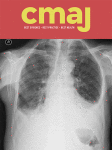
Evaluation of the patient with pleural effusion
Beaudoin and Gonzalez cite that gathering of initial clinical data guided by the differential diagnosis can orient care by identifying patients in need of urgent evaluation and by highlighting possible etiologies. The initial assessment of the patient with a pleural effusion should include an ultrasonography-guided thoracentesis to categorize the effusion as a transudate or an exudate, and obtain specimens for microbiology and cytology. If a parapneumonic effusion is suspected, a diagnostic aspiration must be promptly performed to identify patients with a complicated effusion that requires drainage. Because the initial assessment with a thoracentesis and a computed tomographic scan cannot rule out malignant disease or tuberculosis, a pleural biopsy is indicated for recurrent, undiagnosed exudative effusions.
Journal Article

Regulation of root morphogenesis in arbuscular mycorrhizae: what role do fungal exudates, phosphate, sugars and hormones play in lateral root formation?
BackgroundArbuscular mycorrhizae (AMs) form a widespread root–fungus symbiosis that improves plant phosphate (Pi) acquisition and modifies the physiology and development of host plants. Increased branching is recognized as a general feature of AM roots, and has been interpreted as a means of increasing suitable sites for colonization. Fungal exudates, which are involved in the dialogue between AM fungi and their host during the pre-colonization phase, play a well-documented role in lateral root (LR) formation. In addition, the increased Pi content of AM plants, in relation to Pi-starved controls, as well as changes in the delivery of carbohydrates to the roots and modulation of phytohormone concentration, transport and sensitivity, are probably involved in increasing root system branching.ScopeThis review discusses the possible causes of increased branching in AM plants. The differential root responses to Pi, sugars and hormones of potential AM host species are also highlighted and discussed in comparison with those of the non-host Arabidopsis thaliana.ConclusionsFungal exudates are probably the main compounds regulating AM root morphogenesis during the first colonization steps, while a complex network of interactions governs root development in established AMs. Colonization and high Pi act synergistically to increase root branching, and sugar transport towards the arbusculated cells may contribute to LR formation. In addition, AM colonization and high Pi generally increase auxin and cytokinin and decrease ethylene and strigolactone levels. With the exception of cytokinins, which seem to regulate mainly the root:shoot biomass ratio, these hormones play a leading role in governing root morphogenesis, with strigolactones and ethylene blocking LR formation in the non-colonized, Pi-starved plants, and auxin inducing them in colonized plants, or in plants grown under high Pi conditions.
Journal Article
Phosphorus deficiency changes carbon isotope fractionation and triggers exudate reacquisition in tomato plants
Plant roots are able to exude vast amounts of metabolites into the rhizosphere in response to phosphorus (P) deficiency. Causing noteworthy costs in terms of energy and carbon (C) for the plants. Therefore, it is suggested that exudates reacquisition by roots could represent an energy saving strategy of plants. This study aimed at investigating the effect of P deficiency on the ability of hydroponically grown tomato plants to re-acquire specific compounds generally present in root exudates by using
13
C-labelled molecules. Results showed that P deficient tomato plants were able to take up citrate (+ 37%) and malate (+ 37%), particularly when compared to controls. While glycine (+ 42%) and fructose (+ 49%) uptake was enhanced in P shortage, glucose acquisition was not affected by the nutritional status. Unexpectedly, results also showed that P deficiency leads to a
13
C enrichment in both tomato roots and shoots over time (shoots—+ 2.66‰, roots—+ 2.64‰, compared to control plants), probably due to stomata closure triggered by P deficiency. These findings highlight that tomato plants are able to take up a wide range of metabolites belonging to root exudates, thus maximizing C trade off. This trait is particularly evident when plants grew in P deficiency.
Journal Article

Mycolactone Diffuses into the Peripheral Blood of Buruli Ulcer Patients - Implications for Diagnosis and Disease Monitoring
Mycobacterium ulcerans, the causative agent of Buruli ulcer (BU), is unique among human pathogens in its capacity to produce a polyketide-derived macrolide called mycolactone, making this molecule an attractive candidate target for diagnosis and disease monitoring. Whether mycolactone diffuses from ulcerated lesions in clinically accessible samples and is modulated by antibiotic therapy remained to be established.
Peripheral blood and ulcer exudates were sampled from patients at various stages of antibiotic therapy in Ghana and Ivory Coast. Total lipids were extracted from serum, white cell pellets and ulcer exudates with organic solvents. The presence of mycolactone in these extracts was then analyzed by a recently published, field-friendly method using thin layer chromatography and fluorescence detection. This approach did not allow us to detect mycolactone accurately, because of a high background due to co-extracted human lipids. We thus used a previously established approach based on high performance liquid chromatography coupled to mass spectrometry. By this means, we could identify structurally intact mycolactone in ulcer exudates and serum of patients, and evaluate the impact of antibiotic treatment on the concentration of mycolactone.
Our study provides the proof of concept that assays based on mycolactone detection in serum and ulcer exudates can form the basis of BU diagnostic tests. However, the identification of mycolactone required a technology that is not compatible with field conditions and point-of-care assays for mycolactone detection remain to be worked out. Notably, we found mycolactone in ulcer exudates harvested at the end of antibiotic therapy, suggesting that the toxin is eliminated by BU patients at a slow rate. Our results also indicated that mycolactone titres in the serum may reflect a positive response to antibiotics, a possibility that it will be interesting to examine further through longitudinal studies.
Journal Article