
Catalogue Search | MBRL


Are you sure you want to remove the book from the shelf?

{{itemTitle}}
1,726
result(s) for
"Eye Evolution."
Sort by:

The evolution of the eye
With fascinating, spectacularly beautiful images, this book piques readers' curiosity about the diversity of visual organs. The compelling images are accompanied by an easy-to-read, understandable text, aimed at both scientists and the educated public, and generally anyone interested in the beauty of nature.
Book

Bacterial origin of a key innovation in the evolution of the vertebrate eye
The vertebrate eye was described by Charles Darwin as one of the greatest potential challenges to a theory of natural selection by stepwise evolutionary processes. While numerous evolutionary transitions that led to the vertebrate eye have been explained, some aspects appear to be vertebrate specific with no obvious metazoan precursor. One critical difference between vertebrate and invertebrate vision hinges on interphotoreceptor retinoid-binding protein (IRBP, also known as retinol-binding protein, RBP3), which enables the physical separation and specialization of cells in the vertebrate visual cycle by promoting retinoid shuttling between cell types. While IRBP has been functionally described, its evolutionary origin has remained elusive. Here, we show that IRBP arose via acquisition of novel genetic material from bacteria by interdomain horizontal gene transfer (iHGT). We demonstrate that a gene encoding a bacterial peptidase was acquired prior to the radiation of extant vertebrates >500 Mya and underwent subsequent domain duplication and neofunctionalization to give rise to vertebrate IRBP. Our phylogenomic analyses on >900 high-quality genomes across the tree of life provided the resolution to distinguish contamination in genome assemblies from true instances of horizontal acquisition of IRBP and led us to discover additional independent transfers of the same bacterial peptidase gene family into distinct eukaryotic lineages. Importantly, this work illustrates the evolutionary basis of a key transition that led to the vertebrate visual cycle and highlights the striking impact that acquisition of bacterial genes has had on vertebrate evolution.
Journal Article


Eye evolution and its functional basis
Eye evolution is driven by the evolution of visually guided behavior. Accumulation of gradually more demanding behaviors have continuously increased the performance requirements on the photoreceptor organs. Starting with nondirectional photoreception, I argue for an evolutionary sequence continuing with directional photoreception, low-resolution vision, and finally, high-resolution vision. Calculations of the physical requirements for these four sensory tasks show that they correlate with major innovations in eye evolution and thus work as a relevant classification for a functional analysis of eye evolution. Together with existing molecular and morphological data, the functional analysis suggests that urbilateria had a simple set of rhabdomeric and ciliary receptors used for directional photoreception, and that organ duplications, positional shifts and functional shifts account for the diverse patterns of eyes and photoreceptors seen in extant animals. The analysis also suggests that directional photoreception evolved independently at least twice before the last common ancestor of bilateria and proceeded several times independently to true vision in different bilaterian and cnidarian groups. This scenario is compatible with Pax-gene expression in eye development in the different animal groups. The whole process from the first opsin to high-resolution vision took about 170 million years and was largely completed by the onset of the Cambrian, about 530 million years ago. Evolution from shadow detectors to multiple directional photoreceptors has further led to secondary cases of eye evolution in bivalves, fan worms, and chitons.
Journal Article


Phototaxis and the origin of visual eyes
Vision allows animals to detect spatial differences in environmental light levels. High-resolution image-forming eyes evolved from low-resolution eyes via increases in photoreceptor cell number, improvements in optics and changes in the neural circuits that process spatially resolved photoreceptor input. However, the evolutionary origins of the first low-resolution visual systems have been unclear. We propose that the lowest resolving (two-pixel) visual systems could initially have functioned in visual phototaxis. During visual phototaxis, such elementary visual systems compare light on either side of the body to regulate phototactic turns. Another, even simpler and non-visual strategy is characteristic of helical phototaxis, mediated by sensory–motor eyespots. The recent mapping of the complete neural circuitry (connectome) of an elementary visual system in the larva of the annelid Platynereis dumerilii sheds new light on the possible paths from non-visual to visual phototaxis and to image-forming vision. We outline an evolutionary scenario focusing on the neuronal circuitry to account for these transitions. We also present a comprehensive review of the structure of phototactic eyes in invertebrate larvae and assign them to the non-visual and visual categories. We propose that non-visual systems may have preceded visual phototactic systems in evolution that in turn may have repeatedly served as intermediates during the evolution of image-forming eyes.
Journal Article


Genetic conflicts and the case for licensed anthropomorphizing
Abstract The use of intentional language in biology is controversial. It has been commonly applied by researchers in behavioral ecology, who have not shied away from employing agential thinking or even anthropomorphisms, but has been rarer among researchers from more mechanistic corners of the discipline, such as population genetics. One research area where these traditions come into contact—and occasionally clash—is the study of genetic conflicts, and its history offers a good window to the debate over the use of intentional language in biology. We review this debate, paying particular attention to how this interaction has played out in work on genomic imprinting and sex chromosomes. In light of this, we advocate for a synthesis of the two approaches, a form of licensed anthropomorphizing. Here, agential thinking’s creative potential and its ability to identify the fulcrum of evolutionary pressure are combined with the rigidity of formal mathematical modeling.
Journal Article

In the blink of an eye : how vision kick-started the big bang of evolution
The Cambrian explosion is the 'big bang' of evolution - a period of less than five million years during which life on Earth rapidly developed both armaments and defences. Animals suddenly became both hunters and the hunted, and the number of animal groups with hard body parts mushroomed from three to 38. But why did the explosion happen when it did? Ground-breaking and accessible, Andrew Parker's In the Blink of an Eye unravels the evidence demonstrating that this was the period when the eye evolved, leading to an evolutionary scramble for survival.
Book
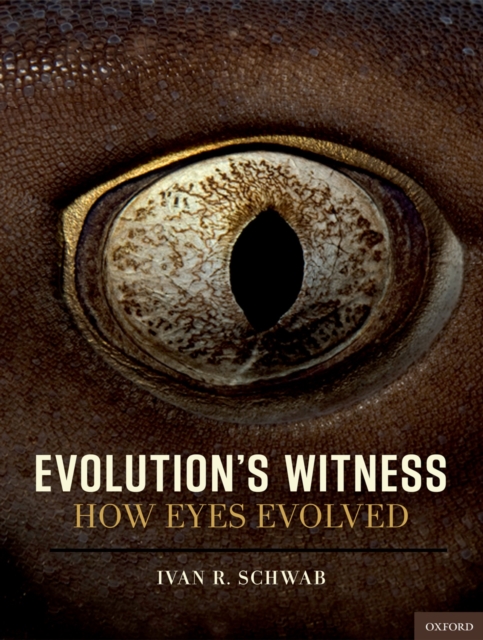
Evolution's witness : how eyes evolved
Evolution's Witness chronicles the evolution of the eye beginning with the initial cellular acquisition of photoreceptive molecules as long as 3.75 billion years ago. This well-illustrated book traces the development of simple, complex compound and camera-style eyes including description of more than ten forms of ocular design. Life has existed on earth an unfathomable length of time accompanied by changing climate and geography, and the evolution of the eye is described in that context. Eyes evolved independently perhaps as many as forty times, and these are reviewed in this text. Each of the forty or so independently evolved eyes has adapted to its niche, and fitting its owner's ecology perfectly. Evolution's greatest gift.
eBook