
Catalogue Search | MBRL


Are you sure you want to remove the book from the shelf?

{{itemTitle}}
528,042
result(s) for
"FAMILY HEALTH"
Sort by:

Looking after : a portrait of my autistic brother
Meet Lionel, Caroline's older brother. Born in the 1950s, when little was known about autism, Lionel was considered a peculiarity. From the beginning, he was a silent child, oblivious to the people around him and intent only on playing with his toy trucks. By the time he turned four, doctors declared him ineducable and advised that he be institutionalised. No one could have predicted that Lionel would go onto music college and find his place in the world. He had perfect pitch, could multiply three-figure numbers in his head, or work out which day of the week you were born on, the instant you told him your birthday. But when Lionel's mother dies, and shortly after he is diagnosed with cancer, his two sisters struggle to fill the void - to become Lionel's caretaker and support him as they had promised their mother.
BOOK

Promoting healthful family meals to prevent obesity: HOME Plus, a randomized controlled trial
BACKGROUND: Family meal frequency has been shown to be strongly associated with better dietary intake; however, associations with weight status have been mixed. Family meals-focused randomized controlled trials with weight outcomes have not been previously conducted. Therefore, this study purpose was to describe weight-related outcomes of the HOME Plus study, the first family meals-focused randomized controlled trial to prevent excess weight gain among youth. METHODS: Families (n = 160 8-12-year-old children and their parents/guardians) were randomized to intervention (n = 81) or control (n = 79) groups. Data were collected at baseline (2011–2012), post-intervention (12-months post-baseline) and follow-up (21-months post-baseline). The intervention included ten monthly group sessions (nutrition education; hands-on meal and snack planning, preparation, and skill development; screen time reductions) and five motivational, goal-setting phone calls. The main outcome was child body mass index (BMI) z-score. RESULTS: General linear models, adjusted for baseline values and demographics, showed no significant treatment group differences in BMI z-scores at post-intervention or follow-up; however, a promising reduction in excess weight gain was observed. Post-hoc stratification by pubertal onset indicated prepubescent children in the intervention group had significantly lower BMI z-scores than their control group counterparts. CONCLUSIONS: The study used a strong theoretical framework, rigorous design, quality measurement and a program with high fidelity to test a family meals-focused obesity prevention intervention. It showed a modest decrease in excess weight gain. The significant intervention effect among prepubescent children suggests the intervention may be more efficacious among relatively young children, although more research with appropriately powered samples are needed to replicate this finding. TRIAL REGISTRATION: This study is registered at www.clinicaltrials.gov NCT01538615. Registered 01/17/2012.
Journal Article


The Autism Family Experience Questionnaire (AFEQ): An Ecologically-Valid, Parent-Nominated Measure of Family Experience, Quality of Life and Prioritised Outcomes for Early Intervention
There is a lack of measures that reflect the intervention priorities of parents of children with autism spectrum disorder (ASD) and that assess the impact of interventions on family experience and quality of life. The Autism Family Experience Questionnaire (AFEQ) was developed through focus groups and online consultation with parents, and reflected parental priorities. It was then administered to the parents of children enrolled in the Pre-school Autism Communication Trial and its 6-year follow-up study. The AFEQ showed good convergent validity with well-established measures of child adaptive functioning, parental mental health and parental wellbeing. It was sensitive to change in response to a parent-mediated intervention for young children with autism, showing treatment effect at treatment endpoint which increased at six-year follow-up.
Journal Article
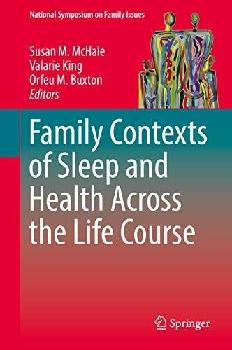
Family contexts of sleep and health across the life course
This unique volume advances the literature on sleep and health by illuminating the impacts of family dynamics on individuals' quality and quantity of sleep. Its lifespan perspective extends across childhood, adolescence, adulthood and older age considering both phenomena of individual development and family system dynamics, particularly parent-child and marital relationships. It extends, as well, to the broader contexts of social disparities in sleep as a significant health behavior. Emerging concepts and practical innovations include ancestral roots of sleep in family contexts, sleep studies as a lens for understanding family health, and methodologies, particularly the use of actigraphy technology, for studying sleep patterns in individuals and families. This rich area of inquiry holds significant keys to understanding a vital human behavior and its critical role in physical, psychological, and relational health and wellbeing. Among the topics covered: ¨ Sleep and development: familial and sociocultural considerations. ¨ Relationship quality: implications for sleep quality and sleep disorders. ¨ Couple dynamics and sleep quality in an international perspective. ¨ Family influences on sleep: comparative and historical-evolutionary perspectives. ¨ Sociodemographic, psychosocial, and contextual factors in children's sleep. ¨ Dynamic interplay between sleep and family life: review and directions for future research. Family Contexts of Sleep and Health Across the Life Course will advance the work of researchers and students in the fields of population health, family demography and sociology, sleep research and medicine, human development, neuroscience, biobehavioral health, and social welfare, as well as that of policymakers and health and human services practitioners.
Book

National Primary Care Policy 2017: analysis of teams composition and national coverage of Family Health
The Family Health Strategy is the main form of organization of the Brazilian health system. However, the third edition of the National Primary Health Care Policy (PNAB) recognized other types of teams financially. A time series study was conducted from 2007 to 2019 using data from the National Register of Health Facilities (CNES) of jobs, teams and national coverage of Family Health to analyze the effects of the 2017 National Primary Health Care Policy (PNAB) on team composition. We observed the concentration of doctors in the Southeast and Northeast and variation of this professional category before the events of the \"Mais Médicos\" (More Doctors) Program. The number of nurses increased 5% and Community Health Workers (ACS) dropped 0.3% in the country. Despite the authorization and funding for the implementation of \"Primary Care\" teams (eAB), they correspond to less than 1% of the total teams. It is noteworthy that the municipal managers' preferred mode is the traditional Family Health Teams, equivalent to 75% of the total and growing. While the questionings and expectations generated by the 2017 PNAB in the context of Primary Health Care, we can conclude that, regarding the teams and their compositions, no significant change was identified two years into its coming into force.
Journal Article


Family and Health: Evolving Needs, Responsibilities, and Experiences
Around the globe, families are often faced with a variety of health issues, often as a result of social, political, religious, and economic forces. This multidisciplinary volume addresses the impact health issues have on individual family members and how this affects their family relationships.
eBook


The prevalence of suboptimal health status among Chinese secondary school students and its relationship with family health: the mediating role of perceived stress and problematic internet use
Background
The health status of secondary school students has received widespread attention, and family plays an extremely important role in protecting and promoting their health. However, the relationship between family health and suboptimal health status (SHS) among secondary school students and its underlying mechanisms are unclear. This study aims to understand the prevalence of SHS among Chinese secondary school students and analyze the relationship between family health and SHS, and examine the mediating roles of perceived stress and problematic internet use.
Methods
The 2,094 secondary school students (52.6% boys, 47.4% girls,
M
age
± SD = 15.74 ± 1.78) of this study came from “2022 Psychology and Behavior Investigation of Chinese Residents, PBICR”. The chi-square test and
t
-test were used to analyze the prevalence of SHS in secondary school students with different characteristics. The SPSS PROCESS macro software was used to explore the relationship between family health and SHS and the mediating effects of perceived stress and problematic internet use.
Results
The prevalence of SHS among Chinese secondary school students was 40.7%, and older students, girls, non-only child, high school students, smokers, drinkers, and students living in the Northeast region of China had higher prevalence. Family health, SHS, perceived stress, and problematic internet use were significantly related (
P
< 0.001). Family health had a negative effect on SHS (
β
= -0.127, 95% CI: -0.173 to -0.080). At the same time, perceived stress mediated the relationship between family health and SHS (chain mediation model 1:
β
= -0.109, 95% CI: -0.133 to -0.087; chain mediation model 2:
β
= -0.098, 95% CI: -0.120 to -0.078) and problematic internet use also mediated their relationship (chain mediation model 1:
β
= -0.034, 95% CI: -0.056 to -0.014; chain mediation model 2:
β
= -0.077, 95% CI: -0.099 to -0.055). The chain mediating effect of perceived stress and problematic internet use was also found in this study and the chain path from family health to perceived stress to problematic internet use to SHS was superior (
β
= -0.043, 95% CI: -0.054 to -0.033).
Conclusions
Many secondary school students are experiencing SHS. Improving family health, such as strengthening parent–child communication and fostering positive parenting practice, is critical to improving their health. Helping secondary school students relieve perceived stress and reduce their problematic internet use is key to implementing family-oriented health interventions.
Journal Article