
Catalogue Search | MBRL


Are you sure you want to remove the book from the shelf?

{{itemTitle}}
39
result(s) for
"FICTION / Anthologies (multiple authors)"
Sort by:

The Short Story
An introduction to the history, culture, aesthetics and economics of the short story. The book pays attention to experimental, postcolonial and popular fiction alongside developments in Anglo-American, Hispanic and European literature.
eBook

Out of the Blue
This extraordinary collection, the first anthology of Icelandic short fiction published in English translation, features work by twenty of Iceland's most popular and celebrated living authors-including Andri Snær Magnason, Jón Kalman Stefánsson, Kristín Ómarsdóttir, and Auður Jónsdóttir-granddaughter of Halldór Laxness, who won the 1955 Nobel Prize in Literature.
Celebrated in Europe and Scandinavia but less known in the English-speaking world, these writers traverse realms of darkness and light that will be familiar to readers who have fallen under the spell of Scandinavian fiction. While uniquely Icelandic in topography and tenor, with a touch of the island's supernatural charm, the stories traffic in the enduring and universal complexities of human nature. Here is a fictional universe where the ghosts of Vikings and spirits tread, volcanoes grumble underfoot, and writers trip the Northern Lights fantastic across the landscape of the Icelandic imagination.
At long last, readers can enjoy award-winning stories now expertly rendered into English by the country's most renowned translators. In \"Killer Whale\" a father contemplates euthanasia for a terminally ill child, in \"Self Portrait\" a vacationing family in Spain crosses paths with migrants, in \"Escape for Men\" a woman searches for an ex-lover in the South of France, and in \"The Most Precious Secret\" the nature of artists and the art world is mercilessly revealed. Both the Viking myths of Iceland's forefathers and the cutting-edge modern world of the country today are brilliantly alive in these remarkable and original stories.
This collection is an excursion to an island where almost two million travelers descend yearly on a population of 345 thousand natives. Iceland is the place Björk calls home, the location whereGame of Throneswas filmed-a place with open lava fields, glaciers, and iceberg lagoons among other natural wonders that is becoming one of the \"hottest\" tourist destinations on earth.
Out of the Bluetransports readers to Iceland's timeless and magical island of Vikings and geographical wonders, and it promises to be a seminal collection that will define Icelandic literature in translation for decades to come.
Contributors: Auður Ava Olafsdóttir, Kristín Eiríksdóttir, Þórarinn Eldjárn, Gyrðir Elíasson, Einar Örn Gunnarsson, Ólafur Gunnarsson, Einar Már Guðmundsson, Auður Jónsdóttir, Gerður Kristný, Andri Snær Magnason, Óskar Magnússon, Bragi Ólafsson, Kristín Ómarsdóttir, Óskar Árni Óskarsson, Magnús Sigurðsson, Jón Kalman Stefánsson, Ágúst Borgþór Sverrisson, Guðmundur Andri Thorsson, Þórunn Erlu-Valdimarsdóttir, Rúnar Helgi Vignisson.
eBook

Why Cows Need Names
Agriculture continues to be the largest industry in the United States with over 2.2 million farms. Amazingly, well over 100,000 new small family farms have sprung up in the past few years . . . and almost no one noticed.
Why Cows Need Names follows one young Amish family as they dream about and then struggle to establish a profitable and quintessentially American small farm. The story starts with Eli Gingerich’s first timid phone call to author Randy James, the county agricultural agent in Ohio’s Geauga Amish Settlement—the fourth-largest Amish settlement in the world—and traces the family’s progress over the next five years. Through gentle dialogue and true stories, James captures the challenges of creating a simple business plan that will lead to the family’s radiant success or dismal failure. As the narrative unfolds, readers get a rare glimpse into what it’s like to work in the fields with draft horses; in the barn with cows, calves, children, and Chip the family dog; or to sit at the table talking with family and friends over a noontime meal. A picture emerges of how quietly living a shared goal and “doing without” during hard times can strengthen families and provide an appreciation for what is truly important in life.
In addition to the business aspects and day-to-day farm activities, James interweaves commentary on our complex relationships with animals. The stark differences in the way animals are treated and valued in agribusinesses versus on small family farms is a recurring theme, as is debunking the myth that bigger is always better in American agriculture.
Surrounded by a factory-farm world, the Gingerich family employs a business model that flatly rejects the dogma of “economies of scale” and instead focuses on the diversity, flexibility, and efficiency that only a small family farm can capture. Why Cows Need Names provides a partial roadmap, not only for other small farms but for the many thousands of family businesses that are created each year and largely ignored in our national psyche. It will appeal to anyone interested in business management, our food supply, animal welfare, and Amish family life.
eBook

Records of woman, with other poems
Felicia Hemans (1793-1835), one of the most influential and widely-read poets of the nineteenth century, wrote Records of Woman in 1828 at the height of her long career.In the series, which includes nineteen poems about exemplary lives, Hemans explores what it means to be a woman, challenging traditional beliefs while at the same time reinforcing.
eBook

Quertext
Knowing that queer voices have been making themselves heard in
Germany, Switzerland, and Austria decades before Stonewall, editors
Gary Schmidt and Merrill Cole curated thrilling snapshots of prose
fiction from more than twenty contemporary writers whose work
defies stereotypes, disciplines, and expectations. These authors
produce fiction for adults and young people that celebrates the
multiplicity of the present, casts a queer eye on the past, and
interrogates LGBTQ+ futures. These outstanding texts exemplify the
glittering variety of styles, themes, settings, and subjects
addressed by openly queer authors who write in German today. They
explore identity, sexuality, history, fantasy, loss, and discovery.
Their authors, narrators, and characters explore gender
nonconformity and living queer everywhere from city centers to
rural communities. They are gay, lesbian, bisexual, trans, and
nonbinary. They are exiles, immigrants, and travelers through time
and space. Witty, titillating, and a delight to read,
Quertext opens up new worlds of experience for readers
interested in queer life beyond the Anglophone world. Featuring
work by Jürgen Bauer • Ella Blix • Claudia Breitsprecher • Lovis
Cassaris • Gunther Geltinger • Joachim Helfer • Odile Kennel •
Friedrich Kröhnke • Anja Kümmel • Marko Martin • Hans Pleschinski •
Christoph Poschenrieder • Peter Rehberg • Michael Roes • Sasha
Marianna Salzmann • Angela Steidele • Antje Rávik Strubel • Alain
Claude Sulzer • Antje Wagner • J. Walther • Tania Witte • Yusuf
Yeşilöz
eBook

After Every War
They are nine women with much in common—all German speaking, all poets, all personal witnesses to the horror and devastation that was World War II. Yet, in this deeply moving collection, each provides a singularly personal glimpse into the effects of war on language, place, poetry, and womanhood.
After Every War is a book of translations of women poets living in Europe in the decades before and after World War II: Rose Ausländer, Elisabeth Langgässer, Nelly Sachs, Gertrud Kolmar, Else Lasker-Schüler, Ingeborg Bachmann, Marie Luise Kaschnitz, Dagmar Nick, and Hilde Domin. Several of the writers are Jewish and, therefore, also witnesses and participants in one of the darkest occasions of human cruelty, the Holocaust. Their poems, as well as those of the other writers, provide a unique biography of the time—but with a difference. These poets see public events through the lens of deep private losses. They chart the small occasions, the bittersweet family ties, the fruit dish on a table, the lost soul arriving at a railway station; in other words, the sheer ordinariness through which cataclysm is experienced, and by which life is cruelly shattered. They reclaim these moments and draw the reader into them.
The poems are translated and introduced, with biographical notes on the authors, by renowned Irish poet Eavan Boland. Her interest in the topic is not abstract. As an Irish woman, she has observed the heartbreaking effects of violence on her own country. Her experience has drawn her closer to these nine poets, enabling her to render into English the beautiful, ruminative quality of their work and to present their poems for what they are: documentaries of resilience—of language, of music, and of the human spirit—in the hardest of times.
eBook

Dinarzad's Children
The first edition of Dinarzad’s Children was a groundbreaking and popular anthology that brought to light the growing body of short fiction being written by Arab Americans. This expanded edition includes sixteen new stories —thirty in all—and new voices and is now organized into sections that invite readers to enter the stories from a variety of directions. Here are stories that reveal the initial adjustments of immigrants, the challenges of forming relationships, the political nuances of being Arab American, the vision directed towards homeland, and the ongoing search for balance and identity.
The contributors are D. H. Melhem, Mohja Khaf, Rabih Alameddine, Rawi Hage, Laila Halaby, Patricia Sarrafian Ward, Alia Yunis, Diana Abu Jaber, Susan Muaddi Darraj, Samia Serageldin, Alia Yunis, Joseph Geha, May Monsoor Munn, Frances Khirallah Nobel, Nabeel Abraham, Yussef El Guindi, Hedy Habra, Randa Jarrar, Zahie El Kouri, Amal Masri, Sahar Mustafah, Evelyn Shakir, David Williams, Pauline Kaldas, and Khaled Mattawa.
eBook

Contemporary Iraqi Fiction
The first anthology of its kind in the West, Contemporary Iraqi Fiction gathers work from sixteen Iraqi writers, all translated from Arabic into English. Shedding a bright light on the rich diversity Iraqi experience, Shakir Mustafa has included selections by Iraqi women, Iraqi Jews now living in Israel, and Christians and Muslims living both in Iraq and abroad.While each voice is distinct, they are united in writing about a homeland that has suffered under repression, censorship, war, and occupation. Many of the selections mirror these grim realities, forcing the writers to open up new narrative terrains and experiment with traditional forms. Muhammad Khodayyir's surrealist portraits of his home city, Basra, in an excerpt from Basriyyatha and the magical realism of Mayselun Hadi's \"Calendars\" both offer powerful expressions of the absurdity of everyday life. Themes range from childhood and family to war, political oppression, and interfaith relationships. Mustafa provides biographical sketches for the writers and an enlightening introduction, chronicling the evolution of Iraqi literature.
eBook
Poems for the millennium
In this fourth volume of the landmark Poems for the Millennium series, Pierre Joris and Habib Tengour present a comprehensive anthology of the written and oral literatures of the Maghreb, the region of North Africa that spans the modern nation states of Libya, Tunisia, Algeria, Morocco, and Mauritania, and including a section on the influential Arabo-Berber and Jewish literary culture of Al-Andalus, which flourished in Spain between the ninth and fifteenth centuries. Beginning with the earliest pictograms and rock drawings and ending with the work of the current generation of post-independence and diasporic writers, this volume takes in a range of cultures and voices, including Berber, Phoenician, Jewish, Roman, Vandal, Arab, Ottoman, and French. Though concentrating on oral and written poetry and narratives, the book also draws on historical and geographical treatises, philosophical and esoteric traditions, song lyrics, and current prose experiments. These selections are arranged in five chronological \"diwans\" or chapters, which are interrupted by a series of \"books\" that supply extra detail, giving context or covering specific cultural areas in concentrated fashion. The selections are contextualized by a general introduction that situates the importance of this little-known culture area and individual commentaries for nearly each author.
eBook
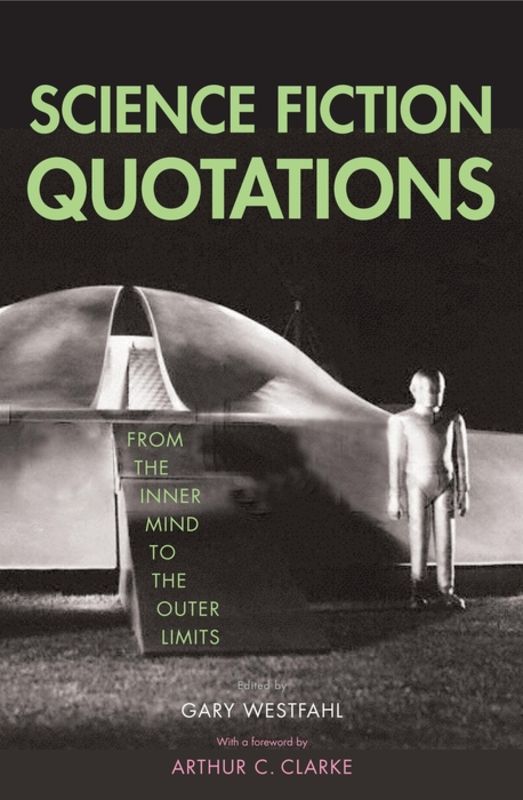
Science Fiction Quotations
In this unprecedented collection of science fiction and fantasy quotations, the reader revisits the stunning moment when Mary Shelley's Frankenstein monster first comes to life; witnesses the transformation of Robert Louis Stevenson's Dr. Jekyll into Mr. Hyde; is present when Bruce Wayne resolves to become Batman; and overhears the cosmic conclusions ofThe Incredible Shrinking Man.Drawing upon two centuries of the vast and provocative literature of science fiction and fantasy, this comprehensive book presents more than 2,900 quotations from wide-ranging sources, including science fiction and fantasy stories, novels, films, and television programs.The quotations are organized by topic-alien worlds; darkness and light; robots, androids, and cyborgs; machines and technology; weapons; and more than one hundred others. The reader will encounter the wit and wisdom of renowned authors (H. G. Wells, Ray Bradbury, J. R. R. Tolkien, Ursula K. Le Guin) along with definitive versions of such important statements as Isaac Asimov's Three Laws of Robotics andStar Trek's Prime Directive.With its thorough index, this book is both an invaluable resource for the writer or scholar and an irresistible page-turner for the curious browser.
eBook