
Catalogue Search | MBRL


Are you sure you want to remove the book from the shelf?

{{itemTitle}}
3,108
result(s) for
"FICTION / Jewish."
Sort by:

The Edinburgh Companion to Modern Jewish Fiction
WINNER of the Association of Jewish Libraries' Judaica Reference AwardProvides critical overviews of the main writers and key themes of Anglophone Jewish fiction
This collection of essays represents a new departure for, and a potentially (re)defining moment in, literary Jewish Studies. It is the first volume to bring together 28 chapters covering a wide range of American, British, South African, Canadian and Australian Jewish fiction.
The volume is divided into 3 parts - American Jewish Fiction; British Jewish Fiction; and International and Transnational Anglophone Jewish Fiction - but many of the essays cross over these boundaries and speak to each other implicitly, as well as, on occasion, explicitly. Extending and redefining the canon of modern Jewish fiction, the volume juxtaposes major authors with more marginal figures, revising and recuperating individual reputations, rediscovering forgotten and discovering new work, and in the process remapping the whole terrain. This volume opens windows onto vistas that previously had been obscured and opens doors for the next generation of studies that could not proceed without a wide-ranging, visionary empiricism grounding their work.
Key FeaturesHighlights the rich diversity of the field and identifies its key themes, including immigration, the Diaspora, the Holocaust, Judaism, assimilation, antisemitism and ZionismAnalyses the main trends in Anglophone Jewish fiction and situates them in historical contextDiscusses the place of Anglophone Jewish fiction in relation to critical debates concerning transatlanticism and transnationalism; ethnicity and identity politics; postcolonial studies, feminist studies and Jewish StudiesWith a preface by Mark Shechner, the volume's contributors include Vicki Aarons (Trinity University, Texas), Debra Shostak (Wooster College, Ohio), Ira Nadel (University of British Columbia), Efraim Sicher (Ben-Gurion University), Phyllis Lassner (Northwestern University), Sue Vice (University of Sheffield), Lori Harrison-Kahan (Boston College), Ruth Gilbert (University of Winchester), Beate Neumeier (University of Cologne) and Sandra Singer (University of Guelph)
eBook

Nineteenth-century Jewish literature : a reader
Recent scholarship has brought to light the existence of a dynamic world of specifically Jewish forms of literature in the nineteenth century—fiction by Jews, about Jews, and often designed largely for Jews. This volume makes this material accessible to English speakers for the first time, offering a selection of Jewish fiction from France, Great Britain, and the German-speaking world. The stories are remarkably varied, ranging from historical fiction to sentimental romance, to social satire, but they all engage with key dilemmas including assimilation, national allegiance, and the position of women. Offering unique insights into the hopes and fears of Jews experiencing the dramatic impact of modernity, the literature collected in this book will provide compelling reading for all those interested in modern Jewish history and culture, whether general readers, students, or scholars.
eBook

Jewish Pasts, German Fictions
Jewish Pasts, German Fictions is the first comprehensive study of how German-Jewish writers used images from the Spanish-Jewish past to define their place in German culture and society. Jonathan Skolnik argues that Jewish historical fiction was a form of cultural memory that functioned as a parallel to the modern, demythologizing project of secular Jewish history writing. What did it imply for a minority to imagine its history in the majority language? Skolnik makes the case that the answer lies in the creation of a German-Jewish minority culture in which historical fiction played a central role. After Hitler's rise to power in 1933, Jewish writers and artists, both in Nazi Germany and in exile, employed images from the Sephardic past to grapple with the nature of fascism, the predicament of exile, and the destruction of European Jewry in the Holocaust. The book goes on to show that this past not only helped Jews to make sense of the nonsense, but served also as a window into the hopes for integration and fears about assimilation that preoccupied German-Jewish writers throughout most of the nineteenth century. Ultimately, Skolnik positions the Jewish embrace of German culture not as an act of assimilation but rather a reinvention of Jewish identity and historical memory.
eBook

Mother India: a novel
\"Reich is the author of the novels \"One Hundred Philistine Foreskins,\" \"My Holocaust,\" \"The Jewish War,\" \"Master of the Return,\" and \"Mara.\" Her stories have appeared in the \"Atlantic,\" \"Harper's,\" \"AGNI,\" \"Ploughshares,\" and elsewhere. She is the recipient of the National Magazine Award for Fiction, the Edward Lewis Wallant Book Award, as well as other prizes.\"--
eBook

The Mighty Walzer
Abstract Howard Jacobson is a British author who is proud of being labelled a Jewish writer and does not hesitate to describe himself as ‘entirely and completely Jewish’. He believes that English-Jewish writers should address directly the challenge of being Jewish, which is precisely what he does in The Mighty Walzer (1999). The novel shows once again Jacobson's greatness as a comic novelist and thus reinforces his assumption that the ingenious, joking Jew is the Jew in essence. Like many scholars, Jacobson believes that self-aimed humour has allowed Jewish people to cope with the paradoxical nature of their culture and historical situation. In The Mighty Walzer Jacobson proves to be the Jew par excellence by joking about everything from religion to food, making fun of the contradictions and incongruities of Jewish life.
Journal Article
Trauma, memory and identity in five Jewish novels from the Southern Cone
The Jewish presence in Latin America is a recent chapter in Jewish history that has produced a remarkable body of literature that gives voice to the fascinating experience of Jews in Latin American lands. This book explores the complexity of Jewish identity in Latin America through the fictional Jewish characters of five novels written by Jewish authors from the Southern Cone: Argentina, Brazil, Chile, Paraguay and Uruguay. It examines how trauma and memory have profound effects on shaping the identity of these Jewish characters who have to forge a new identity as they begin to interact with the Latin American societies of their newly adopted homes. The first three novels present stories narrated by the first generation of immigrants who arrived in Latin American lands escaping pogroms in Russia, and the increasing persecution and anti-Semitism in Europe, in the decades prior to World War II. The fourth novel analyses the identity conflicts experienced by a second generation Latin American born Jew who questions his Jewish, questions of assimilation and integration in to his society. The last novel closes this study with the existential crisis experienced by a perfectly assimilated non-religious Jew, who enquires about his Jewishness and compares himself to other Jews around him.
eBook

Israel through the Jewish-American imagination : a survey of Jewish-American literature on Israel, 1928-1995
Examines eight Jewish-American writers--Meyer Levin, Leon Uris, Saul Bellow, Hugh Nissenson, Chaim Potok, Philip Roth, Anne Roiphe, and Tova Reich--who have imagined Israel in their work. Analyzing a wide array of Jewish-American fiction on Israel, Andrew Furman explores the evolving relationship between the Israeli and American Jew. He devotes individual chapters to eight Jewish-American writers who have “imagined” Israel substantially in one or more of their works. In doing so, he gauges the impact of the Jewish state in forging the identity of the American Jewish community and the vision of the Jewish-American writer.
Furman devotes individual chapters to Meyer Levin, Leon Uris, Saul Bellow, Hugh Nissenson, Chaim Potok, Philip Roth, Anne Roiphe, and Tova Reich. To chart the evolution of the Jewish-American relationship with Israel from pre-statehood until the present, he considers works from 1928 to 1995, examining them in their historical and political contexts. The writers Furman examines address the central issues which have linked and divided the American and Israeli Jewish communities: the role of Israel as both safe haven and spiritual core for Jews everywhere pitted against its secularism, militarism, and entrenched sexism.
While the writers Furman examines depict contrasting images of the Middle East, the very persistence of Israel in occupying that imagination reveals, above all, how prominent a role Israel played and continues to play in shaping the Jewish-American identity.
eBook

Last scene underground : an ethnographic novel of Iran
Leili could not have imagined that arriving late to Islamic morals class would change the course of her life. But her arrival catches the eye of a young man, and a chance meeting soon draws Leili into a new circle of friends and artists. Gathering in the cafes of Tehran, these young college students come together to create an underground play that will wake up their generation. They play with fire, literally and figuratively, igniting a drama both personal and political to perform their play—just once. From the wealthy suburbs and chic coffee shops of Tehran to subterranean spaces teeming with drugs and prostitution to spiritual lodges and saints' tombs in the mountains high above the city, Last Scene Underground presents an Iran rarely seen. Young Tehranis navigate their way through politics, art, and the meaning of home and in the process learn hard lessons about censorship, creativity, and love. Their dangerous discoveries ultimately lead to finding themselves. Written in the hopeful wake of Iran's Green Movement and against the long shadow of the Iran-Iraq war, this unique novel deepens our understanding of an elusive country that is full of misunderstood contradictions and wonder.
eBook

Bambi Abroad, 1924–1954
This paper explores the visual sources that inspired Felix Salten's Bambi, Eine Lebensgeschichte aus dem Walde (1923), and its postpublication legacy in America, Poland, India, Israel, and Russia. While both Jewish and non-Jewish artists embraced the hunted deer motif as their own “national folktale,” the Jewish roots of the visual motif are critical to understanding the revisions and adaptations of the tale in the mid-twentieth century. The case of the myriad revamps of Bambi demonstrates that the nationalist idiom was so elastic in the mid-twentieth century that it functioned as an aesthetic mode rather than an a priori category of identity. At the center of the analysis is the contention that Jewish artists, filmmakers, and writers used the aesthetic properties of the nationalist idiom not only to forge a path to political agency but also to build a shelter from the nation-state.
Journal Article
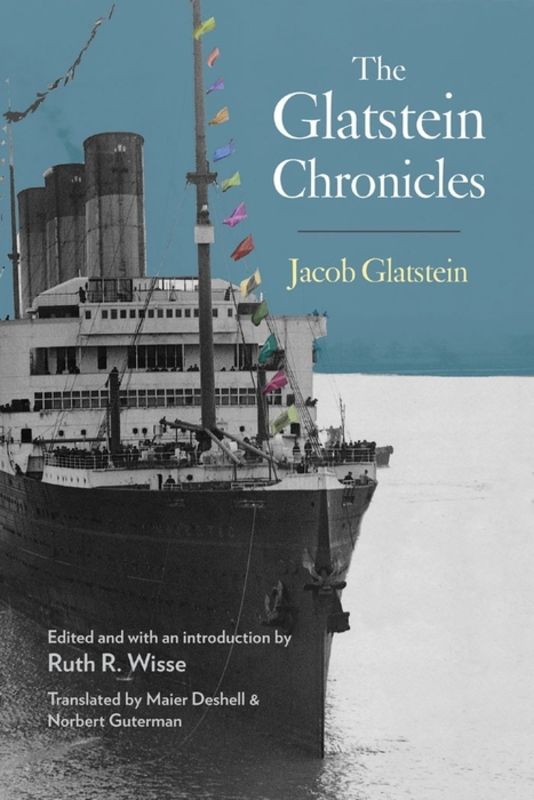
The Glatstein Chronicles
In 1934, with World War II on the horizon, writer Jacob Glatstein (1896-1971) traveled from his home in America to his native Poland to visit his dying mother. One of the foremost Yiddish poets of the day, he used his journey as the basis for two highly autobiographical novellas (translated asThe Glatstein Chronicles) in which he intertwines childhood memories with observations of growing anti-Semitism in Europe.
Glatstein's accounts \"stretch like a tightrope across a chasm,\" writes preeminent Yiddish scholar Ruth Wisse in the Introduction. In Book One, \"Homeward Bound,\" the narrator, Yash, recounts his voyage to his birthplace in Poland and the array of international travelers he meets along the way. Book Two, \"Homecoming at Twilight,\" resumes after his mother's funeral and ends with Yash's impending return to the United States, a Jew with an American passport who recognizes the ominous history he is traversing.
The Glatstein Chroniclesis at once insightful reportage of the year after Hitler came to power, reflection by a leading intellectual on contemporary culture and events, and the closest thing we have to a memoir by the boy from Lublin, Poland, who became one of the finest poets of the twentieth century.
eBook