
Catalogue Search | MBRL


Are you sure you want to remove the book from the shelf?

{{itemTitle}}
801
result(s) for
"FICTION - Indigenous."
Sort by:

Adam's tree : stories
\"Adam's Tree is a fictional account of life on the Cowesses First Nation in Saskatchewan during the 1940's and 50's.This period in history finds forces like regulatory policy, World War II, systemic racism, and the long reach of the depression defining reserve life and rural relationships. These short stories are told from the perspective of various characters on the reserve: an Indigenous teenage girl named Sophie, men who return to Cowesses after the war, struggling with untreated and unacknowledged PTSD, settlers like the local school teacher and the \"Indian agent\". This book contributes to the dialogue on reconciliation, freeing Indigenous voices during a period of time that is rarely written about. It encourages readers to examine the sources and meaning of today's inheritance of complex relations.\"-- Provided by publisher.
Book

The Destruction of Nationalism in Twenty-First Century Canadian Apocalyptic Fiction
This article argues that, since the turn of the twenty-first century, fiction in Canada – whether by English-Canadian, Québécois, or Indigenous writers – has seen a re-emergence in the apocalyptic genre. While apocalyptic fiction also gained critical attention during the twentieth century, this initial wave was tied to disenfranchised, marginalized figures, excluded as failures in their attempts to reach a promised land. As a result, fiction at that time – and perhaps equally so in the divided English-Canadian and Québécois canons – was chiefly a (post)colonial, nationalist project. Yet, apocalyptic fiction in Canada since 2000 has drastically changed. 9/11, rapid technological advancements, a growing climate crisis, the Truth and Reconciliation Commission: these changes have all marked the fictions of Canada in terms of futurities. This article thus examines three novels – English-Canadian novelist Emily St. John Mandel’s
(2014), Indigenous writer Thomas King’s
(2014), and Québécois author Nicolas Dickner’s
(2010) – to discuss the ways in which they work to bring about the destruction of nationalism in Canada through the apocalyptic genre and affectivity to envision new futures.
Journal Article

I am not a number
\"When eight-year-old Irene is removed from her First Nations family to live in a residential school she is confused, frightened, and terribly homesick. She tries to remember who she is and where she came from--despite the efforts of the nuns to force her to do otherwise. Based on the life of Jenny Kay Dupuis' own grandmother, [this book] brings a terrible part of Canada's history to light\"-- Provide by publisher.
CHILDBOOK

Terminal Futurity and Native Ressentiment in the Indigenous Post-Apocalypse
Indigenous post-apocalyptic fiction projects an Indigenous presence into future spaces, attesting to the endurance and survivance of Indigenous peoples and thereby challenging settler myths of erasure. The Indigenous post-apocalypse foregrounds continuity by focusing on how the violences of the future mirror the violences inflicted by settler colonialism in the past and present. In Cherie Dimaline’s Marrow Thieves series and Waubgeshig Rice’s Moon novels, communities of Indigenous survivors are depicted amidst the violence and hostility of the post-apocalyptic landscape. Both authors, as well as other post-apocalyptic writers such as Gerald Vizenor and Stephen Graham Jones, depict the threats to Indigenous characters as not simply external, however, but internal as well. Not all Indigenous characters in the post-apocalypse are able to resist a colonized identity, with some going so far as to privilege settler futurities over Indigenous ones. Instead of Indigenous futurity, these characters embrace colonized futurities, visions of the future that render it as a dead-end, as trapped in what Jones refers to as the “End of the Trail mode.” The means of refuting this type of futurity consist of resisting the settler imaginary’s constructions of Indigeneity, but also in pushing back against Native ressentiment. In this case, ressentiment signifies Indigenous identities formulated as a reaction to settler colonialism, a negative rather than affirmative conception of self. Each of these texts creates future spaces in which Indigenous characters are empowered with agency to refuse terminal futurity’s vision of ressentiment, with some characters fighting to build a communal and resurgent future while others are unable to escape settler colonialism’s pull. In this way, these texts serve as a cautionary tale for Indigenous readers: to survive in the future means actively combatting terminal ideologies which seek to keep Indigenous futurity tethered to a colonial past.
Journal Article
Rez rebel
Floyd Twofeathers has always trusted his mom, a traditional healer, and his dad, hereditary chief of their band, to take care of the people on their reserve. But a lack of educational and career opportunities, medical support and counselling has left young people feeling that they have no future. As suicides pile up, Floyd finds that his friends and kids he knows are taking their own lives because they feel that they have no future -- but his father refuses to listen to Floyd's attempts to find a realistic solution. When Floyd's father is overwhelmed by the situation and succumbs to alcohol and depression, it is up to Floyd to turn around his community's descent into crisis before it's too late. Set in a situation of suicide contagion among young people in Aboriginal communities, this novel follows one teenager's determined efforts to help his friends and his community find solutions.
Book
From Colonial Terraforming towards a Planet-Based Solidarity: Indigenous Speculations between Planet Earth and Outer Space
Terraforming has long been one of the most popular concepts in SF and space colonization discourses to think about the necessary territorial changes on other planets to make them livable for human life. More recently, however, terraforming has made the journey from alien environments back to Earth to reflect on how colonialist-capitalist practices have already changed the planet. Anne Stewart conceptualizes the histories and futures of these practices with the term ‘colonial terraforming’ – a praxis which describes the transformation of places to make them habitable only for a particular set of people: European colonial settlers. Thus, terraforming not only changes the land but also can be read as an ontological practices that creates the \"ecological genre of the human,\" as Derek Woods puts it in conversation with Sylvia Wynter.
When land provides the “ontological framework for understanding relationships,” as Glen Coulthard frames it in Red Skin, White Masks, what does it mean for Indigenous onto-epistemologies when the ground is shifting, dispossessed, terraformed? This essay critically engages with this question: translating Coulthard and Leanne Simpson’s concept of “place-based solidarity” to a “planet-based solidarity,” I read Indigenous futurist texts as decolonial practices of relating to the land, planets, and the cosmos. After a theoretical engagement with terraforming and its entanglements within current speculative projects of colonizing Mars and dominant narratives of astrocapitalism, I read three short stories that are set against and beyond the extractive logics of colonial modernity: Adam Garnet Jones’s “History of the New World,” jaye simpson’s “The Ark of the Turtle’s Back” (both published in Love After the End, ed. Joshua Whitehead) and Celu Amberstone’s “Refugees” (first published in So Long Been Dreaming, ed. Nalo Hopkinson). Each of these stories is set in a different moment of extraterrestrial exodus: while still on Earth, during the journey in space, and after arrival on an alien planet. Through their speculative interventions in discourses of climate disaster, colonialism, and the ongoing dispossession of Indigenous peoples, I argue that these Indigenous futurist narratives imagine a different cosmic order, marked by a generative refusal of the available scripts of relating to the galaxy.
Journal Article
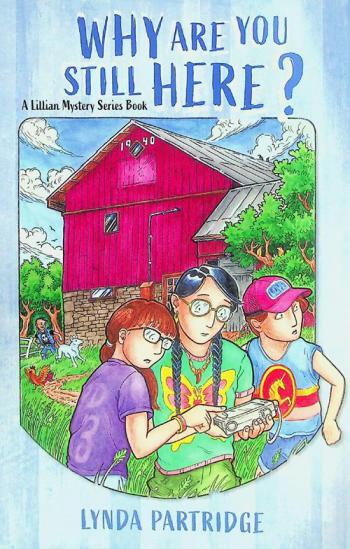
Why are you still here ?
An exciting adventure begins for Lillian when her friends Chloe and Grace ask her to help them investigate a mysterious window in the old barn. Lillian's sleuthing ability helps uncover surprises that returns the family to Indigenous ways of knowledge.
Time Travelling and Thought Experiments; or, an (insistently-too-quick) introduction to (some of the work of) Indigenous speculative fiction
This introduction conceives of a thought experiment with respect to the history of the study of Native North American literatures in order to comment on the comparatively smaller impact Indigenous speculative fiction has had on the study of Indigenous literatures. It broadly surveys lesser-known and out-of-print works alongside canonical works and popular bestsellers to demonstrate the breadth of works published by Indigenous writers in English. The introduction concludes by briefly summarizing the essays published in the special issue.
Journal Article

Moon of the crusted snow : a novel
\"A daring post-apocalyptic novel from a powerful rising literary voice. With winter looming, a small northern Anishinaabe community goes dark. Cut off, people become passive and confused. Panic builds as the food supply dwindles. While the band council and a pocket of community members struggle to maintain order, an unexpected visitor arrives, escaping the crumbling society to the south. Soon after, others follow. The community leadearship loses its grip on power as the visitors manipulate the tired and hungry to take control of the reserve. Tensions rise and, as the months pass, so does the death toll due to sickness and despair. Frustrated by the building chaos, a group of young friends and their families turn to the land and Anishinaabe tradition in hopes of helping their community thrive again. Guided through the chaos by an unlikely leader named Evan Whitesky, they endeavor to restore order while grappling with a grave decision. Blending action and allegory, Moon of the Crusted Snow upends our expectations. Out of catastrophe comes resilience. And as one society collapses, another is reborn.\"--provided by publisher.
Book
Wondrous Hauntings in Eden Robinson's Monkey Beach
In Why Indigenous Literatures Matter (2018), Cherokee author Daniel Heath Justice suggests the term “wonderwork” as a useful alternative to “speculative fiction” or “fantastic literature”, to describe Indigenous creative works that convey “meaningful ways of experiencing this and other worlds” beyond dualistic notions of real and unreal. In Justice’s formulation, Indigenous wonderworks counter colonial deficit narratives and inspire radical hope by envisioning alternative futures. Hope does not deny struggle, and it can be a driving force even in texts in which trauma is foregrounded, as in Monkey Beach (2000), the debut novel of Haisla/Heiltsuk author Eden Robinson. Set in the evocative landscapes of British Columbia, enlivened by talking crows, forest spirits, b’gwus, and other more-than-human beings, the novel incorporates Indigenous epistemologies while engaging with and subverting the conventions of the Euro-Canadian Gothic tradition. If Indigenous ghosts have long been a part of a white settler Canadian narrative of dominance – with Indigenous presence spectralized to justify land theft and to enforce a sense of loss and deficit – the ghostly figures in Robinson’s novel oppose colonial tropes and the Gothic’s discourses of pity, absence and terror. Robinson conveys the haunting legacy of residential schools through silences, narrative gaps, and intergenerational echoes of colonial violence, but her ghosts are never merely allegories of trauma. Instead, they embody kinship, knowledge, more-than-human agency, and a profound sense of wonder, engaging Lisa in reciprocal relationships that demand responsibility, interpretation, and care. Drawing from Daniel Heath Justice’s theorization of wonderworks as an antidote to despair, as well as Haisla critical perspectives on wonder, this paper examines how Monkey Beach challenges narratives of Indigenous absence and loss, offering instead a vision of presence, interconnectedness, and radical hope.
Journal Article