
Catalogue Search | MBRL


Are you sure you want to remove the book from the shelf?

{{itemTitle}}
100,690
result(s) for
"FINANCIAL CRISES"
Sort by:


CoVaR
We propose a measure of systemic risk, ΔCoVaR, defined as the change in the value at risk of the financial system conditional on an institution being under distress relative to its median state. Our estimates show that characteristics such as leverage, size, maturity mismatch, and asset price booms significantly predict ΔCoVaR. We also provide out-of-sample forecasts of a countercyclical, forwardlooking measure of systemic risk, and show that the 2006:IV value of this measure would have predicted more than one-third of realized ΔCoVaR during the 2007-2009 financial crisis.
Journal Article

World financial meltdown
Learn about the economic problems being experienced and look at it compared to past crises.
Book
Neglected Risks: The Psychology of Financial Crises
We model a financial market in which investor beliefs are shaped by representativeness. Investors overreact to a series of good news, because such a series is representative of a good state. A few bad news do not change investor minds because the good state is still representative, but enough bad news leads to a radical change in beliefs and a financial crisis. The model generates debt over-issuance, “this time is different” beliefs, neglect of tail risks, under- and over-reaction to information, boom-bust cycles, and excess volatility of prices in a unified psychological model of expectations.
Journal Article

New Evidence on the Aftermath of Financial Crises in Advanced Countries
This paper examines the aftermath of postwar financial crises in advanced countries. We construct a new semiannual series on financial distress in 24 OECD countries for the period 1967-2012. The series is based on assessments of the health of countries' financial systems from a consistent, real-time narrative source, and classifies financial distress on a relatively fine scale. We find that the average decline in output following a financial crisis is statistically significant and persistent, but only moderate in size. More important, we find that the average decline is sensitive to the specification and sample, and that the aftermath of crises is highly variable across major episodes. A simple forecasting exercise suggests that one important driver of the variation is the severity and persistence of financial distress itself. At the same time, we find little evidence of nonlinearities in the relationship between financial distress and the aftermaths of crises.
Journal Article


Macroprudential policy, countercyclical bank capital buffers and credit supply: evidence from the spanish dynamic provisioning experiments
To study the impact of macroprudential policy on credit supply cycles and real effects, we analyze dynamic provisioning. Introduced in Spain in 2000, revised four times, and tested in its countercyclicality during the crisis, it affected banks differentially. We find that dynamic provisioning smooths credit supply cycles and, in bad times, supports firm performance. A 1 percentage point increase in capital buffers extends credit to firms by 9 percentage points, increasing firm employment (6 percentage points) and survival (1 percentage point). Moreover, there are important compositional effects in credit supply related to risk and regulatory arbitrage by nonregulated and regulated but less affected banks.
Journal Article

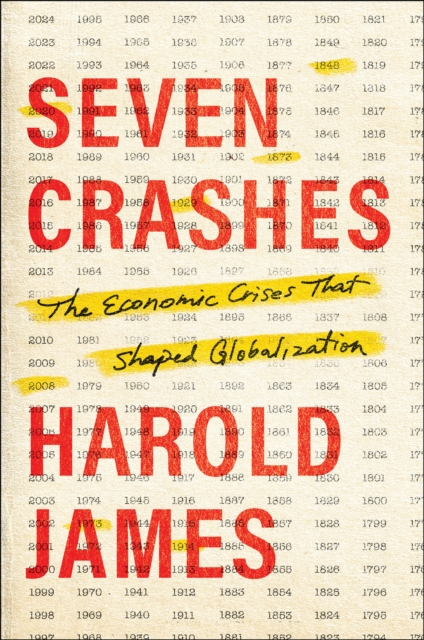
Seven Crashes
BA leading economic historian presents a new history of financial crises, showing how some led to greater globalization while others kept nations apart/BBR / BR / The eminent economic historian Harold James presents a new perspective on financial crises, dividing them into \"good\" crises, which ultimately expand markets and globalization, and \"bad\" crises, which result in a smaller, less prosperous world. Examining seven turning points in financial history-from the depression of the 1840s through the Great Depression of the 1930s to the Covid-19 crisis-James shows how crashes prompted by a lack of supply, like the oil shortages of the 1970s, lead to greater globalization as markets expand and producers innovate to increase supply. By contrast, crises triggered by a lack of demand-such as the Global Financial Crisis of 2007-2008-result in less globalization as markets contract, austerity measures are imposed, and skepticism of government grows.BR / BR / By considering not only the times but also the observers who shaped our understanding of each crisis-from Karl Marx to John Maynard Keynes to Larry Summers-James shows how the uneven course of globalization has led to new economic thinking, and how understanding this history can help us better prepare for the future.
eBook