
Catalogue Search | MBRL


Are you sure you want to remove the book from the shelf?

{{itemTitle}}
90,047
result(s) for
"FOREST LAND"
Sort by:

Green wars : conservation and decolonization in the Maya forest
\"Green Wars challenges international conservation efforts, revealing through in-depth case studies how \"saving\" the Maya Forest facilitates racialized dispossession. Megan Ybarra brings Guatemala's 36-year civil war into the perspective of a longer history of 200 years of settler colonialism to show how conservation works to make Q'eqchi's into immigrants on their own territory. Even as the post-war state calls on them to claim rights as individual citizens, Q'eqchi's seek survival as a people. Her analysis reveals that Q'eqchi's both appeal to the nation-state and engage in relationships of mutual recognition with other Indigenous peoples -- and the land itself -- in their calls for a material decolonization.\"--Provided by publisher.
Book
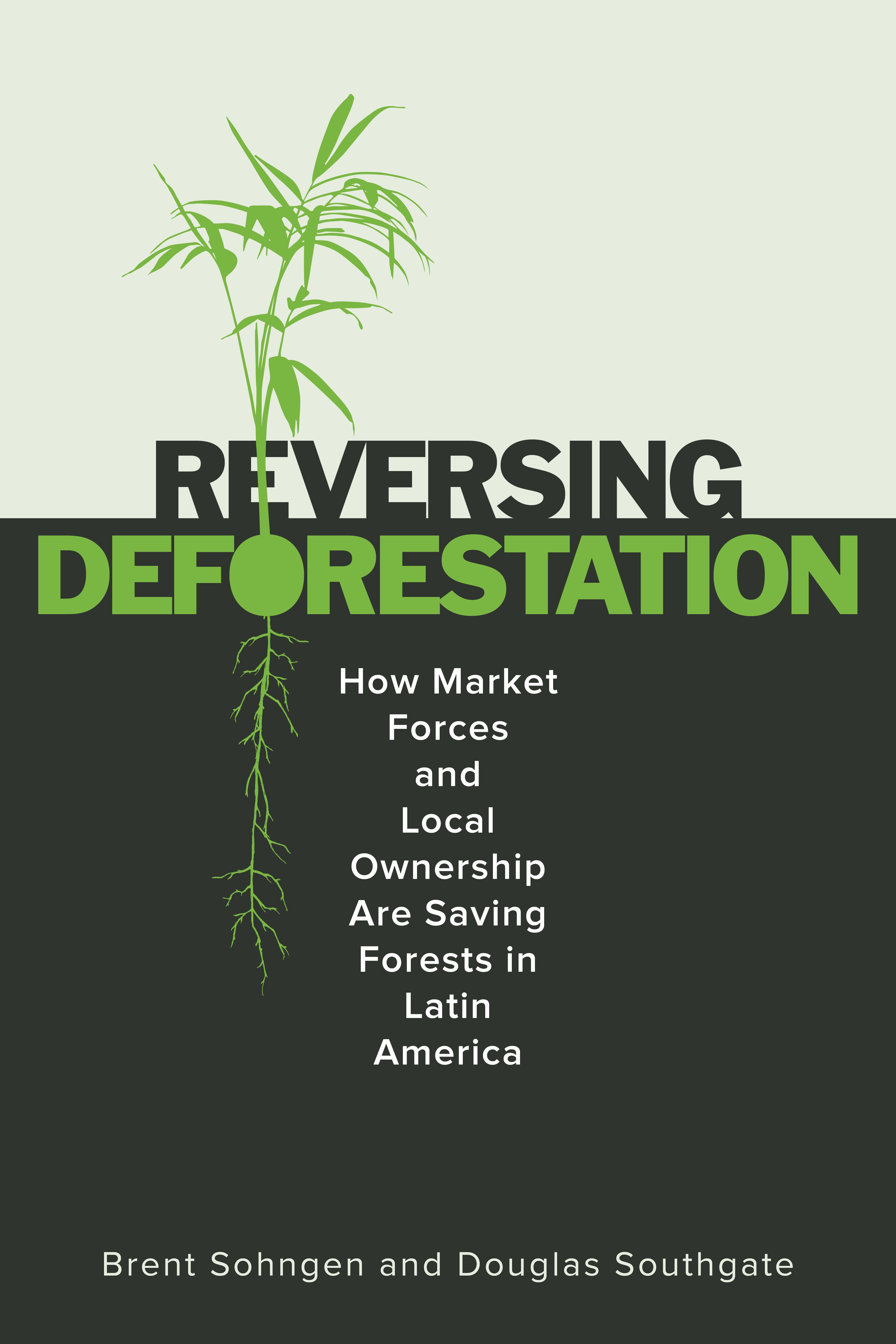
Reversing Deforestation
Dire reports of surging deforestation in the Brazilian Amazon appear often in international headlines, with commentators decrying the destruction of tree-covered habitats as an act of environmental vandalism. Although forest losses are alarming, broader trends are bending in the direction of forest recovery. In this book, Brent Sohngen and Douglas Southgate address the long-term recovery of forests in Latin America. The authors synthesize trends in demography, agricultural development, and technological change, and argue that slower population growth and increasing crop and tree yields—in conjunction with protecting local ownership of natural resources—have encouraged forest transition. This book explores how market forces, ownership arrangements, and the enforcement of property rights have influenced this shift from net deforestation to net afforestation. Forest transitions have happened before, such as the recovery of tree-covered habitats in Europe and the United States. Signs of a similar transformation in land use are now present in Latin America. Ending deforestation requires a strengthening of forest dwellers' property rights while ensuring that biodiversity conservation is no longer treated as a value-less externality. The resulting forest landscape, actively managed for ecosystem services, will be more resilient, as is needed to overcome climate change.
eBook


Song of the Forest
The Soviets are often viewed as insatiable industrialists who saw nature as a force to be tamed and exploited.Song of the Forestcounters this assumption, uncovering significant evidence of Soviet conservation efforts in forestry, particularly under Josef Stalin. In his compelling study, Stephen Brain profiles the leading Soviet-era conservationists, agencies, and administrators, and their efforts to formulate forest policy despite powerful ideological differences.By the time of the revolution of 1905, modern Russian forestry science had developed an influential romantic strand, especially prevalent in the work of Georgii Morozov, whose theory of \"stand types\" asked forest managers to consider native species and local conditions when devising plans for regenerating forests. After their rise to power, the Bolsheviks turned their backs on this tradition and adopted German methods, then considered the most advanced in the world, for clear-cutting and replanting of marketable tree types in \"artificial forests.\" Later, when Stalin's Five Year Plan required vast amounts of timber for industrialization, forest radicals proposed \"flying management,\" an exaggerated version of German forestry where large tracts of virgin forest would be clear-cut. Opponents who still upheld Morozov's vision favored a conservative regenerating approach, and ultimately triumphed by establishing the world's largest forest preserve.Another radical turn came with the Great Stalin Plan for the Transformation of Nature, implemented in 1948. Narrow \"belts\" of new forest planted on the vast Russian steppe would block drying winds, provide cool temperatures, trap moisture, and increase crop production. Unfortunately, planters were ordered to follow the misguided methods of the notorious Trofim Lysenko, and the resulting yields were abysmal. But despite Lysenko, agency infighting, and an indifferent peasant workforce, Stalin's forestry bureaus eventually succeeded in winning many environmental concessions from industrial interests. In addition, the visionary teachings of Morozov found new life, ensuring that the forest's song did not fall upon deaf ears.
eBook


The Disputed Białowieża Forest
The Białowieża Forest is probably the best known forest in Central and Eastern Europe, owing its fame to not only to its natural value, but also to the disputes which have arisen in recent years concerning approaches to its protection. In this book the authors present the Białowieża Forest and the principles of its protection, as well as the legal remedies constructively derived from the disputes. The proposed remedies can also be applied appropriately to other priceless shared goods and cross-border properties.
eBook


At loggerheads? : agricultural expansion, poverty reduction, and environment in the tropical forests
Despite the vast number of books and reports on tropical deforestation, there's confusion about the causes of forest loss and forest poverty, and the effectiveness of policy responses. At Loggerheads seeks to describe ways to reconciles pressures for agricultural expansion in the tropics with the urgent needs for both forest conservation and poverty alleviation. It diagnoses the causes and impacts of forest loss and the reasons for the association of forests and poverty. It looks at how policies - modulated by local conditions - act simultaneously on deforestation and poverty, creating tradeoffs or complementarities, depending on the situation. The report brings to the surface problems that impede adoption of favourable policies, describing institutional and technological innovations that might help overcome these impediments.
eBook

The Wisdom of Trees
Pioneering essays that reveal the significance of new
interdisciplinary understandings of trees and forests,
especially in terms of their philosophical and ecological
dimensions and their importance for addressing the climate
emergency.
This is the first book to apply philosophical thinking to
trees. Through a series of sixteen diverse essays by leading
scholars and writers, along with an in-depth introduction to
the key issues and ideas, it examines the new and emerging
understanding of trees in science and society. Contributors
show how these developments encourage a revisioning of
philosophical thought and a more sustainable relationship with
trees and forests-a reconceptualization with important
ecological and social implications for responding to
deforestation, the loss of biodiversity, and the climate
emergency. The interdisciplinary contributions in this
collection investigate the many interconnected dimensions of
arboreality, focusing on subjects related to time, mind, truth,
memory, being, beauty, goodness, silence, wisdom, personhood,
and death. The volume engages in a conversation about why trees
matter, how they can best be protected, our obligations to
them, and even what or who they are. Most of the chapters are
informed by natural history or ecological science and many
share a particular emphasis on continental philosophy and the
environmental humanities.
eBook

A Novel Approach for Forest Fragmentation Susceptibility Mapping and Assessment: A Case Study from the Indian Himalayan Region
An estimation of where forest fragmentation is likely to occur is critically important for improving the integrity of the forest landscape. We prepare a forest fragmentation susceptibility map for the first time by developing an integrated model and identify its causative factors in the forest landscape. Our proposed model is based upon the synergistic use of the earth observation data, forest fragmentation approach, patch forests, causative factors, and the weight-of-evidence (WOE) method in a Geographical Information System (GIS) platform. We evaluate the applicability of the proposed model in the Indian Himalayan region, a region of rich biodiversity and environmental significance in the Indian subcontinent. To obtain a forest fragmentation susceptibility map, we used patch forests as past evidence of completely degraded forests. Subsequently, we used these patch forests in the WOE method to assign the standardized weight value to each class of causative factors tested by the Variance Inflation Factor (VIF) method. Finally, we prepare a forest fragmentation susceptibility map and classify it into five levels: very low, low, medium, high, and very high and test its validity using 30% randomly selected patch forests. Our study reveals that around 40% of the study area is highly susceptible to forest fragmentation. This study identifies that forest fragmentation is more likely to occur if proximity to built-up areas, roads, agricultural lands, and streams is low, whereas it is less likely to occur in higher altitude zones (more than 2000 m a.s.l.). Additionally, forest fragmentation will likely occur in areas mainly facing south, east, southwest, and southeast directions and on very gentle and gentle slopes (less than 25 degrees). This study identifies Himalayan moist temperate and pine forests as being likely to be most affected by forest fragmentation in the future. The results suggest that the study area would experience more forest fragmentation in the future, meaning loss of forest landscape integrity and rich biodiversity in the Indian Himalayan region. Our integrated model achieved a prediction accuracy of 88.7%, indicating good accuracy of the model. This study will be helpful to minimize forest fragmentation and improve the integrity of the forest landscape by implementing forest restoration and reforestation schemes.
Journal Article