
Catalogue Search | MBRL


Are you sure you want to remove the book from the shelf?

{{itemTitle}}
3,232
result(s) for
"FORMS OF DISCRIMINATION"
Sort by:


Gender Stereotyping
Drawing on domestic and international law, as well as on judgments given by courts and human rights treaty bodies, Gender Stereotyping offers perspectives on ways gender stereotypes might be eliminated through the transnational legal process in order to ensure women's equality and the full exercise of their human rights.A leading international framework for debates on the subject of stereotypes, the Convention on the Elimination of All Forms of Discrimination against Women, was adopted in 1979 by the UN General Assembly and defines what constitutes discrimination against women. It also establishes an agenda to eliminate discrimination in all its forms in order to ensure substantive equality for women. Applying the Convention as the primary framework for analysis, this book provides essential strategies for eradicating gender stereotyping. Its proposed methodology requires naming operative gender stereotypes, identifying how they violate the human rights of women, and articulating states' obligations to eliminate and remedy these violations.According to Rebecca J. Cook and Simone Cusack, in order to abolish all forms of discrimination against women, priority needs to be given to the elimination of gender stereotypes. While stereotypes affect both men and women, they can have particularly egregious effects on women, often devaluing them and assigning them to subservient roles in society. As the legal perspectives offered in Gender Stereotyping demonstrate, treating women according to restrictive generalizations instead of their individual needs, abilities, and circumstances denies women their human rights and fundamental freedoms.
eBook

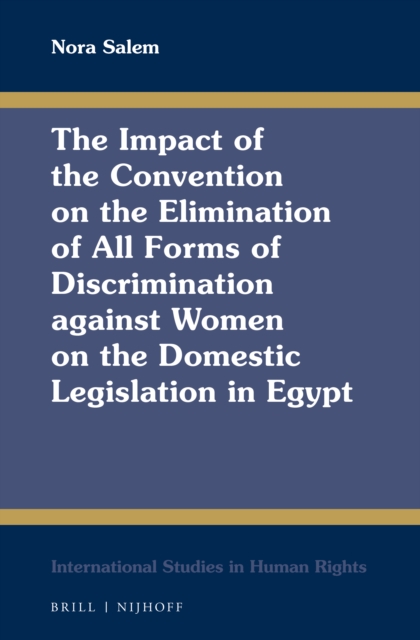
The Impact of the Convention on the Elimination of All Forms of Discrimination against Women on the Domestic Legislation in Egypt
The book offers an account of Egypt's legislative achievements and shortcomings in light of its international obligation to eliminate gender discrimination resulting from the Women's Convention and proposes de jure and de facto reforms to improve Egypt's implementation efforts.
eBook

Women, poverty, equality
The stark reality is that throughout the world, women disproportionately live in poverty. This indicates that gender can both cause and perpetuate poverty, but this is a complex and cross-cutting relationship.The full enjoyment of human rights is routinely denied to women who live in poverty. How can human rights respond and alleviate gender-based poverty? This monograph closely examines the potential of equality and non-discrimination at international law to redress gender-based poverty. It offers a sophisticated assessment of how the international human rights treaties, specifically the Convention on the Elimination of Discrimination Against Women (CEDAW), which contains no obligations on poverty, can be interpreted and used to address gender-based poverty. An interpretation of CEDAW that incorporates the harms of gender-based poverty can spark a global dialogue. The book makes an important contribution to that dialogue, arguing that the CEDAW should serve as an authoritative international standard setting exercise that can activate international accountability mechanisms and inform the domestic interpretation of human rights.
eBook

Auditing the ‘Social’ Using Conventions, Declarations, and Goal Setting Documents: A Scoping Review
The state of the ‘social’ that individuals, social groups and societies experience are a focus of international conventions, declarations and goal setting documents. Many indicators of the ‘social’ and measures of well-being that contain sets of indicators of the ‘social’ exist to ascertain the state of the ‘social’ of individuals, social groups, and societies. Marginalized groups are well known to have problems with the ‘social’ they experience. Equity, Diversity, and Inclusion (EDI) and similar phrases are used in policy discussions to deal with ‘social problems’ within research, education, and general workplace environments encountered by women, Indigenous peoples, visible/racialized minorities, disabled people, and LGBTQ2S+. The prevention of the worthening of the ‘social’ is one focus of science and technology governance and ethics discussions. Many health professions are also concerned about the ‘social’ such as the well-being of their clients and their roles as stated by many of their associations include being advocates and change agents. The objective of the study was to ascertain how the ‘social’ is engaged with in conjunction with the following international documents (“Convention on the Rights of Persons with Disabilities”, “Convention on the Rights of the Child”, “Convention on the Elimination of All Forms of Discrimination against Women”, “Declaration on the Rights of Indigenous Peoples”, “Universal Declaration of Human Rights”, “International Convention on the Elimination of All Forms of Racial Discrimination”, “UN Framework Convention on Climate Change”, “transforming our world: the 2030 agenda for sustainable development” and “UN flagship report on disability and development Realizing the Sustainable Development Goals by, for and with persons with disabilities”; from now on called “the documents”). A scoping review using the academic databases SCOPUS, Web of Science, databases accessible under Compendex, and the databases accessible under EBSCO-HOST, coupled with a manifest hit-count coding approach was uses to answer five research questions: (1) Which terms, phrases, and measures of the ‘social’ are present in the literature searched (2) Which of the social issues flagged in the Convention on the Rights of Persons with Disabilities (CRPD) are present in the academic abstracts mentioning the other eight documents? (3) Which EDI frameworks, phrases and social groups covered under EDI are present in the literature covered. (4) Which technologies, science and technology governance terms and ethics fields are present in the literature covered? (5) Which health professions are mentioned in the literature covered? The results reveal vast gaps and opportunities to engage with the ‘social’ in relation to “the documents” covered for all five questions.
Journal Article

Multiple forms of discrimination and postpartum depression among indigenous Palestinian-Arab, Jewish immigrants and non-immigrant Jewish mothers
Background
While discrimination takes multiple forms, racial or ethnic discrimination is a root cause of this health-damaging social phenomenon. We drew on intersectionality theory, which offers an account of discrimination’s multiple effects, to consider associations between women’s experiences of discrimination and postpartum depression (PPD) using four measures: single forms of discrimination (SFD); multiple forms of discrimination (MFD); ethnic discrimination combined with MFD (E-MFD); and a composite MFD that interacted with women’s identity (C-MFD).
Methods
We interviewed a stratified sample of 1128 mothers face to face in 2014–2015 during mothers’ visits to maternal and child health clinics. The mothers belonged to three groups in Israel: Palestinian-Arab minority, Jewish immigrant, and non-immigrant Jewish. We conducted unadjusted and adjusted logistic regressions for PPD, measured on the Edinburgh Postnatal Depression Scale, in associations with SFD (experiencing discrimination based on any of the following: age, sex, class, ethno-national identity, religiosity level and skin color); MFD (experiencing 0,1, 2 or ≥ 3 of SFD); E-MFD (ethnic discrimination combined with other MFD); and finally, C-MFD (interaction between MFD and women’s identity).
Results
Palestinian-Arab mothers had higher PPD and reported higher SFD (based on ethnicity, religiosity level, and socioeconomic status), as well as higher MFD and E-MFD. This was followed by Jewish immigrant mothers, and lastly by non-immigrant Jewish mothers. However, both MFD and E-MFD had a strong association with PPD among non-immigrant Jewish mothers reporting 2MFD and ≥ 3MFD, and Palestinian-Arab mothers reporting ≥3MFD, but no significant association among immigrant Jewish mothers. When we used C-MFD, we found a dose-response association in which Palestinian-Arab mothers experiencing more MFD (2MFD and ≥ 3MFD) were more likely to experience PPD. This was followed by immigrant Jewish mothers (reporting 2MFD and ≥ 3MFD), and lastly by non-immigrant Jewish mothers.
Conclusions
MFD should be considered in relation to women’s identity (being part of a minority, immigrant, or non-immigrant majority group) in maternal mental health research and practice. Otherwise, we risk underestimating the effects of MFD on PPD, especially in minority and immigrant mothers, who are more likely to face interlocking forms of discrimination.
Journal Article

When the state speaks, what should it say?
How should a liberal democracy respond to hate groups and others that oppose the ideal of free and equal citizenship? The democratic state faces the hard choice of either protecting the rights of hate groups and allowing their views to spread, or banning their views and violating citizens' rights to freedoms of expression, association, and religion. Avoiding the familiar yet problematic responses to these issues, political theorist Corey Brettschneider proposes a new approach called value democracy. The theory of value democracy argues that the state should protect the right to express illiberal beliefs, but the state should also engage in democratic persuasion when it speaks through its various expressive capacities: publicly criticizing, and giving reasons to reject, hate-based or other discriminatory viewpoints.
Distinguishing between two kinds of state action--expressive and coercive--Brettschneider contends that public criticism of viewpoints advocating discrimination based on race, gender, or sexual orientation should be pursued through the state's expressive capacities as speaker, educator, and spender. When the state uses its expressive capacities to promote the values of free and equal citizenship, it engages in democratic persuasion. By using democratic persuasion, the state can both respect rights and counter hateful or discriminatory viewpoints. Brettschneider extends this analysis from freedom of expression to the freedoms of religion and association, and he shows that value democracy can uphold the protection of these freedoms while promoting equality for all citizens.
eBook

Opening doors
Since the early 1990s, countries in the Middle East and North Africa (MENA) Region have made admirable progress in reducing the gap between girls and boys in areas such as access to education and health care. Indeed, almost all young girls in the Region attend school, and more women than men are enrolled in university. Over the past two decades, maternal mortality declined 60 percent, the largest decrease in the world. Women in MENA are more educated than ever before. It is not only in the protest squares that have seen women whose aspirations are changing rapidly but increasingly unmet. The worldwide average for the participation of women in the workforce is approximately 50 percent. In MENA, their participation is half that at 25 percent. Facing popular pressure to be more open and inclusive, some governments in the region are considering and implementing electoral and constitutional reforms to deepen democracy. These reforms present an opportunity to enhance economic, social, and political inclusion for all, including women, who make up half the population. However, the outlook remains uncertain. Finally, there are limited private sector and entrepreneurial prospects not only for jobs but also for those women who aspire to create and run a business. These constraints present multiple challenges for reform. Each country in MENA will, of course, confront these constraints in different contexts. However, inherent in many of these challenges are rich opportunities as reforms unleash new economic actors. For the private sector, the challenge is to create more jobs for young women and men. The World Bank has been pursuing an exciting pilot program in Jordan to assist young women graduates in preparing to face the work environment.
eBook

Resolving the Constitutional Dilemma of the Uniform Civil Code in India through the Women’s Convention
The debate over the Uniform Civil Code (UCC) is mired in the conflict between the right to freedom of religion and the right to gender-based equality. The retraction of the UCC also hinges on legal pluralism. This paper argues for shifting the foci of the debate towards gender-based violence as rightly suggested by the feminist argument in India. In order to do so, this paper argues that the debate over the UCC needs to be restructured around the Due Diligence Obligation (DDO) to the Convention on the Elimination of all forms of Discrimination Against Women (CEDAW). This paper presents the argument that the absence of a UCC creates a normative vacuum that is currently filled by an intersubjective climate on patriarchy which primes the average Indian mindset. This intersubjective mindset requires to be replaced by the normative language of the DDO to the CEDAW. This process of norm effectuation also ties into the question of how international norms are implemented in domestic contexts and reiterates the causal chain propounded therein.
Journal Article