
Catalogue Search | MBRL


Are you sure you want to remove the book from the shelf?

{{itemTitle}}
60
result(s) for
"Faith and reason Islam."
Sort by:


The rational believer : choices and decisions in the madrasas of Pakistan
Islamic schools, or madrasas, have been accused of radicalizing Muslims and participating, either actively or passively, in terrorist networks since the events of 9/11. In Pakistan, the 2007 siege by government forces of Islamabad's Red Mosque and its madrasa complex, whose imam and students staged an armed resistance against the state for its support of the \"war on terror,\" reinforced concerns about madrasas' role in regional and global jihad. By 2006 madrasas registered with Pakistan's five regulatory boards for religious schools enrolled over one million male and 200,000 female students. In The Rational Believer, Masooda Bano draws on rich interview, ethnographic, and survey data, as well as fieldwork conducted in madrasas throughout the country to explore the network of Pakistani madrasas. She maps the choices and decisions confronted by students, teachers, parents, and clerics and explains why available choices make participation in jihad appear at times a viable course of action.
Bano's work shows that beliefs are rational and that religious believers look to maximize utility in ways not captured by classical rational choice. She applies analytical tools from the New Institutional Economics to explain apparent contradictions in the madrasa system—for example, how thousands of young Pakistani women now demand the national adoption of traditional sharia law, despite its highly restrictive limits on female agency, and do so from their location in Islamic schools for girls that were founded only a generation ago.
eBook
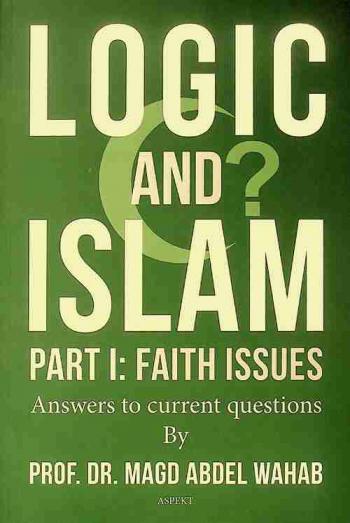
Logic and Islam : answers to current questions
Throughout history, a believer did not need logical proof to believe in Almighty God. This is because the spiritual proof was always enough to admit the existence of Almighty God and to submit to Him. Finding Almighty God is not a mathematical equation that needs to be proven. Rather, it is a spiritual feeling due to a call from inside a human being. The relationship between Almighty God and humans is spiritual rather logical.However, with the advances in science and technology, this spiritual relationship decreases. Nowadays, modern man is looking for logic and scientific answers to many questions relating to Almighty God and religions. In fact, nonbelievers or atheists are not the only ones looking for answers to these types of questions; believers also want to increase their faith and remove doubts from their hearts. The main objective of this book is to provide logical answers to questions relating to belief in Almighty God, creations and Islam as the last heavenly religion. These questions are grouped under several topics, namely: 1) Almighty God, 2) the creation, 3) the soul, 4) the hereafter, 5) the destiny and freedom in choices, 6) the holy Quran and 7) the Islam.0The main feature of this book is that the author provides logic flowcharts with each presented question relating to the different topics. Each logic flowchart has three phases: a start, a process and an end.0Prof. Dr. Magd Abdel Wahab is a full-time Professor of Applied Mechanics in the Faculty of Engineering and Architecture at Ghent University, Belgium.Beside his interest in engineering, Prof. Wahab has a strong interest in research in Islamic religion. During the last 15 years, he has served as an Associate Imam, and has delivered Friday ceremony speeches and Islamic talks in several mosques in the UK and Belgium. This book, Logic and Islam, summarises his experiences and provides logical answers to questions related to Almighty God, creations and Islam.

Islam, Modernity and a New Millennium
As the world becomes increasingly globalised Islam faces some important choices. Does it seek to “modernise” in line with the cultures in which it is practised, or does it retain its traditions even if they are at odds with the surrounding society? This book utilises a critical rationalist viewpoint to illuminate many of the hotly contested issues in modern Islam and to offer a fresh analysis.
A variety of issues within Islam are discussed in this book, including Muslims and modernity; Islam, Christianity and Judaism; approaches to the understanding of the Quran; Muslim identity and civil society; doctrinal certainty and violent radicalism. In each case, the author makes use of Karl Popper’s theory of critical rationalism to uncover new aspects of these issues and to challenge post-modern, relativist, literalist and justificationist readings of Islam.
This is a unique perspective on contemporary Islam and as such will be of significant interest to scholars of Religious Studies, Islamic Studies and the Philosophy of Religion.
eBook
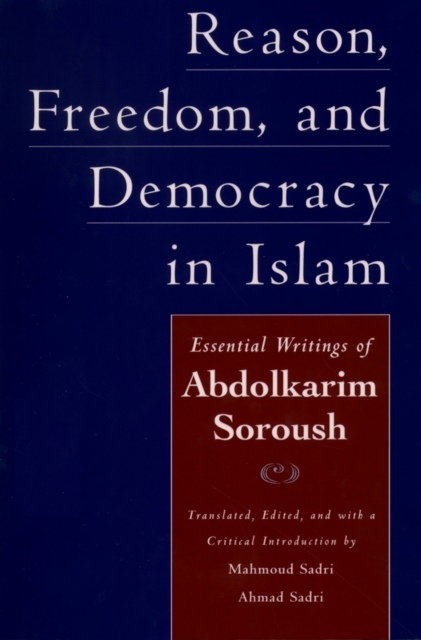
Reason, freedom, & democracy in Islam : essential writings of ʿAbdolkarim Soroush
In recent years Abdolkarim Soroush has emerged as one of the leading revisionist thinkers of the Muslim world. Translated into English for the first time, this book features a critical introduction by the editors and an original interview that reveals the intellectual biography of the author. It sets forth Soroush's views on such matters as the inevitablity of change in religion, the necessity of freedom of belief, and the compatibility of Islam with democracy.
eBook

Religion as critique : Islamic critical thinking from Mecca to the marketplace
\"Irfan Ahmad makes the far-reaching argument that potent systems and modes for self-critique as well as critique of others are inherent in Islam--indeed, critique is integral to its fundamental tenets and practices. Challenging common views of Islam as hostile to critical thinking, Ahmad delineates thriving traditions of critique in Islamic culture, focusing in large part on South Asian traditions. Ahmad contemplates and interrogates Greek and Enlightenment notions of reason and critique, and he notes how they are invoked in relation to \"others,\" including Muslims. Drafting an alternative genealogy of critique in Islam, Ahmad reads religious teachings and texts, drawing on sources in Hindi, Urdu, Farsi, and English, and demonstrates how they serve as expressions of critique. Throughout, he depicts Islam as an agent, not an object, of critique.\"-- Provided by publisher.
Book

The Islamic roots of democratic pluralism
This book tackles the most significant issues facing Muslims today. As Islam and Muslims enter the 21st century, the book argues, it is necessary to reopen the doors of religious interpretation—to re-examine and correct false interpretations, replace outdated laws and formulate new doctrines that respond to changing social contexts. Always using the Quran as a yardstick, the book demonstrates how and why Islamic law came to reflect political and social influences, leading to regulations that violate the spirit and the letter of the Quran. It analyzes critically Muslim teachings on issues of pluralism, civil society, war and peace, violence and self-sacrifice, the status and role of non-Muslims, and capital punishment.
eBook


Religion and science as forms of life
The relationships between science and religion are about to enter a new phase in our contemporary world, as scientific knowledge has become increasingly relevant in ordinary life, beyond the institutional public spaces where it traditionally developed. The purpose of this volume is to analyze the relationships, possible articulations and contradictions between religion and science as forms of life: ways of engaging human experience that originate in particular social and cultural formations. Contributions use this theoretical and ethnographic research to exploredifferent scientific and religious cultures in the contemporary world.
eBook