
Catalogue Search | MBRL


Are you sure you want to remove the book from the shelf?

{{itemTitle}}
2,012
result(s) for
"Fallacies"
Sort by:

Myths busted! : just when you thought you knew what you knew--
Full of colorful photographs and funny text, this book includes hundreds of fascinating facts and interesting tidbits that prove you can't believe everything you're told.
Book

Lie Machines
Technology is breaking politics - what can be done about it? Artificially intelligent \"bot\" accounts attack politicians and public figures on social media. Conspiracy theorists publish junk news sites to promote their outlandish beliefs. Campaigners create fake dating profiles to attract young voters. We live in a world of technologies that misdirect our attention, poison our political conversations, and jeopardize our democracies. With massive amounts of social media and public polling data, and in depth interviews with political consultants, bot writers, and journalists, Philip N. Howard offers ways to take these \"lie machines\" apart. Lie Machines is full of riveting behind the scenes stories from the world's biggest and most damagingly successful misinformation initiatives-including those used in Brexit and U.S. elections. Howard not only shows how these campaigns evolved from older propaganda operations but also exposes their new powers, gives us insight into their effectiveness, and shows us how to shut them down.
eBook

Bad arguments : 100 of the most important fallacies in Western philosophy
\"Ever decide to avoid a restaurant because of one bad meal? Choose a product because a celebrity endorsed it? Or ignore what a politician says because she's not a member of your party? For as long as people have been discussing, conversing, persuading, advocating, proselytizing, pontificating, or otherwise stating their case, arguments have been vulnerable to false assumptions and faulty reasoning. Drawing upon a long history of logical falsehoods and philosophical flubs, [this book] demonstrates how misguided arguments come to be, what we can do to detect them in the rhetoric of others, and how to avoid using them ourselves\"--Back cover.
Book

Committing Fallacies and the Appearance Condition
This appearance condition of fallacies refers to the phenomenon of weak arguments, or moves in argumentation, appearing to be okay when really they aren’t. Not all theorists agree that the appearance condition should be part of the conception of fallacies but this essay explores some of the consequences of including it. In particular, the differences between committing a fallacy, causing a fallacy and observing a fallacy are identified. The remainder of the paper is given over to discussing possible causes of mistakenly perceiving weak argumentation moves as okay. Among these are argument caused misperception, perspective caused misperception, discursive environment caused misperception and perceiver caused misperception. The discussion aims to be sufficiently general so that it can accommodate different models and standards of argumentation that make a place for fallacies.
Journal Article


Overarching Principles for the Organization of Socioemotional Constructs
Psychological scientists have intensively studied how people handle emotions and navigate social situations for more than a century. However, advancements in our understanding of socioemotional constructs have been hampered because of challenges in assessment. Several measurement problems have been identified; however, we want to bring attention to a potentially larger problem. Many operationalizations and measures of socioemotional constructs are poorly embedded within the larger body of psychological research, hampered by jingle and jangle fallacies. Jingle fallacies occur when assessment tools are assumed to measure the same construct but in practice measure different constructs. Jangle fallacies occur when assessment tools are assumed to measure different constructs but in practice measure the same construct. Both fallacies are primarily due to a qualitative divide between a construct’s definition and how it was measured. We discuss this issue, identify examples of jingle and jangle fallacies, and conclude with recommendations.
Journal Article
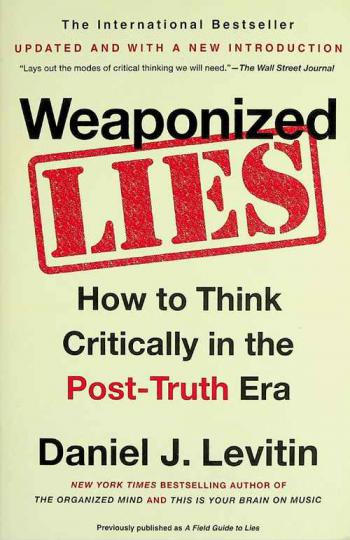
Weaponized lies : how to think critically in the post-truth era
\"It's raining bad data, half-truths, and fake news out there-and some of this nonsense is having devastation consequences. Daniel J. Levitin shows how corporate and government reports, statistics, and news stories can mislead, and reveals the way lying weasels use them. What makes lies dangerous is the certainty with which people are prone to believe them. Here is how to fix that.\"--Page [4] of cover.
Book

SURPRISED BY THE HOT HAND FALLACY? A TRUTH IN THE LAW OF SMALL NUMBERS
We prove that a subtle but substantial bias exists in a common measure of the conditional dependence of present outcomes on streaks of past outcomes in sequential data. The magnitude of this streak selection bias generally decreases as the sequence gets longer, but increases in streak length, and remains substantial for a range of sequence lengths often used in empirical work. We observe that the canonical study in the influential hot hand fallacy literature, along with replications, are vulnerable to the bias. Upon correcting for the bias, we find that the longstanding conclusions of the canonical study are reversed.
Journal Article

The Encyclopedia of Misinformation
\"In an era of 'alternative facts,' Rex Sorgatz's The Encyclopedia of Misinformation helps put things in perspective.\" -- Fast Company This compendium of misinformation, deception, and self-delusion throughout history examines fakery in the context of science and advertising, humor and law, sports and video games, and beyond.
eBook