
Catalogue Search | MBRL


Are you sure you want to remove the book from the shelf?

{{itemTitle}}
40
result(s) for
"Families India Biography."
Sort by:

Ants among elephants : an untouchable family and the making of modern India
\"The stunning true story of an untouchable family who become teachers, and one, a poet and revolutionary. Like one in six people in India, Sujatha Gidla was born an untouchable. While most untouchables are illiterate, her family was educated by Canadian missionaries in the 1930s, making it possible for Gidla to attend elite schools and move to America at the age of twenty-six. It was only then that she saw how extraordinary--and yet how typical--her family history truly was. Her mother, Manjula, and uncles Satyam and Carey were born in the last days of British colonial rule. They grew up in a world marked by poverty and injustice, but also full of possibility. In the slums where they lived, everyone had a political side, and rallies, agitations, and arrests were commonplace. The Independence movement promised freedom. Yet for untouchables and other poor and working people, little changed. Satyam, the eldest, switched allegiance to the Communist Party. Gidla recounts his incredible life--how he became a famous poet, student, labor organizer, and founder of a left-wing guerrilla movement. And Gidla charts her mother's battles with caste and women's oppression. Page by page, Gidla takes us into a complicated, close-knit family as they desperately strive for a decent life and a more just society. A moving portrait of love, hardship, and struggle, Ants Among Elephants is also that rare thing: a personal history of modern India told from the bottom up\"-- Provided by publisher.
BOOK

My family and other saints
In 1969, young Kirin Narayan’s older brother, Rahoul, announced that he was quitting school and leaving home to seek enlightenment with a guru. From boyhood, his restless creativity had continually surprised his family, but his departure shook up everyone— especially Kirin, who adored her high-spirited, charismatic brother.
eBook


House on fire
A story of courage and risk-taking, House on Fire tells how smallpox, a disease that killed, blinded, and scarred millions over centuries of human history, was completely eradicated in a spectacular triumph of medicine and public health. Part autobiography, part mystery, the story is told by a man who was one of the architects of a radical vaccination scheme that became a key strategy in ending the horrible disease when it was finally contained in India. In House on Fire, William H. Foege describes his own experiences in public health and details the remarkable program that involved people from countries around the world in pursuit of a single objective--eliminating smallpox forever. Rich with the details of everyday life, as well as a few adventures, House on Fire gives an intimate sense of what it is like to work on the ground in some of the world's most impoverished countries--and tells what it is like to contribute to programs that really do change the world.
eBook

The bargain from the bazaar : a family's day of reckoning in Lahore
\"The story of one struggling middle-class Pakistani family, compellingly narrated by a young scholar and diplomat who has observed the traumas of the region firsthand. As a young boy, Awais Reza's family moved from Indian Kashmir to Lahore in Pakistan after Partition. Now middle-aged, Awais is a shopkeeper in the Anarkali Bazaar. Married, with three sons, he looks back on his journey from idealistic young nationalist to increasingly watchful and anxious member of the mercantile class at the heart of Pakistani life. Awais's eldest son has drifted, but returned to help his father run the shop; the middle one is involved in radical Islamist politics; and the youngest is a law student who believes that a secular future is Pakistan's last and only hope. Their lives unfold against an increasingly turbulent and violent background as suicide bombers enter the life of urban Lahore with devastating consequences. Haroon K. Ullah's portrait of a middle class family oppressed by a state falling apart around them is a remarkable piece of storytelling. Radical Islam is confronted not only in distant mountain passes by the armed forces, but most personally and tellingly across the kitchen table as families like the Rezas debate their future\"-- Provided by publisher.
Book

Windows into the Past
Judith M. Brown, one of the leading historians of South Asia,
provides an original and thought-provoking strategy for conducting
and presenting historical research in her latest book, Windows
into the Past . Brown looks at how varieties of \"life history\"
that focus on the lives of institutions and families, as well as
individuals, offer a broad and rich means of studying history. Her
distinctively creative approach differs from traditional historical
biography in that it explores a variety of \"life histories\" and
shows us how they become invaluable windows into the past.
Following her introduction, \"The Practice of History,\" Brown
opens windows on the history of South Asia. She begins with the
life history of an educational institution, Balliol College,
Oxford, and tracks the interrelationship between Britain and India
through the lives of the British and Indian men who were educated
there. She then demonstrates the significance of family life
history, showing that by observing patterns of family life over
several generations, it is possible to gain insight into the
experiences of groups of people who rarely left historical
documents about themselves, particularly South Asian women.
Finally, Brown uses the life history of two prominent individuals,
Mahatma Gandhi and Jawaharlal Nehru, to examine questions about the
nature of Indian nationalism and the emergent Indian state.
eBook

The Bargain from the Bazaar
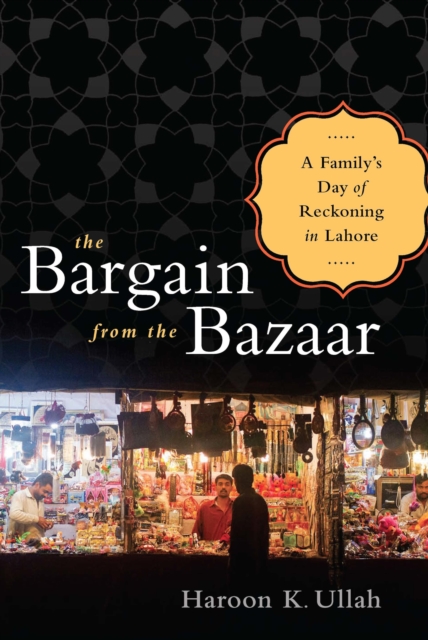
Awais Reza is a shopkeeper in Lahore's Anarkali Bazaarthe largest open market in South Asiawhose labyrinthine streets teem with shoppers, rickshaws, and cacophonous music. But Anarkali's exuberant hubbub cannot conceal the fact that Pakistan is a country at the edge of a precipice. In recent years, the easy sociability that had once made up this vibrant community has been replaced with doubt and fear. Old-timers like Awais, who inherited his shop from his father and hopes one day to pass it on to his son, are being shouldered aside by easy money, discount stores, heroin peddlers, and the tyranny of fundamentalists. Every night before Awais goes to bed, he plugs in his cell phone and hopes. He hopes that the city will not be plunged into a blackout, that the night will remain calm, that the following morning will bring affluent and happy customers to his shop and, most of all, that his three sons will safely return home. Each of the boys, though, has a very different vision of their, and Pakistan's, future. The Bargain from the Bazaarthe product of eight years of field researchis an intimate window onto ordinary middle-class lives caught in the maelstrom of a nation falling to pieces. It's an absolutely compelling portrait of a family at riskfrom a violently changing world on the outside and a growing terror from within.
eBook

The Bhutto Dynasty
A major new investigation into the Bhutto family, examining
their influence in Pakistan from the colonial era to the present
day The Bhutto family has long been one of the most
ambitious and powerful in Pakistan. But politics has cost the
Bhuttos dear. Zulfikar Ali Bhutto, widely regarded as the most
talented politician in the country's history, was removed from
power in 1977 and executed two years later, at the age of 51. Of
his four children, three met unnatural deaths: Shahnawaz was
poisoned in 1985 at the age of 27; Murtaza was shot by the police
outside his home in 1996, aged 42; and Benazir Bhutto, who led the
Pakistan Peoples Party and became Prime Minister twice, was killed
by a suicide bomber in Rawalpindi in 2007, aged 54. Drawing on
original research and unpublished documents gathered over twenty
years, Owen Bennett-Jones explores the turbulent existence of this
extraordinary family, including their volatile relationship with
British colonialists, the Pakistani armed forces, and the United
States.
eBook
