
Catalogue Search | MBRL


Are you sure you want to remove the book from the shelf?

{{itemTitle}}
3,812,532
result(s) for
"Family"
Sort by:

The forgotten kin : aunts and uncles
\"Although much is written about contemporary families, the focus is typically limited to marriage and parenting. In this path-breaking assessment of families, sociologist Robert M. Milardo demonstrates how aunts and uncles contribute to the daily lives of parents and their children. Aunts and uncles complement the work of parents, sometimes act as second parents, and sometimes form entirely unique brands of intimacy grounded in a lifetime of shared experiences. The Forgotten Kin explores how aunts and uncles support parents, buffer the relationships of parents and children, act as family historians, and develop lifelong friendships with parents and their children. This is the first comprehensive study of its kind, detailing the routine activities of aunts and uncles, the features of families that encourage closeness, how aunts and uncles go about mentoring nieces and nephews, and how adults are mentored by the very children for whom they are responsible. This book aims to change the public discourse on families and the involvement of the forgotten kin across generations and households\"--Provided by publisher.
Book

Qualitative methods for family studies & human development
Qualitative Methods for Family Studies and Human Development serves as a step-by-step, interdisciplinary, qualitative methods text for those working in the areas of family studies, human development, family therapy, and family social work. Providing a systematic outline for carrying out qualitative projects from start to finish, author Kerry J. Daly uniquely combines epistemology, theory, and methodology into a comprehensive package illustrated specifically with examples from family relations and human development research.
eBook


Parental Incarceration and the Family
Winner of the 2014 Outstanding Book Award presented by the Academy of Criminal Justice SciencesOver 2% of U.S.children under the age of 18more than 1,700,000 childrenhave a parent in prison. These children experience very real disadvantages when compared to their peers: they tend to experience lower levels of educational success, social exclusion, and even a higher likelihood of their own future incarceration. Meanwhile, their new caregivers have to adjust to their new responsibilities as their lives change overnight, and the incarcerated parents are cut off from their childrens development.Parental Incarceration and the Familybrings a family perspective to our understanding of what it means to have so many of our nations parents in prison. Drawing from the fields most recent research and the authors own fieldwork, Joyce Ardittioffers an in-depth look at how incarceration affects entire families: offender parents, children, and care-givers. Through the use of exemplars, anecdotes, and reflections, Joyce Arditti puts a human face on the mass of humanity behind bars, as well as those family members who are affected by a parents imprisonment. In focusing on offenders as parents, a radically different social policy agenda emergesone that calls for real reform and that responds to the collective vulnerabilities of the incarcerated and their kin.
eBook


The Family on Trial in Revolutionary France
In a groundbreaking book that challenges many assumptions about gender and politics in the French Revolution, Suzanne Desan offers an insightful analysis of the ways the Revolution radically redefined the family and its internal dynamics. She shows how revolutionary politics and laws brought about a social revolution within households and created space for thousands of French women and men to reimagine their most intimate relationships. Families negotiated new social practices, including divorce, the reduction of paternal authority, egalitarian inheritance for sons and daughters alike, and the granting of civil rights to illegitimate children. Contrary to arguments that claim the Revolution bound women within a domestic sphere,The Family on Trialmaintains that the new civil laws and gender politics offered many women unexpected opportunities to gain power, property, or independence. The family became a political arena, a practical terrain for creating the Republic in day-to-day life. From 1789, citizens across France-sons and daughters, unhappily married spouses and illegitimate children, pamphleteers and moralists, deputies and judges-all disputed how the family should be reformed to remake the new France. They debated how revolutionary ideals and institutions should transform the emotional bonds, gender dynamics, legal customs, and economic arrangements that structured the family. They asked how to bring the principles of liberty, equality, and regeneration into the home. And as French citizens confronted each other in the home, in court, and in print, they gradually negotiated new domestic practices that balanced Old Regime customs with revolutionary innovations in law and culture. In a narrative that combines national-level analysis with a case study of family contestation in Normandy, Desan explores these struggles to bring politics into households and to envision and put into practice a new set of familial relationships.
eBook

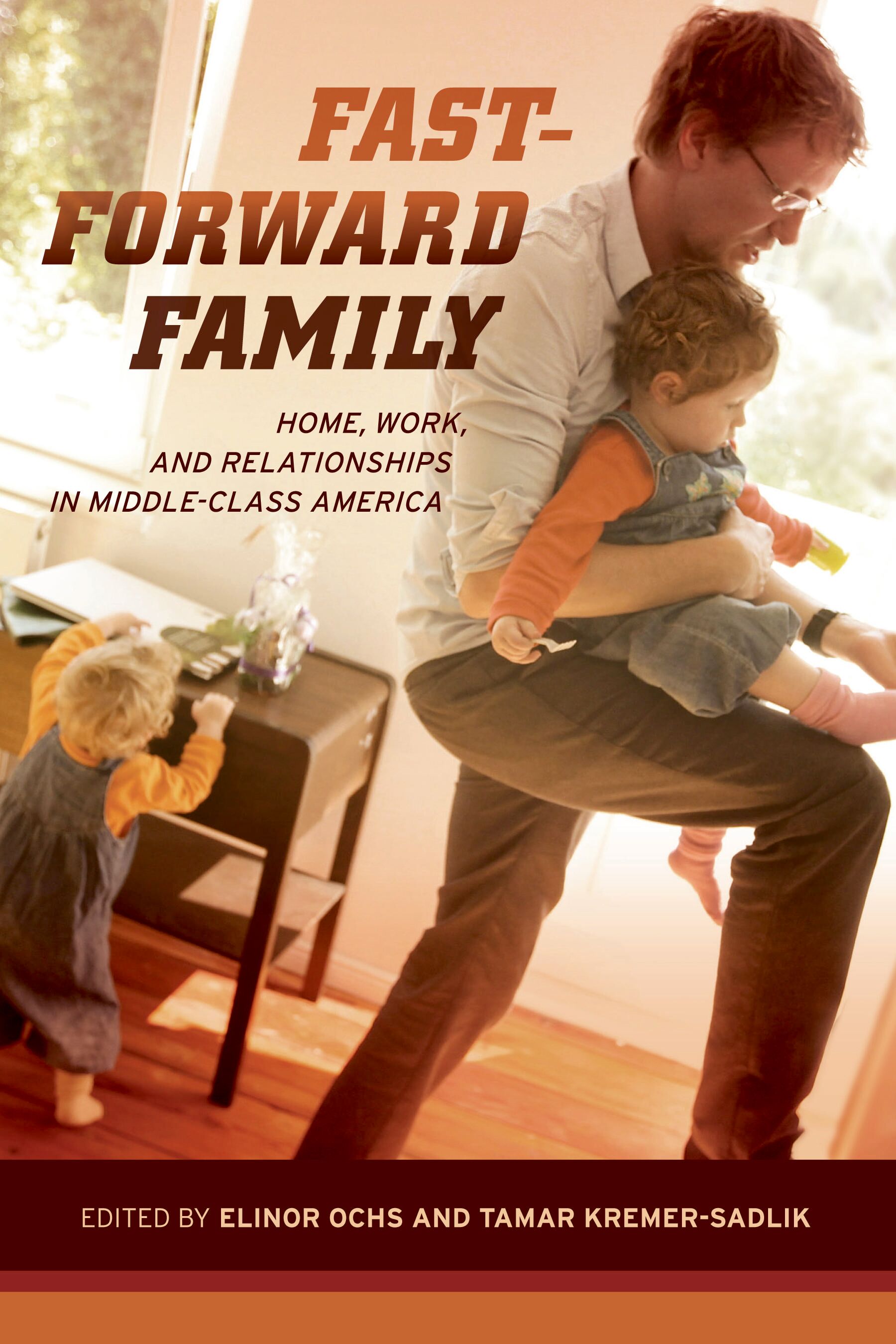
Fast-forward family
Called \"the most unusually voyeuristic anthropology study ever conducted\" by the New York Times, this groundbreaking book provides an unprecedented glimpse into modern-day American families. In a study by the UCLA Sloan Center on Everyday Lives and Families, researchers tracked the daily lives of 32 dualworker middle class Los Angeles families between 2001 and 2004. The results are startling, and enlightening. Fast-Forward Family shines light on a variety of issues that face American families: the differing stress levels among parents; the problem of excessive clutter in the American home; the importance (and decline) of the family meal; the vanishing boundaries that once separated work and home life; and the challenges for parents as they try to reconcile ideals regarding what it means to be a good parent, a good worker, and a good spouse. Though there are also moments of connection, affection, and care, it's evident that life for 21st century working parents is frenetic, with extended work hours, children's activities, chores, meals to prepare, errands to run, and bills to pay.
eBook


Migration and New Media
How do parents and children care for each other when they are separated because of migration? The way in which transnational families maintain long-distance relationships has been revolutionised by the emergence of new media such as email, instant messaging, social networking sites, webcam and texting. A migrant mother can now call and text her left-behind children several times a day, peruse social networking sites and leave the webcam for 12 hours achieving a sense of co-presence.
Drawing on a long-term ethnographic study of prolonged separation between migrant mothers and their children who remain in the Philippines, this book develops groundbreaking theory for understanding both new media and the nature of mediated relationships. It brings together the perspectives of both the mothers and children and shows how the very nature of family relationships is changing. New media, understood as an emerging environment of polymedia, have become integral to the way family relationships are enacted and experienced. The theory of polymedia extends beyond the poignant case study and is developed as a major contribution for understanding the interconnections between digital media and interpersonal relationships.
\"[A] compelling read about the ‘connected transnational family’ … The most compelling aspect of this book, this reader would argue, is its simultaneous engagement with a broad range of entangled issues. It convincingly puts mothers/children, migration/communication, mediation/relationship, past/present/future as well as theory/research practice into close encounter throughout.\" - Nicole Shephard, LSE Review of Books
\"Mirca Madianou and Daniel Miller seem to have formed a dream team when they embarked on their mutual research project on transnational families and the role of ICTs ... In my view, the book succeeds in what many authors fruitlessly pursue: deriving convincing theory from an abundance of vast qualitative data. It is a highly engaging book that is rich in detail without drowning the reader in it. Its empirical and theoretical innovations make it a highly recommended book for any scholar working on media and migration, long-distance communication and the increasingly complex media environments that enfold us.\" - Kevin Smets, Communications
\"An exemplary and groundbreaking study, with contributions to theory and our understanding of polymedia in everyday life, this stands out as an extraordinary read on the technology of relationships.\" - Zizi Papacharissi, University of Illinois-Chicago, USA
\"This fascinating, richly detailed book investigates the role that fluency across multiple digital platforms plays in enabling mothering and caring to be sustained at a distance. A genuine breakthrough.\" - Nick Couldry , Goldmiths, University of London, UK
\"With deft weaving of interview material and theorization...Mirca Madianou and Daniel Miller have produced an important and useful theoretical intervention that advances our understanding of the social life of transnational communities.\" - Radha S. Hegde, Media, Culture, & Society
Mirca Madianou is Senior Lecturer in Media and Communication at the University of Leicester, UK. She is the author of Mediating the Nation and several articles on the social consequences of the media.
Daniel Miller is Professor of Material Culture at the Department of Anthropology, University College London, UK. His most recent books include Tales from Facebook and Digital Anthropology (edited with Heather Horst).
1. Introduction 2. Philippines at the Forefront of Globalisation 3. The Hidden Motivations of Migration 4. Crafting Love: Letters and Cassettes 5. The Cultural Contradictions of Transnational Motherhood: The Mothers’ Perspective 6. The Children’s Perspective 7. Technologies of Relationships 8. Polymedia 9. A Theory of Mediated Relationships 10. Appendix: A Note on Method
eBook