
Catalogue Search | MBRL


Are you sure you want to remove the book from the shelf?

{{itemTitle}}
166,090
result(s) for
"Family Planning"
Sort by:

The case for the only child : your essential guide
\"The Case for the Only Child debunks the myths, taking into account the many changes the nuclear family has experienced in the face of two-family incomes, women who have children later, and the economic reality of raising children in our modern world. Combining often-surprising findings with real-life stories, compassionate insight, and thought-provoking questions, Dr. Susan Newman provides a guide to help you decide for yourself how to best plan your family and raise a single child.\"--from cover, p. [4].
Book

Public Funding for Contraception, Provider Training, and Use of Highly Effective Contraceptives: A Cluster Randomized Trial
Objectives. We determined whether public funding for contraception was associated with long-acting reversible contraceptive (LARC) use when providers received training on these methods. Methods. We evaluated the impact of a clinic training intervention and public funding on LARC use in a cluster randomized trial at 40 randomly assigned clinics across the United States (2011–2013). Twenty intervention clinics received a 4-hour training. Women aged 18 to 25 were enrolled and followed for 1 year (n = 1500: 802 intervention, 698 control). We estimated the effects of the intervention and funding sources on LARC initiation with Cox proportional hazards models with shared frailty. Results. Women at intervention sites had higher LARC initiation than those at control (22 vs 18 per 100 person-years; adjusted hazard ratio [AHR] = 1.43; 95% confidence interval [CI] = 1.04, 1.98). Participants receiving care at clinics with Medicaid family planning expansion programs had almost twice the initiation rate as those at clinics without (25 vs 13 per 100 person-years; AHR = 2.26; 95% CI = 1.59, 3.19). LARC initiation also increased among participants with public (AHR = 1.56; 95% CI = 1.09, 2.22) but not private health insurance. Conclusions. Public funding and provider training substantially improve LARC access.
Journal Article


Does family planning counseling reduce unmet need for modern contraception among postpartum women: Evidence from a stepped-wedge cluster randomized trial in Nepal
Postpartum women have high rates of unmet need for modern contraception in the two years following birth in Nepal. We assessed whether providing contraceptive counseling during pregnancy and/or prior to discharge from the hospital for birth or after discharge from the hospital for birth was associated with reduced postpartum unmet need in Nepal.
We used data from a larger a stepped-wedge, cluster randomized trial, including contraceptive counselling in six tertiary hospitals. Group 1 hospitals (three hospitals) initiated the intervention after three months of baseline data collection, while Group 2 hospitals (three hospitals) initiated the same intervention after nine months. We have enrolled 21,280 women in the baseline interviews and conducted two follow-up interviews with them, one and two years after they had delivered in one of our study hospitals. We estimated the effect of counseling and its timing (pre-discharge, post- discharge, both, or neither) on unmet need for modern contraception in the postpartum period, using random-effects logistic regressions.
Unmet need for modern contraception was high (54% at one year and 50% at two years). Women counseled in either the pre-discharge period (Odds ratio [OR] 0·86; 95% CI: 0·80, 0·93) or in the post-discharge period (OR 0·86; 95% CI: 0·79, 0·93) were less likely to have an unmet need in the postpartum period compared to women with no counseling. However, women who received counseling in both the pre- and post-discharge period were 27% less likely than women who had not received counseling to have unmet need (OR 0.73; 95% CI: 0·67, 0·80).
Counseling women either before or after discharge reduces unmet need for postpartum contraception but counseling in both periods is most effective.
Journal Article


Reductions in pregnancy rates in the USA with long-acting reversible contraception: a cluster randomised trial
Unintended pregnancy remains a serious public health challenge in the USA. We assessed the effects of an intervention to increase patients' access to long-acting reversible contraceptives (LARCs) on pregnancy rates.
We did a cluster randomised trial in 40 reproductive health clinics across the USA in 2011–13. 20 clinics were randomly assigned to receive evidence-based training on providing counselling and insertion of intrauterine devices (IUDs) or progestin implants and 20 to provide standard care. Usual costs for contraception were maintained at all sites. We recruited women aged 18–25 years attending family planning or abortion care visits and not desiring pregnancy in the next 12 months. The primary outcome was selection of an IUD or implant at the clinic visit and secondary outcome was pregnancy within 12 months. We used generalised estimating equations for clustered data to measure the intervention effect on contraceptive selection, and used survival analysis to assess pregnancy rates.
Of 1500 women enrolled, more at intervention than control sites reported receiving counselling on IUDs or implants (565 [71%] of 797 vs 271 [39%] of 693, odds ratio 3·8, 95% CI 2·8–5·2) and more selected LARCs during the clinic visit (224 [28%] vs 117 [17%], 1·9, 1·3–2·8). The pregnancy rate was lower in intervention group than in the control group after family planning visits (7·9 vs 15·4 per 100 person-years), but not after abortion visits (26·5 vs 22·3 per 100 person-years). We found a significant intervention effect on pregnancy rates in women attending family planning visits (hazard ratio 0·54, 95% CI 0·34–0·85).
The pregnancy rate can be reduced by provision of counselling on long-term reversible contraception and access to devices during family planning counselling visits.
William and Flora Hewlett Foundation.
Journal Article

Elegant weddings : the ceremony, the reception, the clothes
\"Many brides- and grooms-to-be dream of walking down the aisle during their perfect wedding, and for this, a lot of preparation is required. All About Weddings, the sumptuous and lavishly photographed guide to wedding planning, offers in depth suggestions and answers to every question about organizing the big day. From obtaining the marriage license to choosing the proper music, picking the perfect dress to finding a reception venue, All About Weddings has everything you need to make the day a success. This luxurious guide discusses: Budgeting: A wedding can be elaborate or inexpensive, but both can have beautiful results. Who does what?: Bridesmaid, groomsmen, ring bearer. What do they do? Learn about key roles. What to wear: Empire, A-Line, a train, or a color other than white? Tips on location and time of year can help you decide. Planning the reception: Make the night unforgettable. Everything from seating arrangements, decorations, cake, dinner, and dancing. Whether you want a fairy tale wedding, a bohemian theme, or simply to slip away to city hall, All About Weddings has elegant images, checklists, and practical tips sure to inspire and assist in your preparations for your big day. Congratulations on your upcoming marriage! \"-- Provided by publisher.
Book
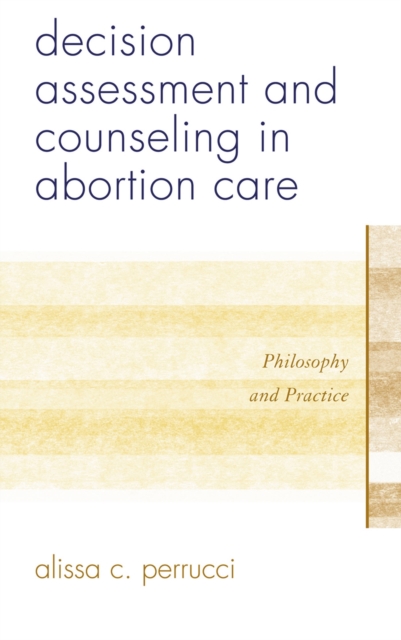
Decision assessment and counseling in abortion care
In today’s contentious political environment surrounding abortion, clinicians, counselors and social workers need a clear framework for providing skilled, compassionate decision counseling. They need help working with the hard stuff: “What do I do when my patient asks me if God will forgive her?” or “What do I say when a woman says that she feels like she’s killing her baby?” These are the questions asked by clinicians and mental health professionals everywhere; these are also the questions for which this book offers answers. The fields of healthcare and counseling psychology have long-awaited a manual for conducting pregnancy decision counseling across the spectrum of patient issues, employee skill levels, and clinic resources. Using case examples, individual and group exercises, guided self-reflection, and values clarification, the reader will develop the necessary skills to provide compassionate and informed pregnancy decision counseling. This book will define the gold standard for decision assessment and counseling for all pregnancy options and will be cited as the definitive guide for learning, teaching, and providing high-quality, compassionate counseling in abortion and family planning clinics nationwide.
eBook


What's so troubling about 'voluntary' family planning anyway? A feminist perspective
Voluntary family planning is a key mainstay of demographic work and population policies. The 1994 International Conference on Population and Development (ICPD) signalled a decisive shift away from fertility reduction and target-setting to an emphasis on voluntary family planning as intrinsic to reproductive health and women's empowerment. Yet, criticisms of voluntary family planning programmes persist, interrogating how 'voluntariness' is understood and wielded or questioning the instrumentalization of women's fertilities in the service of economic and developmental goals. In this paper, I reflect on these debates with the aim of troubling the notion of voluntary family planning as an unambiguous good that enables equitable empowerment and development for all. Drawing on literature from cognate disciplines, I highlight how voluntariness is linked to social and structural conditions, and I challenge the instrumentalization of voluntary family planning as a 'common agenda' to solve 'development' problems. Engaging with this work can contribute to key concepts (e.g. 'voluntary') and measurements (e.g. autonomy), strengthening the collective commitment to achieving the ICPD and contributing to reproductive empowerment and autonomy. Through this intervention, I aim to help demographers see why some critics call for a reconsideration of voluntary family planning and encourage a decoupling of interventions from fertility reduction aims, instead centring human rights, autonomy, and reproductive empowerment.
Journal Article