
Catalogue Search | MBRL


Are you sure you want to remove the book from the shelf?

{{itemTitle}}
46
result(s) for
"Famines Great Britain History"
Sort by:


Daniel O'Connell, The British Press and The Irish Famine
Through an investigation of the reportage in nineteenth-century English metropolitan newspapers and illustrated journals, this book begins with the question 'Did anti-O'Connell sentiment in the British press lead to \"killing remarks,\" rhetoric that helped the press, government and public opinion distance themselves from the Irish Famine?' The book explores the reportage of events and people in Ireland, focussing first on Daniel O'Connell, and then on debates about the seriousness of the Famine. Drawing upon such journals as The Times, The Observer, the Morning Chronicle, The Scotsman, the Manchester Guardian, the Illustrated London News, and Punch, Williams suggests how this reportage may have effected Britain's response to Ireland's tragedy. Continuing her survey of the press after the death of O'Connell, Leslie Williams demonstrates how the editors, writers and cartoonists who reported and commented on the growing crisis in peripheral Ireland drew upon a metropolitan mentality. In doing so, the press engaged in what Edward Said identifies as 'exteriority,' whereby reporters, cartoonists and illustrators, basing their viewpoints on their very status as outsiders, reflected the interests of metropolitan readers. Although this was overtly excused as an effort to reduce bias, stereotyping and historic enmity - much of unconscious - were deeply embedded in the language and images of the press. Williams argues that the biases in language and the presentation of information proved dangerous. She illustrates how David Spurr's categories or tropes of invalidation, debasement and negation are frequently exhibited in the reports, editorials and cartoons. However, drawing upon the communications theories of Gregory Bateson, Williams concludes that the real 'subject' of the British Press commentary on Ireland was Britain itself. Ireland was used as a negative mirror to reinforce Britain's own commitment to capitalist, industrial values at a time of great internal stress.
Contents: Preface; Introduction; The Times, O'Connell and repeal ” 1843; Punch, 'rint' and 'repale' ” 1843; Traversers and priests ” 1844-1845; 'The commissioner' ” 1845; Imagining a famine/Imaginary famine ” 1845; 'The battlefield of contending factions' ” January to June, 1846; Parsing Pharaoh's dream ” July to December 1846; 'A Transition of Great Difficulty' ” January to March 1847; The death of Daniel O'Connell ” May 1847; 'A conspiracy against life': June to December 1847; Charles Trevelyan and the 'great opportunity' ” January 1848; The uprising at Boulagh ” 1848; A dream of the future ”1849; Conclusion; Bibliography; Index.
Leslie A. Williams, author of Daniel O'Connell, the British Press, and Killing Remarks, was an art historian specializing in the Victorian period. At the time of her death she was Chair of the Department of Arts and Humanities at Shawnee State University, Portsmouth, Ohio. William H. A. Williams, editor, is historian and author of 'Twas Only an Irishman's Dream: The Image of the Irish and Ireland in American Popular Song Lyrics, 1800-1920. He is member of the faculty of the College of Undergraduate Studies, Union Institute & University, Cincinnati, Ohio
eBook

Churchill's secret war : the British empire and the ravaging of India during World War II
Examines Winston Churchill's efforts to defeat the freedom movement in India during World War II, comparing his actions in Europe to the decisions he made between 1940 and 1944, which resulted in the deaths of more than three million men, women, and children in India.
Book

Victims of Ireland's Great Famine
With one million dead, and just as many forced to emigrate, the Irish Famine (1845-52) is among the worst health calamities in history. In 2006, archaeologists discovered a mass burial containing the remains of nearly 1,000 Kilkenny Union workhouse inmates. In the first bioarchaeological study of Great Famine victims, Jonny Geber uses skeletal analysis to tell the story of how and why the Irish Famine decimated the lowest levels of nineteenth century society.
By examining the physical conditions of the inmates that might have contributed to their institutionalization, as well as to the resulting health consequences, Geber sheds new and unprecedented light on Ireland's Great Hunger.
eBook

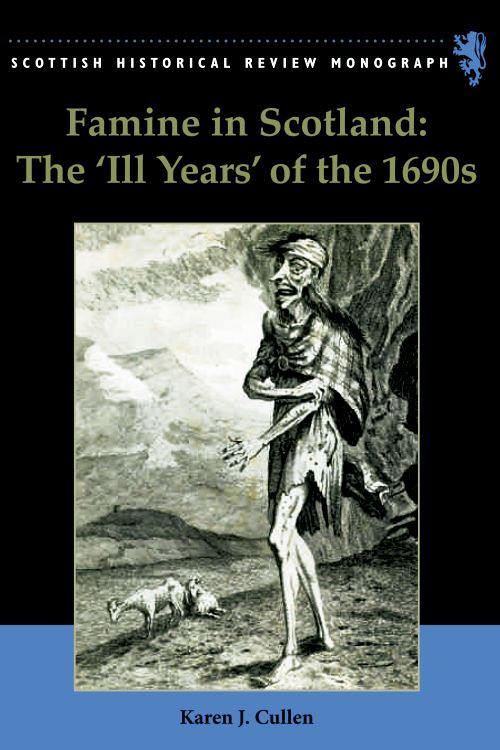
Famine in Scotland - the 'Ill Years' of the 1690s
This book examines the climatic and economic origins of the last national famine to occur in Scotland, the nature and extent of the crisis which ensued, and what the impact of the famine was upon the population in demographic, economic and social terms. Current published knowledge about the causes, extent, and impact of the famine in Scotland is limited and many conclusions have been speculative in the absence of extensive research. Despite the critical importance of this crisis, one of the four disasters of the 1690s, which are widely acknowledged to have contributed to the economic arguments
eBook


Ireland : the politics of enmity, 1789-2006
This book is an innovative interpretation of the history of Anglo–Irish relations from 1789 right to the present day. The French Revolution had an electrifying impact on Irish society, with the 1790s seeing the birth of modern Irish republicanism and Orangeism. This decade also saw the political integration between Ireland and the British elite, such as with Pitt and Castlereagh. The Irish, who were strongly influenced by Edmund Burke's freedom philosophies, argued that Britain's strategic interests were best served by a policy of Catholic emancipation. Britain's failure to achieve this objective — dramatised by the horrifying and tragic Irish famine of 1846–50 — set the context for the emergence of a popular mass nationalism. Eventually, the Fenian, Parnell, and Sinn Fein movements expelled the British from most of the island. This book reassesses all the key leaders of Irish nationalism, alongside key British political leaders — from Tone, Parnell and de Valera, to Haughey, Peel and Blair. It evaluates the changing ideological passions of the modern Irish question, while examining the changing economical and social worlds in London, Dublin and Belfast, all in one coherent analysis.
eBook
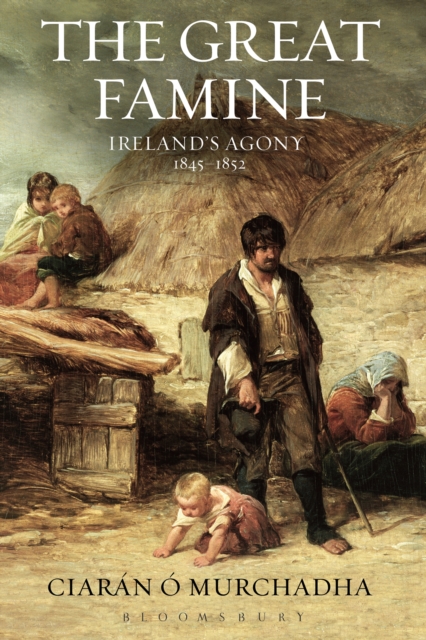
The great famine : Ireland's agony 1845-1852
Over one million people died in the Great Famine, and more than one million more emigrated on the coffin ships to America and beyond.Drawing on contemporary eyewitness accounts and diaries, the book charts the arrival of the potato blight in 1845 and the total destruction of the harvests in 1846 which brought a sense of numbing shock.
eBook

Hunger
Rigorously researched, Hunger: A Modern History draws together social, cultural, and political history, to show us how we came to have a moral, political, and social responsibility toward the hungry. Vernon forcefully reminds us how many perished from hunger in the empire and reveals how their history was intricately connected with the precarious achievements of the welfare state in Britain, as well as with the development of international institutions committed to the conquest of world hunger.
eBook