
Catalogue Search | MBRL


Are you sure you want to remove the book from the shelf?

{{itemTitle}}
10,800
result(s) for
"Fascism History."
Sort by:

The \new man\ in radical right ideology and practice, 1919-45
\"An exploration of the ideological attempts by far-right movements across Europe and beyond to create an idealized version of the human race, or a 'new man', during the fascist epoch of 1919 to 1945\"-- Provided by publisher.
Book

Fascists
Fascists presents a theory of fascism based on intensive analysis of the men and women who became fascists. It covers the six European countries in which fascism became most dominant - Italy, Germany, Austria, Hungary, Romania and Spain. It is a comprehensive analysis of who fascists actually were, what beliefs they held and what actions they committed. The book suggests that fascism was essentially a product of post World War I conditions in Europe and is unlikely to re-appear in its classic garb in the future. Nonetheless, elements of its ideology remain relevant to modern conditions and are now re-appearing, though mainly in different parts of the world.
eBook


Photofascism : photography, film, and exhibition culture in 1930s Germany and Italy
Photography and fascism in interwar Europe developed into a highly toxic and combustible formula. Particularly in concert with aggressive display techniques, the European fascists were utterly convinced of their ability to use the medium of photography to manufacture consent among their publics. Unfortunately, as we know in hindsight, they succeeded. Other dictatorial regimes in the 1930s harnessed this powerful combination of photography and exhibitions for their own odious purposes. But this book, for the first time, focuses on the particularly consequential dialectic between Germany and Italy in the early-to-mid 1930s, and within each of those countries vis-à-vis display culture. The 1930s provides a potent case study for every generation, and it is as urgent as ever in our global political environment to deeply understand the central role of visual imagery in what transpired. Photofascism demonstrates precisely how dictatorial regimes use photographic mass media, methodically and in combination with display, to persuade the public with often times highly destructive-even catastrophic-results.
eBook

Mussolini's children : race and elementary education in Fascist Italy
\"\"Mussolini's Children\" uses modern theories of race and biopolitics and the lens of state-mandated youth culture--elementary education and the auxiliary organizations designed to mold the minds and bodies of Italy's children between the ages of five and eleven--to understand the evolution of Fascist racism\"-- Provided by publisher.
Book

The Eugenic Fortress
The ever growing library on the history of eugenics and fascism focuses largely on nation states, while this monograph asks why an ethnic minority, the Transylvanian Saxons, turned to eugenics as a means of self-empowerment in interwar Romania. The Eugenic Fortress investigates and unpacks the eugenic movement that emerged in the early twentieth century, and focuses on its conceptual and methodological evolution during the interwar period. Further on, the book analyzes the gradual process of politicisation and radicalisation at the hands of a second generation of Saxon eugenicists in conjunction with the rise of an equally indigenous fascist movement. The Saxon case study offers valuable insights into why an ethnic minority would seek to re-entrench itself behind the race-hygienic walls of a 'eugenic fortress', as well as the influence host and home nations had upon its design. Georgescu's work is ground breaking in the sense that the history of this uprooted community is usually handled with sensitivity and serious (and critical) research into Transylvanian Saxon involvement with Nazism has been energetically resisted.
eBook

Vanguardism : ideology and organization in totalitarian politics
\"Providing an innovative conceptualization to extremist political movements founded upon \"world-historic\" populations and vanguard party organizations, Vanguardism sets out a new path in investigating the intellectual and historical influences that created extremist politics, the totalitarian movements and regimes of the twentieth century, and a framework for interpreting extremism in the present. Expanding its view across the turbulent intellectual currents of the nineteenth century, Philip W. Gray illustrates how these ideas shaped the shared ideational and organizational structures that would develop into Leninism, Fascism, and Nazism in the early twentieth century. Moving beyond the Second World War, the book explicates how vanguardism did not vanish with the war's conclusion, but modified throughout the period of national liberation movements and Western extremist groups over the ensuing decades. Concluding in the present with an eye to the future, Gray presents a framework for comprehending the extremist movement of today, and how organizational shifts can give us clues to the forms of totalitarian politics of tomorrow. Original and provocative, Vanguardism will become essential reading for everyone looking to understand totalitarianism and extremist politics of our time\"-- Provided by publisher.
Book

Planning for Empire
Japan's invasion of Manchuria in September of 1931 initiated a
new phase of brutal occupation and warfare in Asia and the Pacific.
It forwarded the project of remaking the Japanese state along
technocratic and fascistic lines and creating a self-sufficient
Asian bloc centered on Japan and its puppet state of Manchukuo. In
Planning for Empire , Janis Mimura traces
the origins and evolution of this new order and the ideas and
policies of its chief architects, the reform bureaucrats. The
reform bureaucrats pursued a radical, authoritarian vision of
modern Japan in which public and private spheres were fused,
ownership and control of capital were separated, and society was
ruled by technocrats.
Mimura shifts our attention away from reactionary young officers
to state planners-reform bureaucrats, total war officers, new
zaibatsu leaders, economists, political scientists, engineers, and
labor party leaders. She shows how empire building and war
mobilization raised the stature and influence of these middle-class
professionals by calling forth new government planning agencies,
research bureaus, and think tanks to draft Five Year industrial
plans, rationalize industry, mobilize the masses, streamline the
bureaucracy, and manage big business. Deftly examining the
political battles and compromises of Japanese technocrats in their
bid for political power and Asian hegemony, Planning
for Empire offers a new perspective on Japanese
fascism by revealing its modern roots in the close interaction of
technology and right-wing ideology.
Japan's invasion of Manchuria in September of 1931 initiated a
new phase of brutal occupation and warfare in Asia and the Pacific.
It forwarded the project of remaking the Japanese state along
technocratic and fascistic lines and creating a self-sufficient
Asian bloc centered on Japan and its puppet state of Manchukuo. In
Planning for Empire , Janis Mimura traces the origins and
evolution of this new order and the ideas and policies of its chief
architects, the reform bureaucrats. The reform bureaucrats pursued
a radical, authoritarian vision of modern Japan in which public and
private spheres were fused, ownership and control of capital were
separated, and society was ruled by technocrats.
Mimura shifts our attention away from reactionary young officers
to state planners-reform bureaucrats, total war officers, new
zaibatsu leaders, economists, political scientists, engineers, and
labor party leaders. She shows how empire building and war
mobilization raised the stature and influence of these middle-class
professionals by calling forth new government planning agencies,
research bureaus, and think tanks to draft Five Year industrial
plans, rationalize industry, mobilize the masses, streamline the
bureaucracy, and manage big business. Deftly examining the
political battles and compromises of Japanese technocrats in their
bid for political power and Asian hegemony, Planning for
Empire offers a new perspective on Japanese fascism by
revealing its modern roots in the close interaction of technology
and right-wing ideology.
eBook

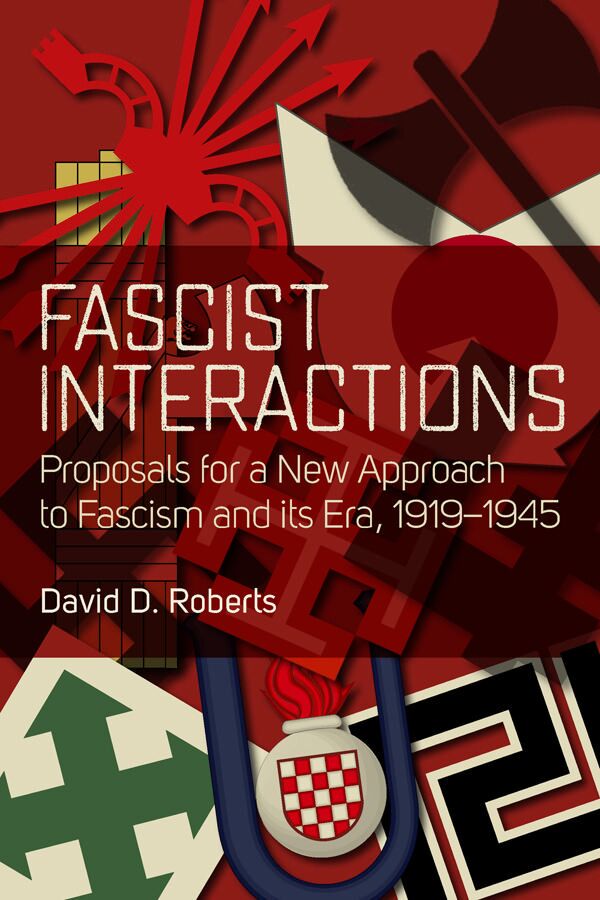
Fascist interactions
Although studies of fascism have constituted one of the most fertile areas of historical inquiry in recent decades, more and more scholars have called for a new agenda with more research beyond Italy and Germany, less preoccupation with definition and classification, and more sustained focus on the relationships among different fascist formations before 1945. Starting from a critical assessment of these imperatives, this rigorous volume charts a historiographical path that transcends rigid distinctions while still developing meaningful criteria of differentiation. Even as we take fascism seriously as a political phenomenon, such an approach allows us to better understand its distinctive contradictions and historical variations.
eBook