
Catalogue Search | MBRL


Are you sure you want to remove the book from the shelf?

{{itemTitle}}
829
result(s) for
"Fascism Italy History."
Sort by:

Mussolini's children : race and elementary education in Fascist Italy
\"\"Mussolini's Children\" uses modern theories of race and biopolitics and the lens of state-mandated youth culture--elementary education and the auxiliary organizations designed to mold the minds and bodies of Italy's children between the ages of five and eleven--to understand the evolution of Fascist racism\"-- Provided by publisher.
Book

Mussolini’s dream factory
The intersection between film stardom and politics is an understudied phenomenon of Fascist Italy, despite the fact that the Mussolini regime deemed stardom important enough to warrant sustained attention and interference. Focused on the period from the start of sound cinema to the final end of Fascism in 1945, this book examines the development of an Italian star system and evaluates its place in film production and distribution. The performances and careers of several major stars, including Isa Miranda, Vittorio De Sica, Amedeo Nazzari, and Alida Valli, are closely analyzed in terms of their relationships to the political sphere and broader commercial culture, with consideration of their fates in the aftermath of Fascism. A final chapter explores the place of the stars in popular memory and representations of the Fascist film world in postwar cinema.
eBook

Fascist Italy and the League of Nations, 1922-1935
\"This book analyses the relationship between Fascist Italy and the League of Nations in the interwar years. By uncovering the traces of those Italians working in the organization, this volume investigates Fascist Italy's membership of the League, and explores the dynamics between nationalism and internationalism in Geneva. The relationship between Fascist Italy and the League of Nations was contradictory, shifting from active collaboration to open disagreement. Previous literature has not reflected this oscillation in policy, focusing disproportionally on the problems Italy caused for the League, such as the Ethiopian crisis. Yet Fascist Italy remained in the League for more than fifteen years, and was the third largest power within the institution. How did a Fascist dictatorship fit into an organization espousing principles of liberal internationalism? By using archival sources from four countries, Elisabetta Tollardo shows that Fascist Italy was much more concerned with, and involved in, the League than currently believed\"--Bcak cover.
Book

The Crisis-Woman
Femininity in the form of the donna-crisi , or “crisis-woman,” was a fixture of fascist propaganda in the early 1930s. A uniquely Italian representation of the modern woman, she was cosmopolitan, dangerously thin, and childless, the antithesis of the fascist feminine ideal – the flashpoint for a range of anxieties that included everything from the changing social roles of urban women to the slippage of stable racial boundaries between the Italian nation and its colonies.
Using a rich assortment of scientific, medical, and popular literature, Natasha V. Chang’s The Crisis-Woman examines the donna-crisi ’s position within the gendered body politics of fascist Italy. Challenging analyses of the era which treat modern and transgressive women as points of resistance to fascist power, Chang argues that the crisis-woman was an object of negativity within a gendered narrative of fascist modernity that pitted a sterile and decadent modernity against a healthy and fertile fascist one.
eBook
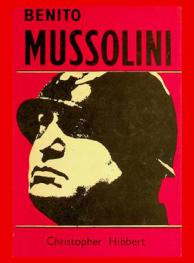
Benito Mussolini : a biography
Benito Mussolini, the son of a peasant, held absolute rule over the Italian nation for the best part of a generation, and played a leading role in high world drama. What happened to Italy was therefore in the fullest sense his personal responsibly, and by this history whose ultimate verdict was his constant self-conscious preoccupation must judge him. The clue to his character as revealed in this remarkable detailed biography is to be found in a web almost pathological contradictions.

The Historic Imaginary
Focusing on both ritual and mass-visual representations of history in 1920s and 1930s Italy,The Historic Imaginaryunveils how Italian Fascism sought to institutionalize a modernist culture of history. The study takes a new historicist and microhistorical approach to cultural-intellectual history, integrating theoretical tools of analysis acquired from visual-cultural studies, art history, linguistics, and reception theory in a sophisticated examination of visual modes of historical representation - from commemorations to monuments to exhibitions and mass-media - spanning the entire period of the Italian-fascist regime.
Claudio Fogu argues that the fascist historic imaginary was intellectually rooted in the actualist philosophy of history elaborated by Giovanni Gentile, culturally grounded in Latin-Catholic rhetorical codes, and aimed at overcoming both Marxist and liberal conceptions of the relationship between historical agency, representation, and consciousness. The book further proposes that this modernist vision of history was a core element of fascist ideology, encapsulated by the famous Mussolinian motto that \"fascism makes history rather than writing it,\" and that its institutionalization constituted a key point of intersection between the fascist aesthetization and sacralization of politics. The author finally claims that his study of fascist historic culture opens the way to an understanding and re-evaluation of the historical relationship between the modernist critique of historical consciousness and the rise of post-modernist forms of temporality.
eBook


The Fascist Effect
During the interwar period, Japanese intellectuals, writers, activists, and politicians, although conscious of the many points of intersection between their politics and those of Mussolini, were ambivalent about the comparability of Imperial Japan and Fascist Italy.InThe Fascist Effect, Reto Hofmann uncovers the ideological links that tied Japan to Italy, drawing on extensive materials from Japanese and Italian archives to shed light on the formation of fascist history and practice in Japan and beyond. Moving between personal experiences, diplomatic and cultural relations, and geopolitical considerations, Hofmann shows that interwar Japan found in fascism a resource to develop a new order at a time of capitalist crisis.
Japanese thinkers and politicians debated fascism as part of a wider effort to overcome a range of modern woes, including class conflict and moral degeneration, through measures that fostered national cohesion and social order. Hofmann demonstrates that fascism in Japan was neither a European import nor a domestic product; it was, rather, the result of a complex process of global transmission and reformulation. By focusing on how interwar Japanese understood fascism, Hofmann recuperates a historical debate that has been largely disregarded by historians, even though its extent reveals that fascism occupied a central position in the politics of interwar Japan. Far from being a vague term, as postwar historiography has so often claimed, for Japanese of all backgrounds who came of age from the 1920s to the 1940s, fascism conjured up a set of concrete associations, including nationalism, leadership, economics, and a drive toward empire and a new world order.
During the interwar period, Japanese intellectuals, writers, activists, and politicians, although conscious of the many points of intersection between their politics and those of Mussolini, were ambivalent about the comparability of Imperial Japan and Fascist Italy. InThe Fascist Effect, Reto Hofmann uncovers the ideological links that tied Japan to Italy, drawing on extensive materials from Japanese and Italian archives to shed light on the formation of fascist history and practice in Japan and beyond. Moving between personal experiences, diplomatic and cultural relations, and geopolitical considerations, Hofmann shows that interwar Japan found in fascism a resource to develop a new order at a time of capitalist crisis.Japanese thinkers and politicians debated fascism as part of a wider effort to overcome a range of modern woes, including class conflict and moral degeneration, through measures that fostered national cohesion and social order. Hofmann demonstrates that fascism in Japan was neither a European import nor a domestic product; it was, rather, the result of a complex process of global transmission and reformulation. By focusing on how interwar Japanese understood fascism, Hofmann recuperates a historical debate that has been largely disregarded by historians, even though its extent reveals that fascism occupied a central position in the politics of interwar Japan. Far from being a vague term, as postwar historiography has so often claimed, for Japanese of all backgrounds who came of age from the 1920s to the 1940s, fascism conjured up a set of concrete associations, including nationalism, leadership, economics, and a drive toward empire and a new world order.
eBook

A bold and dangerous family : the remarkable story of an Italian mother, her two sons, and their fight against fascism
Mussolini was not only ruthless- he was subtle and manipulative. Black-shirted thugs did his dirty work for him- arson, murder, destruction of homes and offices, bribes, intimidation and the forcible administration of castor oil. His opponents - including editors, publishers, union representatives, lawyers and judges - were beaten into submission. But the tide turned in 1924 when his assassins went too far, horror spread across Italy and twenty years of struggle began. Antifascist resistance was born and it would end only with Mussolini's death in 1945. Among those whose disgust hardened into bold and uncompromising resistance was a family from Florence- Amelia, Carlo and Nello Rosselli.Caroline Moorehead's research into the Rossellis struck gold. She has drawn on letters and diaries never previously translated into English to reveal - in all its intimacy - a family driven by loyalty, duty and courage, yet susceptible to all the self-doubt and fear that humans are prey to. Readers are drawn into the lives of this remarkable family - and their loves, their loyalties, their laughter and their ultimate sacrifice.
Book

Mussolini, Architect
During the fascist years in Italy, architecture and politics enjoyed a close alliance. Benito Mussolini used architecture to educate the masses, exploiting its symbolic prowess as a powerful tool for achieving political consensus.
Mussolini, Architect examines Mussolini in Italy from 1922 to 1943 and expands the traditional interpretations of fascism, advancing the claim that Mussolini devised and implemented architecture as a tool capable of determining public behaviour and influencing opinion. Paolo Nicoloso challenges the assertion that Mussolini was of minimal influence on Italian architecture and argues that in fact the fascist leader played a strong role in encouraging civic architectural development in order to reflect the totalitarian values of the period. Drawing on archival documents, Nicoloso lists the architects who gave Mussolini ideas and describes the times when the dictator himself sometimes picked up a pencil and suggested changes.
Examining the political, social, and architectural history of the fascist period, Mussolini, Architect gives careful attention to the final years of fascist rule in order to demonstrate the extent to which Mussolini was intent on shaping Italy and its citizens through architectural projects.
eBook