
Catalogue Search | MBRL


Are you sure you want to remove the book from the shelf?

{{itemTitle}}
2,004
result(s) for
"Fascism and education"
Sort by:

Mussolini's children : race and elementary education in Fascist Italy
\"\"Mussolini's Children\" uses modern theories of race and biopolitics and the lens of state-mandated youth culture--elementary education and the auxiliary organizations designed to mold the minds and bodies of Italy's children between the ages of five and eleven--to understand the evolution of Fascist racism\"-- Provided by publisher.
Book
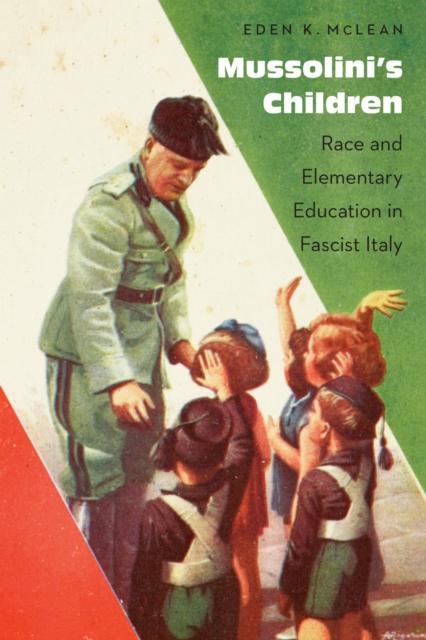
Mussolini's children
\"\"Mussolini's Children\" uses modern theories of race and biopolitics and the lens of state-mandated youth culture--elementary education and the auxiliary organizations designed to mold the minds and bodies of Italy's children between the ages of five and eleven--to understand the evolution of Fascist racism\"--.
eBook
Walter Benjamin's Antifascist Education
\"Walter Benjamin's Antifascist Education is the first comprehensive analysis of educational themes across the entirety of the critical theorist's diverse writings. Starting with Benjamin's early reflections on teaching and learning, Tyson E. Lewis argues that the aesthetic and cultural forms to which Benjamin so often turned-namely, radio broadcasts, children's theatrical productions, collections, cityscapes, public cinemas, and word games-swell with educational potentialities. What emerges from Lewis's reading is a constellational curriculum composed of minor practices such as poor teaching, absentminded learning, and nondurational studying. This curriculum carries political significance, offering an antidote to past and present forms of fascist manipulation, hardness, and coldness. Walter Benjamin's Antifascist Education is a testimony to Benjamin's belief that \"everyone is an educator and everyone needs to be educated and everything is education.\"\"--.
eBook
Darker Legacies of Law in Europe
The legal scholarship of the National Socialist and Fascist period of the 20th century and its subsequent reverberation throughout European law and legal tradition has recently become the focus of intense scholarly discussion. This volume presents theoretical,historical and legal inquiries into the legacy of National Socialism and Fascism written by a group of the leading scholars in this field. Their essays are wide-ranging, covering the reception of National Socialist and Fascist ideologies into legal scholarship; contemporary perceptions of Nazi Law in the Anglo-American world; parallels and differences among authoritarian regimes in the Third Reich, Austria, Italy, Spain, and Vichy-France; how formerly authoritarian countries have dealt with their legal antecedents; continuities and discontinuities in legal thought in private law, public law, labour law, international and European law; and the legal profession’s endogenous obedience and the pains of Vergangenheitsbewältigung. The majority of the contributions were first presented at a conference at the EUI in the autumn of 2000, the others in subsequent series of seminars.
eBook

Shaping the new man
Despite their undeniable importance, the leaders of the Fascist and Nazi youth organizations have received little attention from historians. In
Shaping the New Man , Alessio Ponzio uncovers the largely untold story of the training and education of these crucial protagonists of the Fascist and Nazi regimes, and he examines more broadly the structures, ideologies, rhetoric, and aspirations of youth organizations in Fascist Italy and Nazi Germany. Ponzio shows how the Italian Fascists' pedagogical practices influenced the origin and evolution of the Hitler Youth. He dissects similarities and differences in the training processes of the youth leaders of the Opera Nazionale Balilla, Gioventù Italiana del Littorio, and Hitlerjugend. And, he explores the transnational institutional interactions and mutual cooperation that flourished between Mussolini's and Hitler's youth organizations in the 1930s and 1940s.
eBook

Ivan Ilyin: fascist or ideologue of the White Movement utopia?
The present article is an attempt at a closer reading of Ivan Ilyin’s relationship to fascism. This is explored primarily through a selection of articles in which Ilyin wrote in positive terms of Italian fascism, and in one case also of German National Socialism. The author of this article first presents a summary of relevant historical and biographical information, revealing that although Ilyin praised fascism in his articles, his personal experience of German Nazism was negative. This is followed by an examination of Ilyin’s own concept of fascism, concluding that it in fact derived from his understanding of the Russian White Movement. The examination focuses on three selected aspects, key notions for both fascism and Ilyin’s philosophy: the principle of the leader, the idea of the elite and the notion of chivalry, and nationalism and anti-Semitism. This analysis demonstrates that Ilyin drew upon idealized versions of these concepts, as integral parts of his projected utopian vision of a future Russia.
Journal Article

Education, Pedagogy, & the ‘F’ Word
This study takes up Paul Gilroy’s recent call to take seriously the political problem of fascism in the contemporary conjuncture as an educational problem. Specifically, the study will begin with analytic work to identify a set of guideposts that delineate the political logics of fascism. It will then examine the still under-developed theoretical work examining the political problem of contemporary fascism as an educational problem. And, it will attempt to advance this necessary work by tracing the outline of an antifascist educational project. It will be argued that an anti-fascist educational project must, in the short-term, develop polemical strategies that articulate a new set of political logics to challenge the increasingly cemented fascist logics at work today and, in the long-term, advance structural changes to educational institutions organized around normative aims of humane and humanizing education, morality and responsibility, and sociological knowledge.
Journal Article

Bowling for Fascism
Using newly collected data on association density in 229 towns and cities in interwar Germany, we show that denser social networks were associated with faster entry into the Nazi Party. The effect is large: one standard deviation higher association density is associated with at least 15 percent faster Nazi Party entry. Party membership, in turn, predicts electoral success. Social networks thus aided the rise of the Nazis that destroyed Germany’s first democracy. The effects of social capital depended on the political context: in federal states with more stable governments, higher association density was not correlated with faster Nazi Party entry.
Journal Article

The Political Origins of Primary Education Systems: Ideology, Institutions, and Interdenominational Conflict in an Era of Nation-Building
This paper is concerned with the development of national primary education regimes in Europe, North America, Latin America, Oceania, and Japan between 1870 and 1939. We examine why school systems varied between countries and over time, concentrating on three institutional dimensions: centralization, secularization, and subsidization. There were two paths to centralization: through liberal and social democratic governments in democracies, or through fascist and conservative parties in autocracies. We find that the secularization of public school systems can be explained by path-dependent state-church relationships (countries with established national churches were less likely to have secularized education systems) but also by partisan politics. Finally, we find that the provision of public funding to private providers of education, especially to private religious schools, can be seen as a solution to religious conflict, since such institutions were most common in countries where Catholicism was a significant but not entirely dominant religion.
Journal Article

Trans Bans Expand: Anti-LGBTIQ+ Lawfare and Neo-fascism
Introduction
Anti-fascist theories suggest different
meanings
for anti-LGBTIQ+ rights laws. This paper explores how 2023 increases in US anti-LGBTIQ+ bill attempts can be explained.
Methods
A Critical Discourse Analysis of 1054 US anti-LGBTIQ+ state-level bill submissions from 1 Jan 2018 to 31 December 2023, compared 2023 trends to previous data.
Results
The co-ordinated neofascist mobilisation behind US hyper-productivity and erratic contradictory justifications of anti-LGBTIQ+ bills expanded exponentially, emphasising less resisted campaigns. Initially smaller bills targeted political weak spots: transgender youth in primary schools, bathrooms and politically enabling Republican-governed states. Increasingly bills expanded in number, frequency, size, and punitive reach against LGBTIQ+ and other citizens’ rights, in wider contexts (higher education, public and Democrat-governed spaces). By 2023, bill strategies used hypocritical and hypothetical anti-LGBTIQ+ logics; replicated federally to thwart democratic and economic structures.
Conclusions
Anti-fascist, Queer and critical socialist theories explained the 2023 bills’ increase as building upon past partisan mobilisation on wedge transgender state election issues; towards neofascist diminishment of increasingly wider-ranging and higher-level US democratic structures, rights protections, and economic functioning. Policy attacks on vulnerable social groups’ rights — particularly trans youth — can signal ‘early stages’ within neo-fascist strong-man state-identity creation supporting democratic structure diminishments.
Policy Implications
Multi-level multi-cultural pluralist democratic institutions and support structures with inter-reinforced rights recognition expansions should be required by and should protect the rights of all citizens.
Journal Article