
Catalogue Search | MBRL


Are you sure you want to remove the book from the shelf?

{{itemTitle}}
773
result(s) for
"Fashion prints"
Sort by:

Fashion plates : 150 years of style
\"Prior to the invention of photography, European and American magazines used colorful prints to depict the latest fashion trends. These illustrations, known as \"fashion plates,\" conveyed the cutting-edge styles embraced by the fashion-conscious elite and proved inspirational to the upwardly mobile. Fashion Plates: 150 Years of Style is a comprehensive survey containing 200 fashion plates, many reproduced at actual size, from publications dating from 1778 to the early 20th century. A number of these charming illustrations are extremely rare, and have not appeared in print since their publication in the periodicals in which they first ran. Organized chronologically and featuring both men's and women's garments, these lively and colorful vignettes not only are beautiful, but also clearly illustrate the evolution of fashion over time. Many of the plates were produced by important artists of the day, including Léon Bakst, George Barbier, and Georges Lepape. With texts by April Calahan on the social, political, and economic significance of fashion and its industries, and a foreword by award-winning fashion designer Anna Sui, this exquisite slipcased publication fills an important gap in the literature on the history of fashion and provides an entertaining historical overview for the general reader\"--Publisher's description.
Book
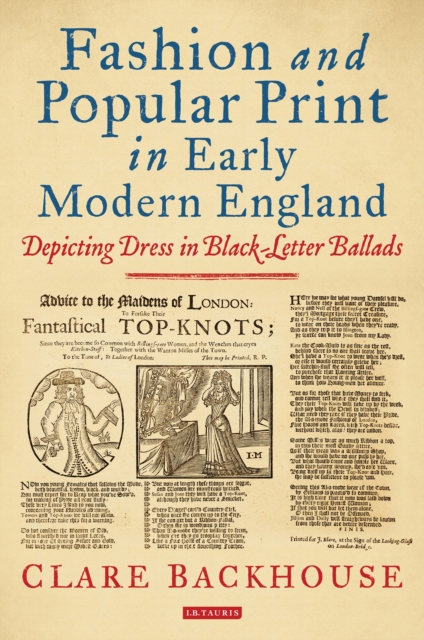
Fashion and Popular Print in Early Modern England
Fashion featured in black-letter broadside ballads over a hundred years before fashion magazines appeared in England. In the seventeenth century, these single-sheet prints contained rhyming song texts and woodcut pictures, accessible to almost everyone in the country. Dress was a popular subject for ballads, as well as being a commodity with close material and cultural connections to them.This book analyses how the distinctive words and images of these ballads made meaning, both in relation to each other on the ballad sheet and in response to contemporary national events, sumptuary legislation, religious practice, economic theory, the visual arts and literature. In this context, Clare Backhouse argues, seventeenth-century ballads increasingly celebrated the proliferation of print and fashionable dress, envisioning new roles for men and women in terms of fashion consumption and its importance to national prosperity. The book demonstrates how the hitherto overlooked but extensive source material that these ballads offer can enrich the histories of dress, art and culture in early modern England.
eBook

Fashion prints in the age of Louis XIV : interpreting the art of elegance
\"Analyzing French fashion prints and what these images represent and reveal about the fashion and culture of the seventeenth-century\"-- Provided by publisher.
Book

Representation of women of color on the covers of the top three fashion magazines: a content analysis
Purpose
This paper aims to assess the representation of women of color (WOC) in the top 3 fashion magazines and explore the implications of underrepresentation within marketing communications. The authors draw from diffusion theory and marketplace omission and commission to situate the research focus and highlight its application to the study findings.
Design/methodology/approach
A content analysis was conducted on 481 cover models on the top three fashion magazines of 2018 – Vogue, Cosmopolitan and Vanity Fair during 2006–2018.
Findings
The findings indicate WOC are underrepresented despite the strides of inclusion in the marketplace in America during a postracial period. Representation is as follows: white – 412 (86%); black – 41 (9%); Latina – 19 (3.9%); biracial 7 (1.5%); Asian – 1 (0.2%); and Native American – 1 (0.2%). Latina models had the lowest representation. Native and Asian women were completely excluded. When they do appear, black and Latina cover models are more likely than white models to be shown wearing sexually suggestive attire.
Practical implications
This study makes four recommendations to promote antiracism in marketing: diversify staff hiring and editorial decision-makers for public-facing talent; solicit counsel from multicultural marketing agencies; create antiracist marketing curriculum; and cultivate a pipeline of diverse talent for future hiring.
Originality/value
The originality of this paper centers its contribution to the dearth research investigating representation implications within the fashion marketing industry during an alleged post-racial period, and a longer time span. It also presents structured antiracist marketing solutions to mitigate underrepresentation.
Journal Article

Brain–computer-interface-driven artistic expression: real-time cognitive visualization in the pangolin scales animatronic dress and screen dress
This paper explores the intersection of brain–computer interfaces (BCIs) and artistic expression, showcasing two innovative projects that merge neuroscience with interactive wearable technology. BCIs, traditionally applied in clinical settings, have expanded into creative domains, enabling real-time monitoring and representation of cognitive states. The first project showcases a low-channel BCI Screen Dress, utilizing a 4-channel electroencephalography (EEG) headband to extract an engagement biomarker. The engagement is visualized through animated eyes on small screens embedded in a 3D-printed dress, which dynamically responds to the wearer’s cognitive state. This system offers an accessible approach to cognitive visualization, leveraging real-time engagement estimation and demonstrating the effectiveness of low-channel BCIs in artistic applications. In contrast, the second project involves an ultra-high-density EEG (uHD EEG) system integrated into an animatronic dress inspired by pangolin scales. The uHD EEG system drives physical movements and lighting, visually and kinetically expressing different EEG frequency bands. Results show that both projects have successfully transformed brain signals into interactive, wearable art, offering a multisensory experience for both wearers and audiences. These projects highlight the vast potential of BCIs beyond traditional clinical applications, extending into fields such as entertainment, fashion, and education. These innovative wearable systems underscore the ability of BCIs to expand the boundaries of creative expression, turning the wearer’s cognitive processes into art. The combination of neuroscience and fashion tech, from simplified EEG headsets to uHD EEG systems, demonstrates the scalability of BCI applications in artistic domains.
Journal Article
Artistic connections: Re-framing printed textile design processes for fashion based on the Chintz
In an era dominated by tidal waves of visual stimuli across various digital platforms, we find ourselves scrolling and swiping incessantly. Images flicker momentarily before disappearing, stored away in unseen databases. When we consider imagery related to fashion, particularly printed textiles, we observe that these pieces also showcase a multitude of visuals but, unlike their digital counterparts, printed textiles are permanently situated within a specific time and place. This permanence highlights a stark contrast with the rising tide of fashion waste, revealing the fleeting nature of our throwaway culture. Print lies at the core of the waste crisis in today's fashion landscape. Alarming statistics surrounding fashion production and waste underscore the issue; printed garments are disposed of just as swiftly as digital images are scrolled into oblivion. Wearing printed art is both majestic and powerful, yet contemporary fashion seems to be out of sync with this value. This research delves into the illustrious chintz, a motif that has maintained its appeal over centuries and has been cherished in the realm of fashion. An exploration of this motif and its applications on fabric reveals concepts of artistry, upcycling and the appreciation of printed pieces as heirlooms. This paper draws on historical lessons that could inform our modern approach to print design in fashion today, creating a bridge between textile artistry and fashion design while fostering deeper connections with garments through interaction with established print techniques.
Journal Article

“West Virginia Tin Man”: The Life and Art of Robert Villamagna
This is the story of tragedy and triumph. The one constant thing Robert Villamagna recognized in his life was that making art was as essential to him as needing to drink water, and if he loved art that much then he should pursue an art career. At every part of his life obstacles delayed him in pursuing his artistic goals, but he ultimately triumphed, creating compelling assemblage art works and earning the nickname the “West Virginia Tin Man.” His work is a mirror revealing a culture found throughout eastern Ohio and the northern panhandle of West Virginia, but his work speaks to a larger population of 1960’s blue-collar American culture.
Journal Article

Does Advertising Spending Influence Media Coverage of the Advertiser?
Recent studies have shown that consumers' product choices are significantly influenced by media coverage and recommendations in various media outlets. Unlike advertising, consumers perceive these sources as neutral and more credible because they usually presume that editorial content and product coverage in newspapers and magazines are independent and free from advertisers' influence. In this article, the authors show how advertising activities of firms may influence media coverage to the firms' advantage. They analyze a recent (2002-2003) large data set comprising 291 fashion companies based in Italy and their advertising and product coverage data published in newspapers and magazines of 123 publishers from Italy, France, Germany, the United Kingdom, and the United States. Controlling for firm heterogeneity, endogeneity, and the simultaneity of advertising and coverage, the authors find that, overall, (1) there is evidence of a strong positive influence of advertising on coverage, (2) publishers that depend more on a specific industry for their advertising revenues are prone to a higher degree of influence from their corporate advertisers than others, (3) peer pressures from competing publishers affect coverage decisions, (4) larger and more innovative companies are at an advantage for obtaining coverage for their products, and (5) the effects of corporate advertising influence exist in both Europe and the United States. These findings raise concerns about the independence of editorial content and coverage of magazines.
Journal Article

The language of luxury fashion advertising: technology of the self and spectacle
PurposeUbiquitous Internet access and social media make visual consumption possibly the most vital characteristic of the experience economy. A cumulative, integrative framework for the analysis of visual artefacts has thus been called for as existing analytical tools and theoretical frameworks (such as semiotics, discourse analysis, content analysis, iconography, rhetoric and so on) each provide in isolation only a restricted perspective. To advance best practice towards shaping brand perception and consumer engagement, this paper provides a crucial analytical tool to uncover the unique and specific characteristics of identitary luxury fashion brand discourse by introducing and applying such an integrative framework.Design/methodology/approachA rigorous grounded theory approach was applied to a corpus of primary data, print advertising in Vogue (UK and US) and Vanity Fair (UK). Outcomes were distilled to first principles of meaning-making and aggregated in a framework which also integrates long-existing classics from diverse fields of knowledge to present a broad cumulative perspective for the analysis of visual discursive practice. This paper demonstrates the methodological rigour and validity of the framework, that is, its practical adequacy and explanatory power in uncovering the identitary brand discourse of luxury fashion.FindingsAn application of the integrative framework breaks new ground in uncovering the discreet identitary characteristics of the discursive practice of the luxury brands under investigation, Chanel and Gucci, which can be encapsulated as gendered technology of the confident self (Foucault) and spectacle (Debord), respectively.Research limitations/implicationsTo advance theory that illuminates understanding and shaping of brand perception and consumer engagement with luxury fashion brands, the proposed framework is the first to integrate insight from a rigorous analysis of primary data with long-existing classics from salient fields of knowledge. It, thus, provides a broader, more inclusive perspective that elucidates the multifaceted layers of meaning of luxury fashion discourse in a new and comprehensive way which existing approaches with focus on an isolated dimension such as semiotics or nonverbal behaviour and so on would not have been able to reveal.Practical implicationsThe inclusive, practicable theoretical framework provides a parsimonious and practical tool that can be applied by non-experts across disciplines to unlock meaning in fashion discourse as a route to shaping brand image and engaging consumers.Originality/valueThe paper provides a new perspective on the communication practice of luxury fashion advertising as the new integrative framework illuminates layers of meaning crucial to understanding the intricacies of identitary brand discourse and to shaping brand perception and engaging consumers.
Journal Article
