
Catalogue Search | MBRL


Are you sure you want to remove the book from the shelf?

{{itemTitle}}
4,094
result(s) for
"Fear of death"
Sort by:


Relationship between death anxiety and spiritual intelligence: the potential mediating role of meaning of life and resilience in Iranian older people
Introduction
The older people, as one of the vulnerable groups in society, face various challenges. Paying attention to their needs and issues during this period of life can improve their quality of life and mental health. This study aimed to investigate the relationship between death anxiety and spiritual intelligence with the potential mediating role of the search for meaning and resilience among Iranian older people.
Methods
This descriptive-correlational study was conducted on 348 older people over 60 years old in Zanjan, Iran, in 2024. The participants were selected using the Cochran formula. The instruments used in this study were the Spiritual Intelligence Scale, the Death Anxiety Scale, the Meaning in Life Questionnaire, and the Connor-Davidson Resilience Scale. Data analysis was performed using Pearson correlation coefficient and path analysis.
Results
The results showed a significant negative correlation between spiritual intelligence and death anxiety. In addition, the two variables of search for meaning and resilience played a potential mediating role in the relationship between spiritual intelligence and death anxiety. The goodness-of-fit indices of the final research model indicated a good fit, confirming the significance of the research hypotheses.
Conclusion
Based on the results, it is suggested that conducting educational programs for the older people and their families can help control death anxiety and enhance spiritual intelligence. This action can improve the quality of life and reduce psychological distress among the older people.
Journal Article

The inevitable : contemporary writers confront death
Birth is not inevitable. Life certainly isn't. The sole inevitability of existence, the only sure consequence of being alive, is death. In these eloquent and surprising essays, twenty writers face this fact, among them Geoff Dyer, who describes the ghost bikes memorializing those who die in biking accidents; Jonathan Safran Foer, proposing a new way of punctuating dialogue in the face of a family history of heart attacks and decimation by the Holocaust; Mark Doty, whose reflections on the art-porn movie Bijou lead to a meditation on the intersection of sex and death epitomized by the AIDS epidemic; and Joyce Carol Oates, who writes about the loss of her husband and faces her own mortality. Other contributors include Annie Dillard, Diane Ackerman, Peter Straub, Brenda Hillman, and Terry Castle. Distributed by Syndetic Solutions, Inc.
Book

Fear of death and its relationship to resilience in nursing students: A longitudinal study
Taking a corpus of nursing students enrolled in the 2017−2021 nursing degree, we aim to analyse how students' levels of resilience and fear of death evolve in the first three years of the degree and whether there are differences between students based on age and gender. In addition, we aim to describe the relationship between resilience and fear of death.
Throughout their training, nursing students will encounter situations of grief and death that may generate reactions of rejection, anxiety and emotional imbalance. Recognising and controlling these emotions through specialised training in end-of-life care and fostering resilience is essential.
Comparative, correlational and longitudinal study.
Our corpus comprised 100 nursing students who were followed through the first three years of their training. Data were collected using a sociodemographic questionnaire, the Collet-Lester Fear of Death Scale and the Resilience Scale.
The corpus reported medium-high levels of fear of death overall. Patterns were similar for all academic years: fear of other people's death was invariably the highest scoring subscale; and while individual dimensions of the Collet-Lester scale correlated directly and significantly with each other they were found to be inversely related to student age. High levels of resilience were recorded and were highest in the final year.
In this sample of student nurses, fear of death and resilience do not appear to be related to each other. Nursing education must include training specifically targeted at increasing levels of resilience and decreasing fear of death to improve end-of-life care.
Journal Article


Analysis of Nurses’ Attitudes toward Patient Death
(1) The aim of the study was to analyze nurses’ attitudes toward a patient’s death, taking into account the emotions they experience and the general perception of death. (2) The study involved 516 nurses from the West Pomeranian Voivodeship in Poland. The research was carried out using the diagnostic survey method using The Death Attitudes Profile Revisited (DAP-R-PL), the Scale of Fear and Fascination with Death, and a demographic questionnaire. (3) Research has shown that nurses accept the phenomenon of death as a natural process of human life; however, they adopt the attitude of fear of death. Most of the respondents experienced: sadness (73.4%), helplessness (58.5%), and regret (43.6%) due to the patient’s death. (4) Both age, sex, marital status, and place of residence significantly influenced the attitudes of nurses toward the patient’s death. Therefore, it is important to provide psychological support or special education in the case of dealing with the fear of death.
Journal Article

Things Jolie needs to do before she bites it
\"Jolie's a lot of things, but she knows that pretty isn't one of them. She has mandibular prognathism, which is the medical term for underbite. Chewing is a pain, headaches are a common occurrence, and she's never been kissed. She's months out from having a procedure to correct her underbite, and she cannot wait to be fixed. Jolie becomes paralyzed with the fear that she could die under the knife. She and her best friends, Evelyn and Derek, decide to make a \"Things Jolie Needs to Do Before She Bites It (Which Is Super Unlikely, but Still, It Could Happen)\" list. Things like: eat every appetizer on the Applebee's menu and kiss her crush Noah Reed. But since when did everything ever go exactly to plan? Filled with humor, heart--and an honest look at today's beauty standards--Jolie's journey is a true feel-good story\"--Jacket flap.
Book

Associations between death anxiety and fear of illness progression or recurrence: A protocol for a systematic review and meta-analysis
Fear of progression or recurrence of chronic physical illness has been associated with negative mental health outcomes across several conditions. Qualitative research suggests that the fear of death (i.e., death anxiety) may be associated with fear of illness progression or recurrence. However, a systematic evaluation of the relationship between fear of illness progression or recurrence and death anxiety is currently lacking. This protocol is for a systematic review of peer-reviewed, quantitative research examining associations between death anxiety and fear of illness progression or recurrence of chronic physical illnesses. Where possible, the strength of these associations will be tested through meta-analysis.
A systematic search of quantitative studies written in English will be conducted across six academic databases: MEDLINE; PsycINFO; PubMed; Web of Science; CINAHL; EMBASE. Each record will be screened for eligibility by two authors. Data extraction and quality assessment, using the Joanna Briggs Inventory Risk of Bias tool, will similarly be performed by two authors, with discrepancies being resolved through discussion and consensus with a third author, REM. Data will be synthesised narratively, according to Cochrane guidelines, by which sample characteristics, measurement tools for both death anxiety and fear of illness progression or recurrence, and associations between death anxiety and fear of illness progression or recurrence will be described. Where sufficient data are available, meta-analysis will be conducted using Comprehensive Meta-Analysis Version 4. If there are sufficient studies (k = 4), additional analyses may examine whether the size of the relationship differs between illness types (e.g., life-threatening vs. non-life-threatening). Gender and age may also be examined as potential moderators of the effect, based on available reported data in the studies. The protocol has been registered in PROSPERO (CRD42024583393).
This systematic review will further the understanding of how death anxiety and fear of illness progression or recurrence interact, and will help to shape future fear of illness progression or recurrence research with the aim of improving the wellbeing of individuals living with chronic physical illness.
Journal Article
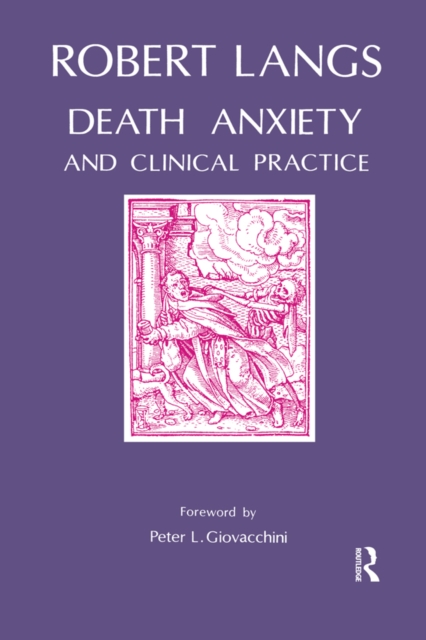
Death anxiety and clinical practice
Robert Langs argues that death anxiety is neglected - in part, because of treatment failures due to countertransference interferences during treatment. He then discusses the technical issues connected with this, whilst introducing the controversial concept that mental activities are derived from immune system activities.
eBook

Embedding existential psychology within psychedelic science: reduced death anxiety as a mediator of the therapeutic effects of psychedelics
Psychedelic therapies can engender enduring improvements in psychological well-being. However, relatively little is known about the psychological mechanisms through which the salutary effects of psychedelics emerge. Through integrating extant research on psychedelics with contemporary existential psychology, we present a novel hypothesis that reduced death anxiety may be a key mechanism underpinning the therapeutic effects of psychedelics. In developing this hypothesis, we also provide a complementary review of mechanisms through which psychedelics may reduce death anxiety. We conclude that an awareness of the role of death anxiety in psychopathology has the potential to guide future research into psychedelic therapies.
Journal Article