
Catalogue Search | MBRL


Are you sure you want to remove the book from the shelf?

{{itemTitle}}
7
result(s) for
"Femininity Social aspects Taiwan."
Sort by:

Identity politics and popular culture in Taiwan : a Sajiao generation
\"An interdisciplinary analysis of Taiwanese popular culture over the past two decades, examining various shifts in the country's identity politics\"--Provided by publisher.
Book

Identity politics and popular culture in Taiwan
In the past two decades, a uniform representation of cutified femininity prevails in the Taiwanese media, evidenced by the shift of Taiwan's popular cultural taste from a Chinese-centered tradition to a mixed absorption from neighboring cultural capitals in the global market. This book argues that the native term \"sajiao\" is the key to understand the phenomenon. Originally referring to a set of persuasive tactics through imitating a spoiled child's gestures and ways of speaking to get attention or material goods, sajiao is commonly understood to be women's weapon to manipulate men in the Mandarin-speaking communities. By re-interpreting sajiao as a \"feminine\" tactic, or the tactic of the weak, the book aims to propose a \"feminine framework\" in exploring identity politics in the following three aspects: the rising obsession with the immature female image in Taiwan's popular culture, the adoption of the feminine communication style in native speakers' everyday language and interactions, and the competing discourses between dominant/subordinate, central/peripheral, global/local, and Chinese/Taiwanese in shaping the identity politics in current Taiwanese society. The micro-analysis of everyday language politics leads the reader to examine layers of discourse about gender, identity, and communication, and finally to inquire how to situate or categorize \"Taiwan\" in area studies. The \"feminine framework\" is a useful theoretical tool that not only deconstructs everyday communication practice but also provides a bottom-up, alternative angle in analyzing Taiwan's role in political, economic, and cultural flows in East Asia.
The massive imports of popular cultural products in the late 80s, mainly from Japan, fermented the kawaii (Japanese cute) type of femininity in regulating everyday communication and the perception of gender roles in Taiwan. The popularity of the baby-like female image is concurrent with the simmering debate on Taiwanese identity. Taiwan offers a unique perspective for observing identity politics because it still holds an undetermined status in the international community. The collective uncertainty about the island's future and the diminishing voice in the international society become the backdrop for the growth of defining, interpreting, and appropriating sajiao elements in the popular culture. This book offers an in-depth examination of the interplay among local historical contexts, cross-border capitalist exchange, and everyday communication that shapes the dialogism of Taiwanese identity.
eBook

The Resilient Self
The Resilient Self explores how international migration re-shapes women’s senses of themselves. Chien-Juh Gu uses life-history interviews and ethnographic observations to illustrate how immigration creates gendered work and family contexts for middle-class Taiwanese American women, who, in turn, negotiate and resist the social and psychological effects of the processes of immigration and settlement. Most of the women immigrated as dependents when their U.S.-educated husbands found professional jobs upon graduation. Constrained by their dependent visas, these women could not work outside of the home during the initial phase of their settlement. The significant contrast of their lives before and after immigration—changing from successful professionals to foreign housewives—generated feelings of boredom, loneliness, and depression. Mourning their lost careers and lacking fulfillment in homemaking, these highly educated immigrant women were forced to redefine the meaning of work and housework, which in time shaped their perceptions of themselves and others in the family, at work, and in the larger community.
eBook

Bridging generations in Taiwan
This book examines identity change between two generations of Taiwanese women, one having come of age before Taiwan became an economic powerhouse, the other after. Biographies and lifestyle inventories were obtained from five mother-daughter pairs, and they show how women's lives have undergone revolutionary changes from the older to the younger generation.
eBook

Articulating Sexuality, Desire, and Identity: A Keyword Analysis of Heteronormativity in Taiwanese Gay and Lesbian Dating Websites
This paper discusses how the so-called social construct, i.e., the frame of heteronormativity, can be maintained, reproduced and enacted by language within same-sex dating communities in the twenty-first century. That is, we examine heteronormativity in discourse collected from two popular same-sex dating websites in Taiwan in order to analyze how heteronormative ideologies influence the linguistic construction of homosexual desires, dating preferences, and queer relationships. By scrutinizing the keywords in the corpora through the lens of Critical Discourse Analysis and Corpus Linguistics, we argue that there are still power relationships among Taiwanese gay men and lesbian women seeking romantic love online that are informed by heteronormative ideologies around gender within the scope of homosexuality. On the one hand, the keywords contain many binary roles providing conventional interactional modes for Taiwanese homosexual couples that show great similarity to those in heterosexual relationships. On the other hand, the analysis indicates that heteronormative constructions of masculinity and femininity are related to anxieties over mainstream preferences for dating on the two target websites.
Journal Article
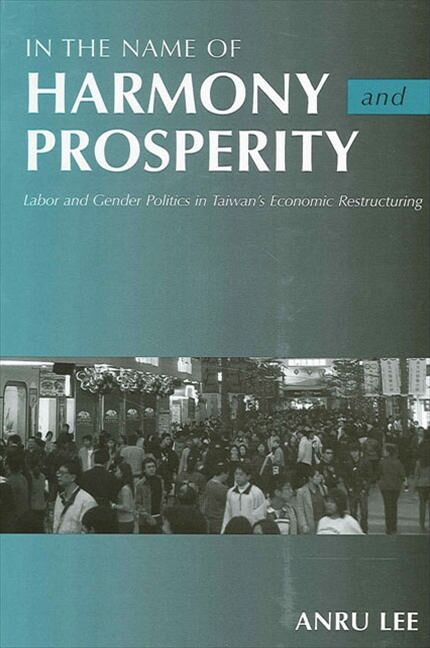
In the Name of Harmony and Prosperity
Since the 1980s Taiwan has grown into a global manufacturing powerhouse, a model of success that has inspired emulation throughout the developing world. Yet at the very peak of this expansion, Taiwan began to feel squeezed by changes both domestically and internationally. In the Name of Harmony and Prosperity examines Taiwan's economic restructuring since the late 1980s. Anru Lee discusses the latest phase of Taiwan's socio-economic development, most importantly the dialectical relationship between its export-oriented industrialization, change in production processes, and discourse on work ethics, including the subject formation of women workers as it relates to conditions in the global economy. At the center of this study is the process by which labor-capital relations become fair and legitimate, and how they contribute to our understanding of Asian capitalism and its role in the world economy.
eBook

Beautiful-and-Bad Woman: Media Feminism and the Politics of Its Construction
The misrecognition of her feminine performance as natural decreases the possibility of her advances in work.45 The Armani feminism or latte feminism advocated in Taiwan's international women's magazines also has to be contextualized within neocolonialism in which global capital (embodied in multinational advertising agencies and international women's magazines), with the help of (U.S.) state power, dissolves national boundaries in search of global subjects of consumption.
Journal Article