
Catalogue Search | MBRL


Are you sure you want to remove the book from the shelf?

{{itemTitle}}
44
result(s) for
"Feminism and higher education Canada."
Sort by:

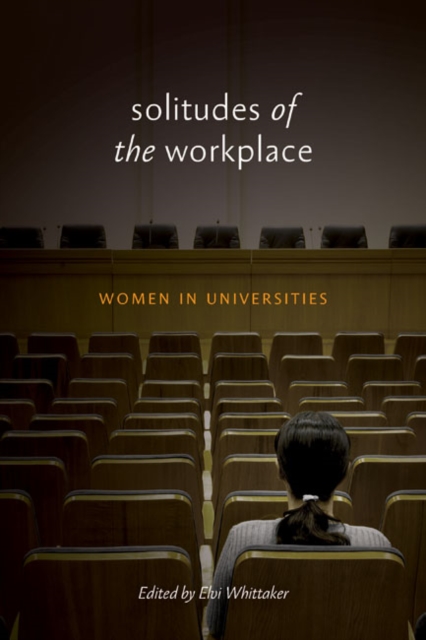
Solitudes of the Workplace
Solitudes of the Workplace focuses on experiences of marginalization, uncertainty and segregation created by the hierarchical structures of categories in universities and by gendered identities. Studying a wider range of women’s roles in universities than prior research, the experiences of support staff, senior administrators, researchers, non-academic administrators, and contract teachers are added to those of faculty and students. The essays show how attempts to introduce new knowledge are manoeuvered and the resistance this process can encounter, as well as the ways in which institutional policies can blur and change identities. Addressing longstanding issues such as the entanglement of gender and the assessment of merit, attention is also given to how new identities are claimed and successfully projected. Essays presenting workers' points of view reveal the confusion that occurs when official policy and everyday knowledge conflict, when processes like tenure and other status changes create troublesome realities, and when it becomes routine to experience status denigration. Within the social order of the university and its existing boundaries, gender issues of past decades sometimes surface, but all too often remain an unspoken presence. Solitudes of the Workplace is a revealing look at the isolating experiences and inequities inherent in these institutional environments.
eBook


Finding a Way to the Heart
Finding a Way to the Heart examines race, gender, identity, and colonization from the early nineteenth to the late twentieth century, and illustrates Sylvia Van Kirk's extensive influence on a generation of feminist scholarship.
eBook


Critical Literacy: Foundational Notes
This article traces the lineage of critical literacy from Freire through critical pedagogies and discourse analysis. It discusses the need for a contingent definition of critical literacy, given the increasingly sophisticated nature of texts and discourses.
Journal Article

Not drowning but waving : women, feminism and the liberal arts
\"Not Drowning But Waving...gestures both at the difficulties faced by feminists in the humanities in Canada and at the possibilities of hope, of new 'waves' of feminism.\" Twenty-two essays explore topics such as feminism in the liberal arts disciplines; the relationship of the liberal arts to the larger university; the costs and rewards for women in administration; the corporatization of university campuses; intergenerational and transcultural tensions within feminist communities; balancing personal life with professional aspirations; the relationship of feminism to cultural studies; women, social justice, and the liberal arts. Not Drowning But Waving is a welcome progress report on the variety of feminisms at work in academe and beyond. It provides crucial insights for university administrators, faculty, and literate non-specialists interested in the Arts and Humanities.\"--pub. desc.
Book

Contested Practice: Political Activism in Nursing and Implications for Nursing Education
Canadian nurses have a social mandate to address health inequities for the populations they serve, as well as to speak out on professional and broader social issues. Although Canadian nursing education supports the role of nurses as advocates for social justice and leadership for health care reform, little is known about how nurse educators understand activism and how this translates in the classroom. A comparative life history study using purposeful sampling and a critical feminist lens was undertaken to explore political activism in nursing and how nurse educators foster political practice among their students. Findings from interviews and focus groups with 26 Ontario nurse educators and nursing students suggested that neoliberal dynamics in both the practice setting and in higher education have constrained nurses’ activist practice and favour a technical rational approach to nursing education. Implications and strategies to inspire political action in nursing education are discussed.
Journal Article

Institutionalizing Public Scholarship: Lessons from Feminism and Symbolic Interactionism
This article contributes to recent debates about public sociology by considering the potential harmful consequences of seeking legitimacy for committed scholarship within academic institutions. After discussing public scholarship’s place within the corporate university, we reflect on how institutionalizing “scholarship with commitment” might create routine practices and standardized expectations that could discourage organic interactions with various publics. Feminism’s role in the academy exemplifies the consequences of institutionalizing committed scholarship. Drawing on insights from feminist and symbolic interactionist traditions and writing from a Canadian perspective, we discuss promising strategies for resisting the stagnation and/or habitualization of public and committed scholarship.
Journal Article

Research-Creation for the Community: Pedagogy, Feminist Maker Cultures, and the Critical Work of Making Face Masks in the Time of Covid-19
Some common themes of the class were: unequal access to resources depending on economic or socio-cultural backgrounds; issues with short-term problem-solving for climate crisis, natural resources, and natural/human/non-human ecologies; and a lack of transparency about processes of the capital circuit (production, distribution, consumption). In March 2020, my class and I noticed several news stories about essential objects in the pandemic, as well as various Canadian responses to these objects: i) a lack of Personal Protective Equipment (ppe) for frontline workers, especially items such as face masks, gowns, hair caps, and visors; ii) technological companies as small as start-ups and as large as gm helping to make ppe with industrial machines that usually construct things like car parts. [...]if reimagined as research-creation, the usually invisible forms of making that occur in socially \"private\" and feminized spaces of labour- such as sewing rooms, kitchens, and offices-must also be understood through the language that is more commonly applied to innovative tech companies: performing critical and creative thinking in production and applying material skills to produce new objects. [...]questions about stages of the capital circuit were combined with theoretical readings to ground class projects in critical thinking and design-or, to create what my colleague Marcel O'Gorman calls \"objects to think with\" One student, Oriana Confente, turned an unwanted keyboard matrix into a handbag, in response to planned obsolescence and unethical e-waste \"recycling\" Another student, Chelsea La Vecchia, patched up an old pair of jeans using a decades-old, \"obsolete\" sewing machine, such that the labour of sewing served to advocate for the right to repair and to retaliate against trends in fast fashion.
Journal Article