
Catalogue Search | MBRL


Are you sure you want to remove the book from the shelf?

{{itemTitle}}
23,081
result(s) for
"Feminism and literature"
Sort by:


Politics of the female body : postcolonial women writers of the Third World
Is it possible to simultaneously belong to and be exiled from a community? In \"\"Politics of the Female Body,\"\" Ketu H. Katrak argues that it is not only possible, but common, especially for women who have been subjects of colonial empires. Through her careful analysis of postcolonial literary texts, Katrak uncovers the ways that the female body becomes a site of both oppression and resistance. She examines writers working in the English language, including Anita Desai from India, Ama Ata Aidoo from Ghana, and Merle Hodge from Trinidad. The writers share colonial histories, a sense of solidarity, and resistance strategies in the on-going struggles of decolonization that center on the body. Bringing together a rich selection of primary texts, Katrak examines published novels, poems, stories, and essays, as well as activist materials, oral histories, pamphlets, and street theater scripts - forms that push against the boundaries of what is considered strictly literary. In these varied materials, she reveals common political and feminist alliances across geographic boundaries. A unique comparative look at women's literary work and its relationship to the body in third world societies, this text will be of interest to literary scholars and to those working in the fields of women's studies and human rights.
eBook


Family Matters
Adopting a comparative and multidisciplinary approach to Puerto Rican literature, Marisel Moreno juxtaposes narratives by insular and U.S. Puerto Rican women authors in order to examine their convergences and divergences. By showing how these writers use the trope of family to question the tenets of racial and social harmony, an idealized past, and patriarchal authority that sustain the foundational myth ofla gran familia,she argues that this metaphor constitutes an overlooked literary contact zone between narratives from both sides. Moreno proposes the recognition of a \"transinsular\" corpus to reflect the increasingly transnational character of the Puerto Rican population and addresses the need to broaden the literary canon in order to include the diaspora. Drawing on the fields of historiography, cultural studies, and gender studies, the author defies the tendency to examine these literary bodies independently of one another and therefore aims to present a more nuanced and holistic vision of this literature.
eBook


Men, Women, and Gods
Men, Women, and God(s) is a pioneering study of the Arab world's leading feminist and most controversial woman writer, Nawal El Saadawi. Author of plays, memoirs, and such novels as Woman at Point Zero and The Innocence of the Devil, El Saadawi has become well known in the West as well as in the Arab community for her unforgettable female heroes and explosive narratives, which boldly address sexual violence, female circumcision, theology, and other politically charged themes. Her outspoken feminism and critique of patriarchy have also earned her the wrath of repressive forces in the Middle East. Imprisoned in her native Egypt under Sadat, El Saadawi is now among those on the death lists of Islamic religious conservatives. In Men, Women, and God(s) Fedwa Malti-Douglas makes the work of this important but little-understood writer truly accessible. Contending that El Saadawi's texts cannot be read in isolation from their Islamic and Arabic heritage, Malti-Douglas draws upon a deep knowledge of classical and modern Arabic textual traditions--and on extensive conversations with Nawal El Saadawi--to place the writer within her cultural and historical context. With this impassioned and radical exegesis of El Saadawi's prolific output, Malti-Douglas has written a crucial study of one of the most controversial and influential writers of our time. This title is part of UC Press's Voices Revived program, which commemorates University of California Press's mission to seek out and cultivate the brightest minds and give them voice, reach, and impact. Drawing on a backlist dating to 1893, Voices Revived makes high-quality, peer-reviewed scholarship accessible once again using print-on-demand technology. This title was originally published in 1995. Many titles in the Voices Revived program are also newly available as ebooks, offered at a discounted price
to support wider access to scholarly work.
eBook

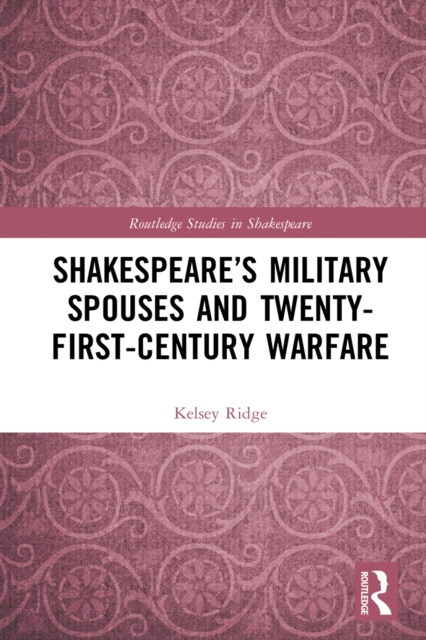
Shakespeare's Military Spouses and Twenty-First-Century Warfare
This volume presents a fresh look at the military spouses in Shakespeare’s Othello, 1 Henry IV, Julius Caesar, Troilus and Cressida, Macbeth, and Coriolanus, vital to understanding the plays themselves. By analyzing the characters as military spouses, we can better understand the current dynamics in modern American civilian and military culture as modern American military spouses live through the War on Terror. Shakespeare’s Military Spouses and Twenty-First-Century Warfare explains what these plays have to say about the role of military families and cultural constructions of masculinity both in the texts themselves and in modern America. Concerns relevant to today’s military families – domestic violence, PTSD, infertility, the treatment of queer servicemembers, war crimes, and the growing civil–military divide – pervade Shakespeare’s works. These parallels to the contemporary lived experience are brought out through reference to memoirs written by modern-day military spouses, sociological studies of the American armed forces, and reports issued by the Department of Defense. Shakespeare’s military spouses create a discourse that recognizes the role of the military in national defense but criticizes risky or damaging behaviors and norms, promoting the idea of a martial identity that permits military defense without the dangers of toxic masculinity. Meeting at the intersection of Shakespeare Studies, trauma studies, and military studies, this focus on military spouses is a unique and unprecedented resource for academics in these fields, as well as for groups interested in Shakespeare and theatre as a way of thinking through and responding to psychiatric issues and traumatic experiences.
eBook


Black Internationalist Feminism
Black Internationalist Feminism examines how African American women writers affiliated themselves with the post-World War II Black Communist Left and developed a distinct strand of feminism. This vital yet largely overlooked feminist tradition built upon and critically retheorized the postwar Left's nationalist internationalism, which connected the liberation of Blacks in the United States to the liberation of Third World nations and the worldwide proletariat. Black internationalist feminism critiques racist, heteronormative, and masculinist articulations of nationalism while maintaining the importance of national liberation movements for achieving Black women's social, political, and economic rights. Cheryl Higashida shows how Claudia Jones, Lorraine Hansberry, Alice Childress, Rosa Guy, Audre Lorde, and Maya Angelou worked within and against established literary forms to demonstrate that nationalist internationalism was linked to struggles against heterosexism and patriarchy. Exploring a diverse range of plays, novels, essays, poetry, and reportage, Higashida illustrates how literature is a crucial lens for studying Black internationalist feminism because these authors were at the forefront of bringing the perspectives and problems of black women to light against their marginalization and silencing. In examining writing by Black Left women from 1945 to 1995, Black Internationalist Feminism contributes to recent efforts to rehistoricize the Old Left, Civil Rights, Black Power, and second-wave Black women's movements.
eBook