
Catalogue Search | MBRL


Are you sure you want to remove the book from the shelf?

{{itemTitle}}
89
result(s) for
"Feminist poetry, American History and criticism."
Sort by:

A history of twentieth-century American women's poetry
\"A History of Twentieth-Century American Women's Poetry explores the genealogy of modern American verse by women from the early twentieth century to the millennium. Beginning with an extensive introduction that charts important theoretical contributions to the field, this History includes wide-ranging essays that illuminate the legacy of American women poets. Organized thematically, these essays survey the multilayered verse of such diverse poets as Edna St Vincent Millay, Marianne Moore, Anne Sexton, Adrienne Rich, and Audre Lorde. Written by a host of leading scholars, this History also devotes special attention to the lasting significance of feminist literary criticism. This book is of pivotal importance to the development of women's poetry in America and will serve as an invaluable reference for specialists and students alike\"-- Provided by publisher.
BOOK

Blue Studios
Examines the work of experimental poets and the
innovative forms they create to disrupt assumptions about gender
and cultural power In her now-classic
The Pink Guitar , Rachel Blau DuPlessis examined a number
of modern and contemporary poets and artists to explore the
possibility of finding a language that would question deeply held
assumptions about gender. In the 12 essays and introduction that
constitute
Blue Studios , DuPlessis continues that task, examining
the work of experimental poets and the innovative forms they have
fashioned to challenge commonplace assumptions about gender and
cultural authority. The essays in “Attitudes and
Practices” deal with two questions: what a feminist reading
of cultural texts involves, and the nature of the essay itself as
a mode of knowing: how poetry can be discursive and how the essay
can be poetic. The goal of “Marble Paper,” with its
studies of William Wordsworth, Ezra Pound, and Charles Olson is
to suggest terms for a “feminist history of poetry.”
“Perspectives must be fashioned that displace and estrange
the world,” Theodore Adorno wrote, and in the section
\"Urrealism\" DuPlessis examines the work of poets from several
schools (the Objectivists, the New York School, the surrealists)
whose work embodies that displacement, among them George Oppen,
Lorine Niedecker, H.D., and Barbara Guest. These writers’
radical deployment of line, sound, and structure, DuPlessis
argues, demonstrate poetry’s power not as a purely
literary, artistic, or aesthetic force but as a rhetorical form
intricately tied to issues of power and ethics. And in \"Migrated
Into,” the author probes the ways these issues have
informed her, as a poet and a critic; how the political has
“migrated into” and suffused her own work; and how
the practice of poetry can be an arousal to a deeper
understanding of what we stand for.
eBook

Translating poetic discourse : questions on feminist strategies in Adrienne Rich
Translating Poetic Discourse argues in favor of a critical model that bridges between translation and women's studies on theoretical and practical levels. It proposes key-elements to be integrated into the problem of interpretation of contemporary poetry by women, and discusses the links between gender markers and the speech situation in feminist discourse as a systematic problem. This book will be of interest to scholars of Translation Studies, Women's Studies, Poetry, Comparative Literature and Discourse.
eBook

The Feminist Avant-Garde in American Poetry
The Feminist Avant-Garde in American Poetryoffers a historical and theoretical account of avant-garde women poets in America from the 1910s through the 1990s and asserts an alternative tradition to the predominantly male-dominated avant-garde movements. Elisabeth Frost argues that this alternative lineage distinguishes itself by its feminism and its ambivalence toward existing avant-garde projects; she also thoroughly explores feminist avant-garde poets' debts and contributions to their male counterparts.
eBook

Lyric interventions : feminism, experimental poetry, and contemporary discourse
Lyric Interventions explores linguistically innovative poetry by contemporary women in North America and Britain whose experiments give rise to fresh feminist readings of the lyric subject. The works discussed by Linda Kinnahan explore the lyric subject in relation to the social: an “I” as a product of social discourse and as a conduit for change. Contributing to discussions of language-oriented poetries through its focus on women writers and feminist perspectives, this study of lyric experimentation brings attention to the cultural contexts of nation, gender, and race as they significantly shift the terms by which the “experimental” is produced, defined, and understood. This study focuses upon lyric intervention in distinct but related spheres as they link public and ideological norms of identity. Firstly, lyric innovations with visual and spatial realms of cultural practice and meaning, particularly as they naturalize ideologies of gender and race in North America and the post-colonial legacies of the Caribbean, are investigated in the works of Barbara Guest, Kathleen Fraser, Erica Hunt, and M. Nourbese Philip. Secondly, experimental engagements with nationalist rhetorics of identity, marking the works of Carol Ann Duffy, Denise Riley, Wendy Mulford, and Geraldine Monk, are explored in relation to contemporary evocations of “self” in Britain. And thirdly, in discussions of all of the poets, but particularly accenuated in regard to Guest, Fraser, Riley, Mulford, and Monk, formal experimentation with the lyric “I” is considered through gendered encounters with critical and avant-garde discourses of poetics. Throughout the study, Kinnahan seeks to illuminate and challenge the ways in which visual and verbal constructs function to make “readable” the subjectivities historically supporting white, male-centered power within the worlds of art, poetry, social locations, or national policy. The potential of the feminist, innovative lyric to generate linguistic surprise simultaneously with engaging risky strategies of social intervention lends force and significance to the public engagement of such poetic experimentation. This fresh, energetic study will be of great interest to literary critics and womens studies scholars, as well as poets on both sides of the Atlantic.
eBook
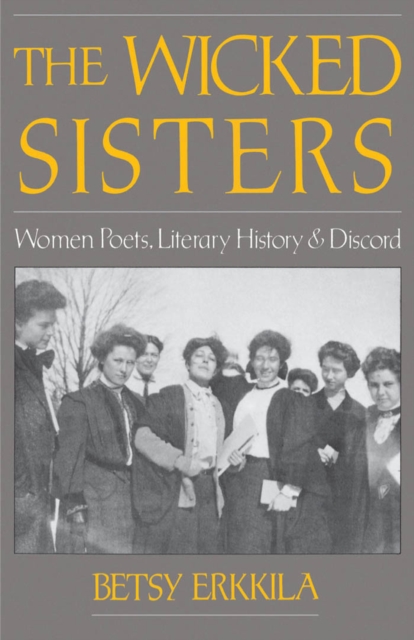
The Wicked Sisters
This provocative study of the lives and works of Emily Dickinson, Marianne Moore, Elizabeth Bishop, Adrienne Rich, and Gwendolyn Brooks focuses on the historical struggles and differences among and within women writers and among feminists themselves. Erkkila explores the troubled relations of women writers with both the masculine and feminine literary culture, arguing that popular feminist views romanticize and maternalize women writers. Offering a revisionary model of women’s literary history, Erkkila focuses on the historical struggles and conflicts that make up the history of women poets. Without discounting the historical power of sisterhood, she seeks to reclaim women’s literary history as a site of contention, contingency, and ongoing struggle, rather than a separate space of untroubled and essentially co-operative accord among women.
eBook

Making Love Modern
In the teens and twenties, New York was home to a rich variety of literary subcultures. Within these intermingled worlds, gender lines and other boundaries were crossed in ways hardly imaginable in previous decades. Among the bohemians of Greenwich Village, the sophisticates of the Algonquin Round Table and the literati of the Harlem Renaissance, certain women found fresh, powerful voices through which to speak and write. Edna St. Vincent Millay and Dorothy Parker are now best remembered for their colourful lives; Genevieve Taggard, Gwendolyn Bennett, and Helene Johnson are hardly remembered at all. Yet each made a serious literary contribution to the meaning of modern femininity, relationship, and selfhood. Making Love Modern uncovers the deep historical sensitivity and interest of these women’s love poetry. Placing their work in the context of subcultures nested within national culture, Nina Miller explores the tensions that make this literature so rewarding for contemporary readers. A poetry of intimate expression, it also functioned powerfully as public assertion. The writers themselves were high-profile embodiments of femininity, the local representatives of New Womanhood within their male-centred subcultural worlds. Making Love Modern captures the literary lives of these women as well as the complex subcultures they inhabited---Harlem, the Village, and glamorous Midtown. In the end, the book is a much a study of modernist New York as of women’s love poetry during modernism.
eBook

Aphrodite's Daughters
The Harlem Renaissance was a watershed moment for racial uplift, poetic innovation, sexual liberation, and female empowerment.Aphrodite's Daughtersintroduces us to three amazing women who were at the forefront of all these developments, poetic iconoclasts who pioneered new and candidly erotic forms of female self-expression.
Maureen Honey paints a vivid portrait of three African American women-Angelina Weld Grimké, Gwendolyn B. Bennett, and Mae V. Cowdery-who came from very different backgrounds but converged in late 1920s Harlem to leave a major mark on the literary landscape. She examines the varied ways these poets articulated female sexual desire, ranging from Grimké's invocation of a Sapphic goddess figure to Cowdery's frank depiction of bisexual erotics to Bennett's risky exploration of the borders between sexual pleasure and pain. Yet Honey also considers how they were united in their commitment to the female body as a primary source of meaning, strength, and transcendence.
The product of extensive archival research,Aphrodite's Daughtersdraws from Grimké, Bennett, and Cowdery's published and unpublished poetry, along with rare periodicals and biographical materials, to immerse us in the lives of these remarkable women and the world in which they lived. It thus not only shows us how their artistic contributions and cultural interventions were vital to their own era, but also demonstrates how the poetic heart of their work keeps on beating.
eBook

Mary Barnard
The most comprehensive collection of writing by award-winning US poet, renowned translator of Sappho, and trailblazing archivist Mary Barnard.
eBook