
Catalogue Search | MBRL


Are you sure you want to remove the book from the shelf?

{{itemTitle}}
49
result(s) for
"Femmes arabes."
Sort by:

Women, civil society and policy change in the Arab world
This book examines the ways in which Arab civil society actors have attempted to influence public policies. In particular, the book studies the drive towards a change of policies that affect women and their well-being. It does so through the lens of women civil society activism and through analysis of cases of policy reform in three Arab countries namely: Lebanon, Morocco and Yemen. The book addresses the tension between policy change and state repression; between Islamic traditional/religious values and civil/secular ones; between the formal and the informal channels for policy-making. One of the first books to reflect on the capability of Arab civil society actors to influence change, it traces recent policy evolution from before the Arab Uprisings in 2011 until the present day, and describes the limited ability of civil society actors to induce change and substantiate it over recent decades. The book explores the use of policy theories in the analysis of cases, and reflects on the possibility of applying and \"adapting\" those concepts, largely applied in the Western world, to encompass policymaking in the Arab world without conceptual 'overstretch'
Book

Women and Gender in Islam
Are Islamic societies inherently oppressive to women? Is the trend among Islamic women to appear once again in veils and other traditional clothing a symbol of regression or an effort to return to a \"pure\" Islam that was just and fair to both sexes? In this book Leila Ahmed adds a new perspective to the current debate about women and Islam by exploring its historical roots, tracing the developments in Islamic discourses on women and gender from the ancient world to the present.
In order to distinguish what was distinctive about the earliest Islamic doctrine on women, Ahmed first describes the gender systems in place in the Middle East before the rise of Islam. She then focuses on those Arab societies that played a key role in elaborating the dominant Islamic discourses about women and gender: Arabia during the period in which Islam was founded; Iraq during the classical age, when the prescriptive core of legal and religious discourse on women was formulated; and Egypt during the nineteenth and twentieth centuries, when exposure to Western societies led to dramatic social change and to the emergence of new discourses on women. Throughout, Ahmed not only considers the Islamic texts in which central ideologies about women and gender developed or were debated but also places this discourse in its social and historical context. Her book is thus a fascinating survey of Islamic debates and ideologies about women and the historical circumstances of their position in society, the first such discussion using the analytic tools of contemporary gender studies.
eBook

Hear us speak : letters from Arab women
\"If Arab women were given a voice, what story would they tell? To be a woman is a gift. But that gift does not come without challenges. Historically, women around the globe have fought to be heard. The stories of Arab women in particular have often been veiled in mystery. In Hear Us Speak, Suzy Kanoo lifts the veil. As a CEO, Suzy has enjoyed great success as an Arab businessperson; as a woman, she has witnessed firsthand how Arab legislation and culture has not always kept pace with a world that continues to evolve. By curating letters from a wide array of women, and one good man, Suzy reveals story after story of courageous, resilient human beings who flourish in the face of impossible odds. The letters in this book are inspiring, shocking, empowering, harrowing -- and a thousand shades between. When read together, they paint a rich portrait of what life is like for Arab women today. These are wives, mothers, daughters, and sisters. They are businesspeople, entrepreneurs, citizens, and refugees. They have seen and done remarkable things, been bruised, and emerged stronger for it. Hear Us Speak is a book by and for women, a chorus of voices that will forever change the way you see the world.\"--Publisher's description.
Book
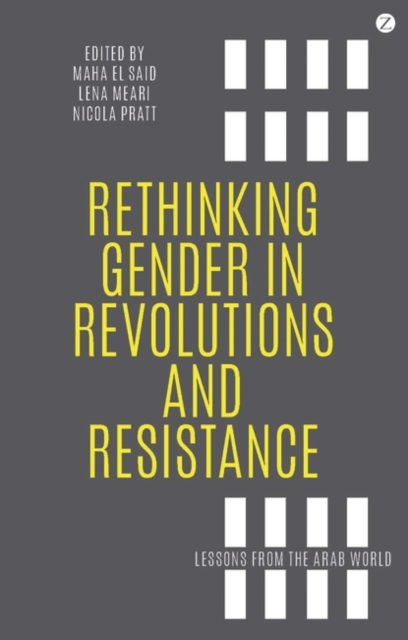
Rethinking Gender in Revolutions and Resistance
Ever since the uprisings that swept the Arab world, the role of Arab women in political transformations received unprecedented media attention. The copious commentary, however, has yet to result in any serious study of the gender dynamics of political upheaval. Rethinking Gender in Revolutions and Resistance is the first book to analyse the interplay between moments of sociopolitical transformation, emerging subjectivities and the different modes of women's agency in forging new gender norms in the Arab world. Written by scholars and activists from the countries affected, including Palestine, Egypt, Tunisia and Libya, this is an important addition to Middle Eastern gender studies.
eBook

Feeding Desire
While the Western world adheres to a beauty ideal that says women can never be too thin, the semi-nomadic Moors of the Sahara desert have for centuries cherished a feminine ideal of extreme fatness. Voluptuous immobility is thought to beautify girls' bodies, hasten the onset of puberty, heighten their sexuality and ripen them for marriage. From the time of the loss of their first milk teeth, girls are directed to eat huge bowls of milk and porridge in one of the world's few examples of active female fattening. Based on fieldwork in an Arab village in Niger, Feeding Desire analyses the meanings of women's fatness as constituted by desire, kinship, concepts of health, Islam, and the crucial social need to manage sexuality. By demonstrating how a particular beauty ideal can only be understood within wider social structures and cultural logics, the book also implicitly provides a new way of thinking about the ideal of slimness in late Western capitalism. Offering a reminder that an estimated eighty per cent of the world's societies prefer plump women, this gracefully written book is both a fascinating exploration of the nature of bodily ideals and a highly readable ethnography of a Saharan people.
eBook

Arab and Arab American Feminisms
In this collection, Arab and Arab American feminists enlist their intimate experiences to challenge simplistic and long-held assumptions about gender, sexuality, and commitments to feminism and justice-centered struggles. Contributors hail from multiple geographical sites, spiritualities, occupations, sexualities, class backgrounds, and generations. Poets, creative writers, artists, scholars, and activists employ a mix of genres to express feminist issues and highlight how Arab and Arab American feminist perspectives simultaneously inhabit multiple, overlapping, and intersecting spaces: within families and communities; in anticolonial and antiracist struggles; in debates over spirituality and the divine; within radical, feminist, and queer spaces; in academia and on the street; and between each other. Contributors explore themes as diverse as the intersections between gender, sexuality, Orientalism, racism, Islamophobia, and Zionism, and the restoration of Arab Jews to Arab American histories. This book asks how members of diasporic communities navigate their sense of belonging when the country in which they live wages wars in the lands of their ancestors. Arab and Arab American Feminisms opens up new possibilities for placing grounded Arab and Arab American feminist perspectives at the center of gender studies, Middle East studies, American studies, and ethnic studies.
eBook

Women, Islam and resistance in the Arab world
No detailed description available for \"Women, Islam, and Resistance in the Arab World\".
eBook

Consuming Desires
Over the course of the twentieth century, most Middle East states adopted a shari'a-based system for recognizing marriages. Partly in reaction to these dynamics, new types of marriage that evade the control of the state and religious authorities have emerged. These marriages allow for men and women to engage in sexual relationships, but do not require that they register the marriage with the state, that they live together, or that the man be financially responsible for the wife or household. In Consuming Desires, Frances Hasso explores the extent to which these new relationship forms are used and to what ends, as well as the legal and cultural responses to such innovations. She outlines what is at stake for the various groups—the state, religious leaders, opposition groups, young people, men and women of different classes and locations, and feminist organizations—in arguments for and against these relationship forms.
eBook

Resistance, Repression, and Gender Politics in Occupied Palestine and Jordan
This book focuses on the central party apparatus of the Democratic Front for the Liberation of Palestine (DFLP), the Democratic Front (DF) branches established in the Occupied Palestinian Territories and Jordan in the 1970s, and the most influential and innovative of the DF women's organizations: the Palestinian Federation of Women's Action Committees in the occupied territories. Until now, no study of a Palestinian political organization has so thoroughly engaged with internal gender histories. In addition, no other work attempts to systematically compare branches in different regional locations to explain those differences. Students of gender and Middle East studies, especially those with a specialty in Palestinian studies, will find this work to be of critical importance. This book will also be of great interest to those working on political protest movements and factional ties.
eBook

Breaking barriers: the role of technological education in advancing arab women in Israel
This study investigates the role of technology integration in educational frameworks on empowering Arab women in Israeli society, focusing on their participation in the high-tech sector. It tests two hypotheses: that technology integration boosts Arab Israeli women's interest in STEM and high-tech careers, and that it enhances their societal and economic empowerment. Despite the success of Israel's high-tech industry and advancements in education, Arab women remain underrepresented in this sector. The research utilizes a structured questionnaire to assess digital literacy's impact on Arab Israeli women's career aspirations in high-tech. The findings suggest that integrating technology into education can significantly increase Arab women's interest in STEM fields, supporting their greater involvement in the high-tech industry. The study underscores the importance of continued technological integration in education to promote diversity and inclusion in the high-tech sector. However, limitations include a regional focus and a quantitative approach, indicating the need for further research to fully understand the empowerment of Arab women in the Israeli high-tech industry.
Journal Article