
Catalogue Search | MBRL


Are you sure you want to remove the book from the shelf?

{{itemTitle}}
13
result(s) for
"Femmes et littérature États-Unis Histoire 19e siècle."
Sort by:

The Oxford handbook of Emily Dickinson
\"Includes new historical research that provides the most thorough nineteenth-century contextualization of Dickinson in relation to religion, race, gender, sexuality, age, class, ecology, and place, and historically grounded contexts for thinking about publication, media, education, and reading practices. Features original interpretations of Dickinson's compositional practices, reception, and influence including chapters on translations of Dickinson's work into visual arts, musical composition, international cultural practices, popular culture, and other languages. Considers Dickinson's composition and circulation of poems, her environmental ecology, her responses to the Civil War, and her relation to publishing and media.\" -- Provided by publisher.
BOOK

To Kiss the Chastening Rod
Examining ideas about masturbation, female sexuality, the family, and post-Calvinist religion that shaped the readership of popular woman's fiction, To Kiss the Chastening Rod shows that passionlessness was the privileged theme of a pervasive discourse which sought to exert social control through the rigorous repression, minute supervision, and covert cultivation of sexuality.
eBook

Reclaiming Authorship
There was, in the nineteenth century, a distinction made between \"writers\" and \"authors,\" Susan S. Williams notes, the former defined as those who composed primarily from mere experience or observation rather than from the unique genius or imagination of the latter. If women were more often cast as writers than authors by the literary establishment, there also emerged in magazines, advice books, fictional accounts, and letters a specific model of female authorship, one that valorized \"natural\" feminine traits such as observation and emphasis on detail, while also representing the distance between amateur writing and professional authorship. Attending to biographical and cultural contexts and offering fresh readings of literary works,Reclaiming Authorshipfocuses on the complex ways writers such as Maria S. Cummins, Louisa May Alcott, Elizabeth Keckley, Mary Abigail Dodge, Elizabeth Stuart Phelps, and Constance Fenimore Woolson put this model of female authorship into practice. Williams shows how it sometimes intersected with prevailing notions of male authorship and sometimes diverged from them, and how it is often precisely those moments of divergence when authorship was reclaimed by women. The current trend to examine \"women writers\" rather than \"authors\" marks a full rotation of the circle, and \"writers\" can indeed be the more capacious term, embracing producers of everything from letters and diaries to published books. Yet certain nineteenth-century women made particular efforts to claim the title \"author,\" Williams demonstrates, and we miss something of significance by ignoring their efforts.
eBook

The Cambridge Companion to Nineteenth-Century American Women's Writing
Providing an overview of the history of writing by women in the period, this 2001 Companion establishes the context in which this writing emerged, and traces the origin of the terms which have traditionally defined the debate. It includes essays on topics of recent concern, such as women and war, erotic violence, the liberating and disciplinary effects of religion, and examines the work of a variety of women writers, including Harriet Beecher Stowe, Rebecca Harding Davis and Louisa May Alcott. The volume plots new directions for the study of American literary history, and provides several valuable tools for students, including a chronology of works and suggestions for further reading.
eBook
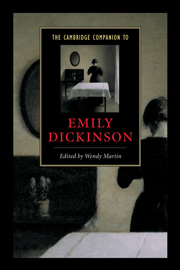
The Cambridge Companion to Emily Dickinson
Emily Dickinson, one of the most important American poets of the nineteenth century, remains an intriguing and fascinating writer. The Cambridge Companion to Emily Dickinson includes eleven new essays by accomplished Dickinson scholars. They cover Dickinson's biography, publication history, poetic themes and strategies, and her historical and cultural contexts. As a woman poet, Dickinson's literary persona has become incredibly resonant in the popular imagination. She has been portrayed as singular, enigmatic, and even eccentric. At the same time, Dickinson is widely acknowledged as one of the founders of American poetry, an innovative pre-modernist poet as well as a rebellious and courageous woman. This volume introduces new and practised readers to a variety of critical responses to Dickinson's poetry and life, and provides several valuable tools for students, including a chronology and suggestions for further reading.
eBook

Our sisters' keepers : nineteenth-century benevolence literature by American women
American culture has long had a conflicted relationship with assistance to the poor. Cotton Mather and John Winthrop were staunch proponents of Christian charity as fundamental to colonial American society, while transcendentalists harbored deep skepticism towards benevolence in favor of Emersonian self-reliance and Thoreau's insistence on an ascetic life. Women in the 19th century, as these essays show, approached issues of benevolence far differently than their male counterparts, consistently promoting assistance to the impoverished, in both their acts and their writings. These essays address a wide range of subjects: images of the sentimental seamstress figure in women's fiction; Rebecca Harding Davis's rewriting of the \"industrial\" novel; Sarah Orne Jewett's place in the transcendental tradition of skepticism toward charity, and her subversion of it; the genre of the poorhouse narrative; and the philanthropic work and writings of Hull House founder Jane Addams. As the editors of Our Sisters' Keepers argue, the vulnerable and marginal positions occupied by many women in the 19th century fostered an empathetic sensitivity in them to the plight of the poor, and their ability to act and write in advocacy of the impoverished offered a form of empowerment not otherwise available to them. The result was the reformulation of the concept of the American individual. Contributors include: Jill Bergman, Debra Bernardi, Sarah E. Chinn, Monika Elbert, Lori Merish, Terry D. Novak, James Salazar, Mary Templin, Karen Tracey, Whitney A. Womack
eBook

Beyond the Gibson Girl
Challenging monolithic images of the New Woman as white, well-educated, and politically progressive, this study focuses on important regional, ethnic, and sociopolitical differences in the use of the New Woman trope at the turn of the twentieth century. Using Charles Dana Gibson's \"Gibson Girls\" as a point of departure, Martha H. Patterson explores how writers such as Pauline Hopkins, Margaret Murray Washington, Sui Sin Far, Mary Johnston, Edith Wharton, Ellen Glasgow, and Willa Cather challenged and redeployed the New Woman image in light of other \"new\" conceptions: the \"New Negro Woman,\" the \"New Ethics,\" the \"New South,\" and the \"New China.\"_x000B__x000B_As she appears in these writers' works, the New Woman both promises and threatens to effect sociopolitical change as a consumer, an instigator of evolutionary and economic development, and, for writers of color, an icon of successful assimilation into dominant Anglo-American culture. Examining a diverse array of cultural products, Patterson shows how the seemingly celebratory term of the New Woman becomes a trope not only of progressive reform, consumer power, transgressive femininity, modern energy, and modern cure, but also of racial and ethnic taxonomies, social Darwinist struggle, imperialist ambition, assimilationist pressures, and modern decay.
eBook
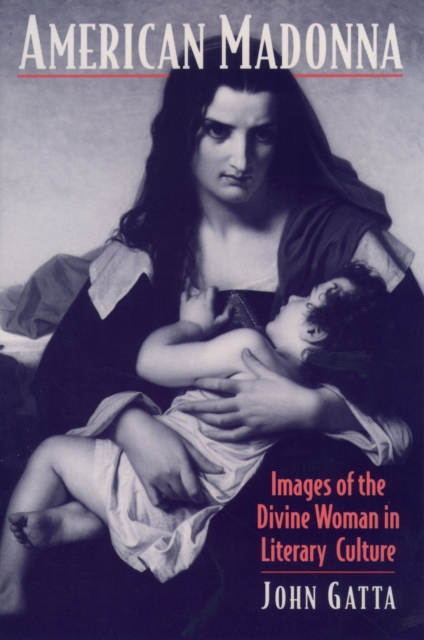
American madonna : images of the divine woman in literary culture
This book explores a notable if unlikely undercurrent of interest in Mary as mythical Madonna that has persisted in American life and letters from fairly early in the nineteenth century into the later twentieth. This imaginative involvement with the Divine Woman - verging at times on devotional homage - is especially intriguing as manifested in the Protestant writers who are the focus of this study: Nathaniel Hawthorne, Margaret Fuller, Harriet Beecher Stowe, Harold Federic, Henry Adams, and T.S. Eliot.
eBook
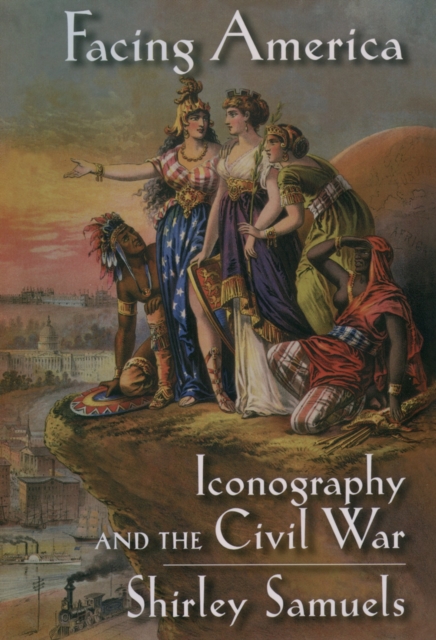
Facing America
Facing America investigates and explains the changing face of America during the Civil War. Drawing on the literature as well as the photographs and political cartoons of the period, Shirley Samuels also explores the body of the nation imagined both physically and metaphorically, arguing that the Civil War marks a dramatic shift from identifying the American nation as feminine to identifying it as masculine.
eBook

Charlotte Perkins Gilman and her contemporaries : literary and intellectual contexts
Considers Gilman's place in American literary and social history by examining her relationships to other prominent intellectuals of her era.
By placing Charlotte Perkins Gilman in the company of her contemporaries, this collection seeks to correct misunderstandings of the feminist writer and lecturer as an isolated radical. Gilman believed and preached that no life is ever led in isolation; indeed, the cornerstone of her philosophy was the idea that humanity is a relation.
Gilman's highly public and combative stances as a critic and social activist brought her into contact and conflict with many of the major thinkers and writers of the period, including Mary Austin, Margaret Sanger, Ambrose Bierce, Grace Ellery Channing, Lester Ward, Inez Haynes Gillmore, William Randolph Hearst, Karen Horney, William Dean Howells, Catharine Beecher, George Bernard Shaw, and Owen Wister. Gilman wrote on subjects as wide ranging as birth control, eugenics, race, women's rights and suffrage, psychology, Marxism, and literary aesthetics. Her many contributions to social, intellectual, and literary life at the turn of the 20th century raised the bar for future discourse, but at great personal and professional cost.
Cynthia J. Davis is Associate Professor of English at the University of South Carolina and author of Bodily and Narrative Forms: The Influence of Medicine on American Literature, 1845 1915. Denise D. Knight is Professor of English at the State University of New York, Cortland, and author of Charlotte Perkins Gilman: A Study of the Short Fiction.
eBook