
Catalogue Search | MBRL


Are you sure you want to remove the book from the shelf?

{{itemTitle}}
5,321
result(s) for
"Festivals Social aspects."
Sort by:


Spectacular Wealth
Bridging print culture and performance, Spectacular Wealth draws on eighteenth-century festival accounts to explore how colonial residents of the silver-mining town of Potosí, in the viceroyalty of Peru, and the gold-mining region of Minas Gerais, in Brazil, created rich festive cultures that refuted European allegations of barbarism and greed. In her examination of the festive participation of the towns’ diverse inhabitants, including those whose forced or slave labor produced the colonies’ mineral wealth, Lisa Voigt shows how Amerindians, Afro-descendants, Europeans, and creoles displayed their social capital and cultural practices in spectacular performances.Tracing the multiple meanings and messages of civic festivals and religious feast days alike, Spectacular Wealth highlights the conflicting agendas at work in the organization, performance, and publication of festivals. Celebrants and writers in mining boomtowns presented themselves as far more than tributaries yielding mineral wealth to the Spanish and Portuguese empires, using festivals to redefine their reputations and to celebrate their cultural, spiritual, and intellectual wealth.
eBook

Festivalisation of urban spaces : factors, processes and effects
\"This is a multi-disciplinary scientific monograph referring to urban geography, urban regions management, event studies, tourism geography, cultural anthropology and sociology. It covers issues which are typically related to the most popular type of events: festivals. This book studies the origins, history, and the main factors of festival development, as well as the concept of a festival in the context of various scientific disciplines. It presents the existing festival typologies as well as the author's own comprehensive typology. The theoretical part concerns the basic research methods and approaches used in the analysis of these events, as well as their impacts on the urban space in the physical (festival facilities), social (a place where people may pursue their interests, meet with family and friends) and cultural aspect. The economic aspect of festivals (generating jobs and income from tourism, using festivals for city branding, etc.) is also discussed. The book presents practical examples in sub-chapters, references to literature (further reading) and the case study of the influence of festivals on urban space management and urban development, using the example of Łódź -- a Polish post-socialist city. It may also be treated as a supplementary course book for students of urban geography, urban regions management, tourism, event management and, to a certain extent, anthropology of culture and sociology\"--Page 4 of cover.
Book

Festivals and the Cultural Public Sphere
Festivals and the Cultural Public Sphere provides the first major social scientific study of these festivals in the wake of their explosion in popularity over the past decade. It explores the cultural significance of contemporary arts festivals from their location within the cultural public sphere, examining them as sites for contestation and democratic debate, and also identifying them as examples of a particular aesthetic cosmopolitanism.
The book approaches contemporary festivals as relatively autonomous social texts that need interpretation and contextualisation. This perspective, combined with a diversified set of theoretical approaches and research methods, and guided by a common thematic rationale, places the volume squarely within some of the most debated topics in current social sciences. Furthermore, the multifaceted nature of festivals allows for unusual but useful connections to be made across several fields of social inquiry.
This timely edited collection brings together contributions from key figures across the social sciences, and proves to be valuable reading for undergraduate students, postgraduates, and professionals working within the areas of contemporary social theory, cultural theory, and visual culture.
Introduction, Liana Giorgi and Monica Sassatelli 1. Urban Festivals and the Cultural Public Sphere: Cosmopolitanism between Ethics and Aesthetics, Monica Sassatelli 2. Between Tradition, Vision and Imagination: The Public Sphere of Literature Festivals, Liana Giorgi 3. Art Biennales and Cities as Platforms for Global Dialogue, Nikos Papastergiadis and Meredith Martin 4. Festivals and the Geography of Culture: African Cinema in the \"World Space\" of its Public, Jim English 5. The Cultural Public Sphere - Critical Measure of Public Culture?, Jim McGuigan 6. Festivals: Local and Global. Critical Interventions and the Cultural Public Sphere, Jean-Luis Fabiani 7. International Festivals in a Small Country: Rites of Recognition and Cosmopolitanism, Motti Regev 8. Festivalization, Cosmopolitanism and European Culture: On the Socio-cultural Significance of Mega-events, Maurice Roche 9. Festival Spaces, Green Sensibilities and Youth Culture, Joanne Cummings, Ian Woodward and Andy Bennett 10. Cannes: a French International Festival, Jérôme Segal and Christine Blumauer 11. 'Space is the Place'. The Global Localities of Sònar and Womad Music Festivals, Jasper Chalcraft and Paolo Magaudda . Conclusion, Gerard Delanty
Professor Gerard Delanty is Professor of Sociology and Social & Political Thought at the University of Sussex. He is the author of twelve books and editor of seven, including Handbook of Contemporary European Social Theory (Routledge, 2006). His most recent publication is The Cosmopolitan Imagination: The Social Theory Renewal of Critical Social Theory (Cambridge University Press, 2009).
Dr Liana Giorgi is Vice-Director of The Interdisciplinary Centre for Comparative Research in the Social Sciences, and the coordinator of the EURO-FESTIVAL project on European arts festivals. She is co-author and co-editor of Democracy in the European Union: Towards the Emergence of a European Public Sphere (Routledge, 2006). Dr
Monica Sassatelli is Lecturer in the Sociology Department at Goldsmiths College. She has published in the sociology of culture, Europe as well as classical and contemporary social theory. She is the author of Becoming Europeans: Cultural Identity and Cultural Policies (Palgrave 2009).
eBook


Southern heritage on display : public ritual and ethnic diversity within southern regionalism
This provocative collection draws on extensive ethnographic fieldwork to shed light on the role that public ceremonies play in affirming or debunking cultural identities associated with the South. W. J. Cash's 1941 observation that there are many Souths and many cultural traditions among them is certainly validated by this book. Although the Civil War and its lost cause tradition continues to serve as a cultural root paradigm in celebrations, both uniting and dividing loyalties, southerners also embrace a panoply of public rituals—parades, cook-offs, kinship homecom-ings, church assemblies, music spectacles, and material culture exhibitions—that affirm other identities. From the Appalachian uplands to the Mississippi Delta, from Kentucky bluegrass to Carolina piedmont, southerners celebrate in festivals that showcase their diverse cultural backgrounds and their mythic beliefs about themselves. The ten essays of this cohesive, interdisciplinary collection present event-centered research from various fields of study—anthropology, geography, history, and literature—to establish a rich, complex picture of the stereotypically Solid South. Topics include the Mardi Gras Indian song cycle as a means of expressing African-American identity in New Orleans; powwow performances and Native American traditions in southeast North Carolina; religious healings in southern Appalachian communities; Mexican Independence Day festivals in central Florida; and, in eastern Tennessee, bonding ceremonies of melungeons who share Indian, Scots Irish, Mediterranean, and African ancestry. Seen together, these public heritage displays reveal a rich creole of cultures that have always been a part of southern life and that continue to affirm a flourishing regionalism. This book will be valuable to students and scholars of cultural anthropology, American studies, and southern history; academic and public libraries; and general readers interested in the American South. It contributes a vibrant, colorful layer of understanding to the continuously emerging picture of complexity in this region historically depicted by simple stereotypes.
Celeste Ray is Assistant Professor of Anthropology at the University of the South, Sewanee, Tennessee, and author of Highland Heritage: Scottish Americans in the American South.
eBook


Festivalising! : theatrical events, politics and culture
Throughout the world festivals are growing - in numbers, in size, in significance - and serve as spaces where aesthetic encounters, religious and political celebrations, economic investments and public entertainment can take place. In this sense, festivals are theatrical events. This volume contains discussions of 14 diverse festival events from five continents across the globe, written by members of the IFTR/FIRT Working Group on the Theatrical Event, the same group that has produced the ground-breaking study Theatrical Events - Borders Dynamics Frames in 2004 (also published by Rodopi). The events discussed here range from traditional carnivals and festivals to more controversial theatre, dance and opera festivals, children's festivals and community events, as well as saints' and workers' festivities. All of these constitute part of the local playing cultures and take on significant political roles, nationally and regionally. The authors explore and extend the theoretical frames of reference for any contemporary discussion of theatrical events and festivals, in order to provide a new and fresh perspective on past and present festival culture across the globe.
eBook

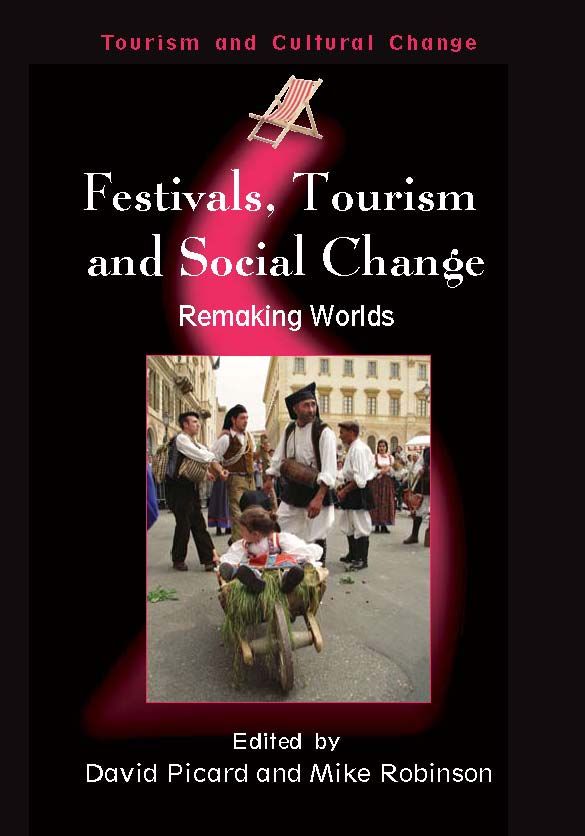
Festivals, tourism and social change : remaking worlds
This book explores the links between tourism and festivals and the various ways in which each mobilises the other to make social realities meaningful.Festivals are examined as ways of responding to various forms of crisis - social, political, economic - and as a way of re-making and re-animating spaces and social life.
eBook