
Catalogue Search | MBRL


Are you sure you want to remove the book from the shelf?

{{itemTitle}}
1,377
result(s) for
"Feud"
Sort by:


Crime in Ireland north and south: Feuding gangs and profiteering paramilitaries
This paper provides a systematic overview of the emergence of organized crime in the Republic of Ireland and Northern Ireland since the late 1960s. It draws on two major studies of organized crime in the South (Hourigan 2011) and paramilitary activity in the North (Morrison 2014) to explore how conflict within and between organized criminal and paramilitary groups, shapes the distinctive dynamic of organized crime on the island of Ireland. The paper opens with an overview of the development of the drugs trade in the Republic of Ireland. The distinctive cultural characteristics of Irish organized crime groups are considered and the role played by paramilitary groups in criminal networks, North and South, is reviewed. As part of this analysis, the dynamic of inter-gang feuds and the spectrum of conflicts between organized criminal and paramilitary groups are analyzed. The competitive and mutually beneficial links between these organizations, North and South are explored as well as the tendency of paramilitaries to engage in vigilantism against criminals (mostly drugs dealers) as a means of building political capital within local communities.
Journal Article
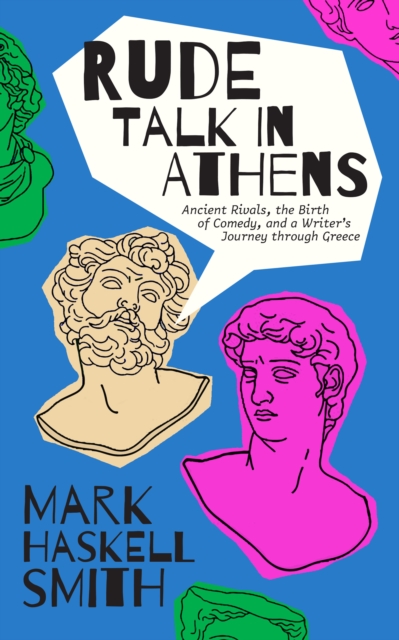
Rude Talk in Athens
\"Rude Talk in Athens is brave, brilliant, and incredibly funny. There are loads of very specific characters, including Mark himself. It's the Mark Haskell Smith version of hanging out with Stanley Tucci and Anthony Bourdain, but in present day and ancient Greece. I agree with everything he says about comedy and have never read anything like it.\" ?Barry Sonnenfeld, Film Director and author of Barry Sonnenfeld, Call Your Mother: Memoirs of a Neurotic FilmmakerIn ancient Athens, thousands would attend theatre festivals that turned writing into a fierce battle for fame, money, and laughably large trophies. While the tragedies earned artistic respect, it was the comedies-the raunchy jokes, vulgar innuendo, outrageous invention, and barbed political commentary-that captured the imagination of the city. The writers of these comedic plays feuded openly, insulting one another from the stage, each production more inventive and outlandish than the last, as they tried to win first prize. Of these writers, only the work of Aristophanes has survived and it's only through his plays that we know about his peers: Cratinus, the great lush; Eupolis, the copycat; and Ariphrades, the sexual deviant. It might have been the golden age of Democracy, but for comic playwrights, it was the age of Rude Talk. Watching a production of an Aristophanes play in 2019 CE and seeing the audience laugh uproariously at every joke, Mark Haskell Smith began to wonder: what does it tell us about society and humanity that these ancient punchlines still land? When insults and jokes made thousands of years ago continue to be both offensive and still make us laugh? Through conversations with historians, politicians, and other writers, the always witty and effusive Smith embarks on a personal mission (bordering on obsession) exploring the life of one of these unknown writers, and how comedy challenged the patriarchy, the military, and the powers that be, both then and now. A comic writer himself and author of many books and screenplays, Smith also looks back at his own career, his love for the uniquely dynamic city of Athens, and what it means for a writer to leave a legacy.
eBook

“Bunglers and Haters of Women” – Delegitimization Strategies of Political Opponents in Selected Video Ads of Poland’s Civic Platform. A Multimodal Analysis
This study investigates the delegitimization strategies employed by Civic Platform, Poland’s largest liberal party, in its portrayal of political opponents during the 2023 parliamentary campaign. By analyzing nine election ads, the paper explores how the formation constructs its political opponents, employing specific semiotic and multimodal strategies to delegitimize the then ruling Law and Justice. The study integrates Bar-Tal’s model of delegitimization to assess the party’s strategic messaging and examines the role of disparaging humor in shaping political legitimacy. The findings reveal that Civic Platform’s campaign frames Law and Justice politicians as incompetent caricatures or lawbreakers harmful to Polish citizens. In particular, Jarosław Kaczyński, the party’s leader, is depicted as inherently malevolent and driven by personal vendettas. The analysis highlights a diverse range of semiotic choices used to construct political adversaries and uncovers striking parallels between Polish liberal discourse and far-right rhetoric, particularly in the use of racial stereotypes against immigrants and in reliance on emotional arguments. These insights emphasize the need for a broader approach to politically-oriented discourse analysis that accounts for ideological overlaps and the strategic use of humor in political communication.
Journal Article

Enmity and Feuding in Classical Athens
Much has been written about the world’s first democracy, but no book so far has been dedicated solely to the study of enmity in ancient Athens. Enmity and Feuding in Classical Athens is a long-overdue analysis of the competitive power dynamics of Athenian honor and the potential problems these feuds created for democracies.The citizens of Athens believed that harming one’s enemy was an acceptable practice and even the duty of every honorable citizen. They sought public wins over their rivals, making enmity a critical element in struggles for honor and standing, while simultaneously recognizing the threat that personal enmity posed to the community. Andrew Alwine works to understand how Athenians addressed this threat by looking at the extant work of Attic orators. Their speeches served as the intersection between private vengeance and public sanction of illegal behavior, allowing citizens to engage in feuds within established parameters. This mediation helped support Athenian democracy and provided the social underpinning to allow it to function in conjunction with Greek notions of personal honor.Alwine provides a framework for understanding key issues in the history of democracy, such as the relationship between private and public realms, the development of equality and the rule of law, and the establishment of individual political rights. Serving also as a nuanced introduction to the works of the Attic orators, Enmity and Feuding in Classical Athens is an indispensable addition to scholarship on Athens.
eBook

Socioemotional wealth and family feuds: corporate social responsibility as insurance
PurposeThis study explores family firms' ex ante conflict management strategies to preserve their socioemotional wealth (SEW) under predictable conflict through the succession process. Specifically, the authors examine how family firms leverage the insurance-like benefits of corporate social responsibility (CSR) to mitigate the threat of foreseeable family feuds among the sons of firms' family heads.Design/methodology/approachThe authors focus on the charitable donations pledged by Korean family business groups (chaebols). Using the data of 62 chaebols with generalized least squares (GLS) models, the authors analyze 711 observations from 2005 to 2017.FindingsThe authors find a positive relationship between the number of sons of a family firm's head and the firm's CSR activities such as spending on charitable donations. Furthermore, the number of daughters of heads in executive positions strengthens such a positive relationship, whereas the number of business and political marriage ties weakens this relationship.Practical implicationsFamily heads of family businesses may leverage CSR activities and marriage ties to elite families interchangeably to ward off negative impacts from foreseeable family feuds and preserve their SEW. Thus, a policy-based incentive for CSR that encourages more family heads to use CSR as insurance would serve the public interest.Originality/valueThe authors contribute to the family business literature by suggesting that CSR activities can be used by family firms as an instrument to mitigate foreseeable damage to the SEW caused by family feuds. The authors also shed new light on CSR research by finding that marriage ties to elite families may reduce the strategic value of CSR activities.
Journal Article

Lethal Aggression in Mobile Forager Bands and Implications for the Origins of War
It has been argued that warfare evolved as a component of early human behavior within foraging band societies. We investigated lethal aggression in a sample of 21 mobile forager band societies (MFBS) derived systematically from the standard cross-cultural sample. We hypothesized, on the basis of mobile forager ethnography, that most lethal events would stem from personal disputes rather than coalitionary aggression against other groups (war). More than half of the lethal aggression events were perpetrated by lone individuals, and almost two-thirds resulted from accidents, interfamilial disputes, within-group executions, or interpersonal motives such as competition over a particular woman. Overall, the findings suggest that most incidents of lethal aggression among MFBS may be classified as homicides, a few others as feuds, and a minority as war.
Journal Article

Vigilantism and Institutions: Understanding Attitudes toward Lynching in Brazil
Why do people support extrajudicial violence? In two survey experiments with respondents in Brazil, we examine which characteristics of lynching scenarios garner greater support for lynching and whether providing different types of information about lynching reduces support for it. We find that people often do support community members to take vengeance. In particular, our analysis finds that people strongly support the use of extrajudicial violence by families of victims against men who sexually assault and murder women and children. We also find that criminal punishment and the threat of vendettas reduce support, but appeals to the human rights of victims have zero effect on support for lynchings. Unlike the U.S. experience with lynchings, race was not observed to play an important role in how respondents answered the survey.
Journal Article

Walther, Reinmar, and Biographism in the Second Degree: A Text-Centered Interpretation of Walther von der Vogelweide's Obituary of Reinmar Walther, Reinmar und der Biographismus auf zweiter Stufe: Eine textfokussierte Interpretation des Reinmar-Nachrufs Walthers von der Vogelweide
Most critics have seen the remarks of Walther von der Vogelweide on the death of his colleague Reinmar as an expression of a private quarrel between both singers. The contrast between the obituary's emphatic praise of Reinmar's singing on the one hand and apparent personal disparagement
on the other is usually regarded either as a result of interpersonal conflicts or, alternatively, as a rhetorical means to even intensify the praise of Reinmar's art. This article wants to demonstrate that the assumption of a personal struggle between Walther and Reinmar is based on a biographistic
circular argument. A reading that refrains from biographical assumptions proves the obituary's supposed personal aspect to be mere speculation. Instead, a purely text-centered reading points out the text's poetological and auto-reflexive functions.
Journal Article

Toward a Modal Anthropology
Abstract This article outlines a modal anthropology, defined as the ethnographic description of what is possible and necessary for actors operating within a given (technical, aesthetic, ecological) medium. Spanning a wide array of examples, from evolutionary biomechanics to socialist jokes to village feuds, it surveys extant work on modality and its disciplinary antecedents, while examining some of the tricky issues involved in shifting across modes in relation to environmental inputs. Comparing the same act within different possible modes or the different possible actions within the same mode provides a powerful comparative technique for anthropological analysis, one that is particularly relevant in an era of planetary counterfactuals.
Journal Article