
Catalogue Search | MBRL


Are you sure you want to remove the book from the shelf?

{{itemTitle}}
60
result(s) for
"Fibroins - biosynthesis"
Sort by:

Mass spider silk production through targeted gene replacement in Bombyx mori
Spider silk is one of the best natural fibers and has superior mechanical properties. However, the large-scale harvesting of spider silk by rearing spiders is not feasible, due to their territorial and cannibalistic behaviors. The silkworm, Bombyx mori, has been the most well known silk producer for thousands of years and has been considered an ideal bioreactor for producing exogenous proteins, including spider silk. Previous attempts using transposon-mediated transgenic silkworms to produce spider silk could not achieve efficient yields, due to variable promoter activities and endogenous silk fibroin protein expression. Here, we report a massive spider silk production system in B. mori by using transcription activator-like effector nuclease-mediated homology-directed repair to replace the silkworm fibroin heavy chain gene (FibH) with the major ampullate spidroin-1 gene (MaSp1) in the spider Nephila clavipes. We successfully replaced the ∼16-kb endogenous FibH gene with a 1.6-kb MaSp1 gene fused with a 1.1-kb partial FibH sequence and achieved up to 35.2% chimeric MaSp1 protein amounts in transformed cocoon shells. The presence of the MaSp1 peptide significantly changed the mechanical characteristics of the silk fiber, especially the extensibility. Our study provides a native promoter-driven, highly efficient system for expressing the heterologous spider silk gene instead of the transposon-based, random insertion of the spider gene into the silkworm genome. Targeted MaSp1 integration into silkworm silk glands provides a paradigm for the large-scale production of spider silk protein with genetically modified silkworms, and this approach will shed light on developing new biomaterials.
Journal Article
Hierarchical spidroin micellar nanoparticles as the fundamental precursors of spider silks
Many natural silks produced by spiders and insects are unique materials in their exceptional toughness and tensile strength, while being lightweight and biodegradable–properties that are currently unparalleled in synthetic materials. Myriad approaches have been attempted to prepare artificial silks from recombinant spider silk spidroins but have each failed to achieve the advantageous properties of the natural material. This is because of an incomplete understanding of the in vivo spidroin-to-fiber spinning process and, particularly, because of a lack of knowledge of the true morphological nature of spidroin nanostructures in the precursor dope solution and the mechanisms by which these nanostructures transform into micrometer-scale silk fibers. Herein we determine the physical form of the natural spidroin precursor nanostructures stored within spider glands that seed the formation of their silks and reveal the fundamental structural transformations that occur during the initial stages of extrusion en route to fiber formation. Using a combination of solution phase diffusion NMR and cryogenic transmission electron microscopy (cryo-TEM), we reveal direct evidence that the concentrated spidroin proteins are stored in the silk glands of black widow spiders as complex, hierarchical nanoassemblies (∼300 nm diameter) that are composed of micellar subdomains, substructures that themselves are engaged in the initial nanoscale transformations that occur in response to shear. We find that the established micelle theory of silk fiber precursor storage is incomplete and that the first steps toward liquid crystalline organization during silk spinning involve the fibrillization of nanoscale hierarchical micelle subdomains.
Journal Article

High-Toughness Silk Produced by a Transgenic Silkworm Expressing Spider (Araneus ventricosus) Dragline Silk Protein
Spider dragline silk is a natural fiber that has excellent tensile properties; however, it is difficult to produce artificially as a long, strong fiber. Here, the spider (Araneus ventricosus) dragline protein gene was cloned and a transgenic silkworm was generated, that expressed the fusion protein of the fibroin heavy chain and spider dragline protein in cocoon silk. The spider silk protein content ranged from 0.37 to 0.61% w/w (1.4-2.4 mol%) native silkworm fibroin. Using a good silk-producing strain, C515, as the transgenic silkworm can make the raw silk from its cocoons for the first time. The tensile characteristics (toughness) of the raw silk improved by 53% after the introduction of spider dragline silk protein; the improvement depended on the quantity of the expressed spider dragline protein. To demonstrate the commercial feasibility for machine reeling, weaving, and sewing, we used the transgenic spider silk to weave a vest and scarf; this was the first application of spider silk fibers from transgenic silkworms.
Journal Article

Recombinant production of spider silk protein in Physcomitrella photobioreactors
Key message
We report the successful moss-produced recombinant spider silk key protein component containing both the N- and the C-terminal domain.
Spider dragline silk stands out as a remarkable biomaterial, representing one of nature's toughest fibres. Its strength rivals that of many synthetic fibres used commercially, rendering it applicable across various industrial and medical domains. However, its widespread utilisation requires cost-effective mass production. Biotechnology presents a promising avenue for achieving this goal, particularly through the production of recombinant dragline silk proteins in transgenic plant systems. This study aimed to assess the feasibility of producing one key protein component of dragline silk, MaSp1, from the western black widow spider,
Latrodectus hesperus
, the protein LhMaSp1, in the moss Physcomitrella (
Physcomitrium patens
). Here, we present the successful recombinant production of spider silk protein containing both the N- and C-terminal domains of LhMaSp1 in moss cells. The production of recombinant LhMaSp1 protein in Physcomitrella was performed in shake flasks and in five-litre photobioreactors and the correct synthesis of LhMaSp1 was proven via mass spectrometry. We estimate that the yield of recombinant spider silk protein in Physcomitrella bioreactors is above 0.82 mg/g fresh weight.
Journal Article

An engineered self-cleavage fusion system for the production of chimaera spider silk proteins
Background
Spidroins are well-known for their exceptional mechanical properties, which have inspired extensive research and applications across various fields. Large-scale production of spidroin continues to face major challenges due to the complexity involved in inducing host organisms to express full-length spidroins. This process requires advanced techniques and has issues such as plasmid instability and potential misfolding.
Results
In this study, we developed a novel expression system by combining a fusion tag with a self-cleavage intein, enabling the convenient expression of three chimeric spidroins with varying numbers of repetitive units. After optimising expression conditions, NT2RepCT, NT4RepCT and NT6RepCT spidroins were obtained in soluble form, with yields of 266, 135 and 125 mg/L, respectively. All three spidroins exhibited an increased β-sheet content with increased numbers of repetitive units during transition from soluble to dry state. In terms of nanofibril morphologies, the self-assemblies of NT4RepCT and NT6RepCT closely resemble those of native silk proteins.
Conclusion
This study can serve as a reference for preparation of high-performance spider silk materials and soluble expression of proteins, such as collagen, and as a foundation for preparation of other structurally complex polymer materials.
Journal Article

Novel Highly Soluble Chimeric Recombinant Spidroins with High Yield
Spider silk has been a hotspot in the study of biomaterials for more than two decades due to its outstanding mechanical properties. Given that spiders cannot be farmed, and their low silk productivity, many attempts have been made to produce recombinant spidroins as an alternative. Herein, we present novel chimeric recombinant spidroins composed of 1 to 4 repetitive units of aciniform spidroin (AcSp) flanked by the nonrepetitive N- and C-terminal domains of the minor ampullate spidroin (MiSp), all from Araneus ventricosus. The spidroins were expressed in the form of inclusion body in E. coli with high yield. Remarkably, the aqueous solubility of the four spidroins ranged from 13.4% to over 50% (m/v). The four spidroins could self-assemble into silk-like fibers by hand-drawing. The secondary structures of these proteins, determined by circular dichroism spectrum (CD) and Fourier transform infrared spectrum (FTIR), indicated a prominent transformation from α-helix to β-sheet after fiber formation. The mechanical properties of the hand-drawn fibers showed a positive correlation with the spidroin molecular weight. In summary, this study describes promising biomaterials for further study and wide application.
Journal Article

To spin or not to spin: spider silk fibers and more
Spider silk fibers have a sophisticated hierarchical structure composed of proteins with highly repetitive sequences. Their extraordinary mechanical properties, defined by a unique combination of strength and extensibility, are superior to most man-made fibers. Therefore, spider silk has fascinated mankind for thousands of years. However, due to their aggressive territorial behavior, farming of spiders is not feasible on a large scale. For this reason, biotechnological approaches were recently developed for the production of recombinant spider silk proteins. These recombinant proteins can be assembled into a variety of morphologies with a great range of properties for technical and medical applications. Here, the different approaches of biotechnological production and the advances in material processing toward various applications will be reviewed.
Journal Article
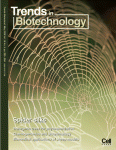
Spider silks and their applications
Spider silks are characterized by remarkable diversity in their chemistry, structure and functions, ranging from orb web construction to adhesives and cocoons. These unique materials have prompted efforts to explore potential applications of spider silk equivalent to those of silkworm silks, which have undergone 5000 years of domestication and have a variety of uses, from textiles to biomedical materials. Recent progress in genetic engineering of spider silks and the development of new chimeric spider silks with enhanced functions and specific characteristics have advanced spider silk technologies. Further progress in yields of expressed spider-silk proteins, in the control of self-assembly processes and in the selective exploration of material applications is anticipated in the future. The unique features of spider silks, the progress and challenges in the cloning and expression of these silks, environmentally triggered silk assembly and disassembly and the formation of fibers, films and novel chimeric composite materials from genetically engineered spider silks will be reviewed.
Journal Article

Efficient protein production inspired by how spiders make silk
Membrane proteins are targets of most available pharmaceuticals, but they are difficult to produce recombinantly, like many other aggregation-prone proteins. Spiders can produce silk proteins at huge concentrations by sequestering their aggregation-prone regions in micellar structures, where the very soluble N-terminal domain (NT) forms the shell. We hypothesize that fusion to NT could similarly solubilize non-spidroin proteins, and design a charge-reversed mutant (NT*) that is pH insensitive, stabilized and hypersoluble compared to wild-type NT. NT*-transmembrane protein fusions yield up to eight times more of soluble protein in
Escherichia coli
than fusions with several conventional tags. NT* enables transmembrane peptide purification to homogeneity without chromatography and manufacture of low-cost synthetic lung surfactant that works in an animal model of respiratory disease. NT* also allows efficient expression and purification of non-transmembrane proteins, which are otherwise refractory to recombinant production, and offers a new tool for reluctant proteins in general.
The properties of many transmembrane or aggregation-prone proteins make them difficult to recombinantly express. Here the authors use a modified N-terminal domain of a spider silk protein to express and purify several difficult to express proteins at levels considerably higher than with conventional tags.
Journal Article

Molecular mechanisms of spider silk
Spiders spin high-performance silks through the expression and assembly of tissue-restricted fibroin proteins. Spider silks are composite protein biopolymers that have complex microstructures. Retrieval of cDNAs and genomic DNAs encoding silk fibroins has revealed an association between the protein sequences and structure-property relationships. However, before spider silks can be subject to genetic engineering for commercial applications, the complete protein sequences and their functions, as well as the details of the spinning mechanism, will require additional progress and collaborative efforts in the areas of biochemistry, molecular biology and material science. Novel approaches to reveal additional molecular constituents embedded in the spider fibers, as well as cloning strategies to manipulate the genes for expression, will continue to be important aspects of spider biology research. Here we summarize the molecular characteristics of the different spider fibroins, the mechanical properties and assembly process of spidroins and the advances in protein expression systems used for recombinant silk production. We also highlight different technical approaches being used to elucidate the molecular constituents of silk fibers.
Journal Article