
Catalogue Search | MBRL


Are you sure you want to remove the book from the shelf?

{{itemTitle}}
108
result(s) for
"Fiddle tunes"
Sort by:

North American fiddle music : a research and information guide
North American Fiddle Music: A Research and Information Guide is the first large-scale annotated bibliography and research guide on the fiddle traditions of the United States and Canada. These countries, both of which have large immigrant populations as well as Native populations, have maintained fiddle traditions that, while sometimes faithful to old-world or Native styles, often feature blended elements from various traditions. Therefore, researchers of the fiddle traditions in these two countries can not only explore elements of fiddling practices drawn from various regions of the world, but also look at how different fiddle traditions can interact and change. In addition to including short essays and listings of resources about the full range of fiddle traditions in those two countries, it also discusses selected resources about fiddle traditions in other countries that have influenced the traditions in the United States and Canada [Publisher description]
Book

Play Me Something Quick and Devilish
Play Me Something Quick and Devilish explores the heritage of traditional fiddle music in Missouri. Howard Wight Marshall considers the place of homemade music in people's lives across social and ethnic communities from the late 1700s to the World War I years and into the early 1920s. This exceptionally important and complex period provided the foundations in history and settlement for the evolution of today's old-time fiddling.
Beginning with the French villages on the Mississippi River, Marshall leads us chronologically through the settlement of the state and how these communities established our cultural heritage. Other core populations include the \"Old Stock Americans\" (primarily Scotch-Irish from Kentucky, Tennessee, North Carolina, and Virginia), African Americans, German-speaking immigrants, people with American Indian ancestry (focusing on Cherokee families dating from the Trail of Tears in the 1830s), and Irish railroad workers in the post–Civil War period. These are the primary communities whose fiddle and dance traditions came together on the Missouri frontier to cultivate the bounty of old-time fiddling enjoyed today.
Marshall also investigates themes in the continuing evolution of fiddle traditions. These themes include the use of the violin in Westward migration, in the Civil War years, and in the railroad boom that changed history. Of course, musical tastes shift over time, and the rise of music literacy in the late Victorian period, as evidenced by the brass band movement and immigrant music teachers in small towns, affected fiddling. The contributions of music publishing as well as the surprising importance of ragtime and early jazz also had profound effects. Much of the old-time fiddlers' repertory arises not from the inherited reels, jigs, and hornpipes from the British Isles, nor from the waltzes, schottisches, and polkas from the Continent, but from the prolific pens of Tin Pan Alley.
Marshall also examines regional styles in Missouri fiddling and comments on the future of this time-honored, and changing, tradition. Documentary in nature, this social history draws on various academic disciplines and oral histories recorded in Marshall's forty-some years of research and field experience. Historians, music aficionados, and lay people interested in Missouri folk heritage—as well as fiddlers, of course—will find Play Me Something Quick and Devilish an entertaining and enlightening read.
With 39 tunes, the enclosed Voyager Records companion CD includes a historic sampler of Missouri fiddlers and styles from 1955 to 2012.
A media kit is available here: press.umsystem.edu/pages/PlayMeSomethingQuickandDevilish.aspx [http://press.umsystem.edu/pages/PlayMeSomethingQuickandDevilish.aspx]
eBook
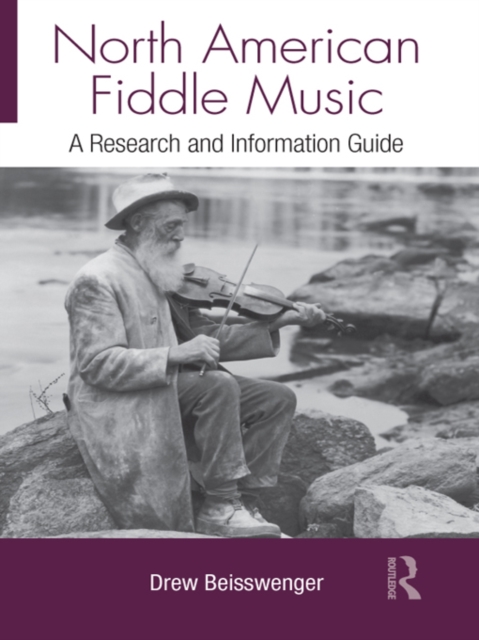
North American Fiddle Music
North American Fiddle Music: A Research and Information Guide is the first large-scale annotated bibliography and research guide on the fiddle traditions of the United States and Canada. These countries, both of which have large immigrant populations as well as Native populations, have maintained fiddle traditions that, while sometimes faithful to old-world or Native styles, often feature blended elements from various traditions. Therefore, researchers of the fiddle traditions in these two countries can not only explore elements of fiddling practices drawn from various regions of the world, but also look at how different fiddle traditions can interact and change. In addition to including short essays and listings of resources about the full range of fiddle traditions in those two countries, it also discusses selected resources about fiddle traditions in other countries that have influenced the traditions in the United States and Canada.
eBook
Fiddling for Norway
Fiddling for Norway is an engrossing portrait of a fiddle-based folk revival in Norway, one that in many ways parallels contemporary folk institutions and festivals throughout the world, including American fiddling. It is a detailed case study in the politics of culture, the causes and purposes of folk revivals, and the cultivation of music to define identity.
The book begins with an investigation of the people and events important to Norwegian folk fiddling, tracing the history of Norwegian folk music and the growth and diversification of the folk music revival. The narrative takes us to fiddle clubs, concerts and competitions on the local, regional, and national levels, and shows how conflicting emphases—local vs. national identity, tradition vs. aesthetic qualities—continue to transform Norwegian folk music. Goertzen utilizes a large anthology of meticulously transcribed tunes to illustrate personal and regional repertoires, aspects of performance practice, melodic gesture and form, and tune relationships. Ethnomusicologists and readers who fiddle will enjoy both the music and the stories it tells.
eBook
Fiddling for Norway
Fiddling for Norway is an engrossing portrait of a fiddle-based folk revival in Norway, one that in many ways parallels contemporary folk institutions and festivals throughout the world, including American fiddling. It is a detailed case study in the politics of culture, the causes and purposes of folk revivals, and the cultivation of music to define identity. The book begins with an investigation of the people and events important to Norwegian folk fiddling, tracing the history of Norwegian folk music and the growth and diversification of the folk music revival. The narrative takes us to fiddle clubs, concerts and competitions on the local, regional, and national levels, and shows how conflicting emphases—local vs. national identity, tradition vs. aesthetic qualities—continue to transform Norwegian folk music. Goertzen utilizes a large anthology of meticulously transcribed tunes to illustrate personal and regional repertoires, aspects of performance practice, melodic gesture and form, and tune relationships. Ethnomusicologists and readers who fiddle will enjoy both the music and the stories it tells.
eBook

Ole Hendricks and His Tunebook
Ole Hendricks was an immigrant both representative and exceptional—a true artistic talent who nevertheless lived a familiar immigrant experience. By day, he was a farmer. But at night, his fiddle lit up dance halls, bringing together all manner of neighbors in rural Minnesota. Each tune in his repertoire of waltzes, reels, polkas, quadrilles, and more were copied neatly into his commonplace book.
Such tunebooks, popular during the nineteenth century, rarely survive and are often overlooked by folk scholars in favor of commercially produced recordings, published sheet music, or oral tradition. Based on extensive historical and genealogical research, Amy Shaw presents a grounded picture of a musician, his family, and his community in the Upper Midwest, revealing much about music and dance in the area. This notable contribution to regional music and folklore includes more than one hundred of Ole's dance tunes, transcribed into modern musical notation for the first time. Ole Hendricks and His Tunebook will be valuable to readers and scholars interested in ethnomusicology and the Norwegian American immigrant experience.
eBook

Bill Rogers, Contemporary Traditional Mississippi Fiddler
Fiddling-vernacular violin playing, largely in oral tradition--has been an important part of American musical life for centuries. Fiddlers are traditional culture bearers who, during most of our history, learned their craft through face-to-face relationships, largely within the family and neighborhood. Their fiddling was a \"tradition\" in the sense of a widely disseminated definition of that word from 1949: \"that information, those skills, concepts, products, etc., which one acquires almost inevitably by virtue of the circumstances to which he is born.\" Here, Goertzen determines the time-honored factors of family and community played in Roger's cultivation of the fiddle and the modern factors that have entered the picture, and how are those affecting younger fiddlers.
Journal Article

Crossroads of the Imagination: A Possible Musical Origin for the Character of Jupiter in Poe’s “The Gold-Bug”
The author posits a connection between the character of Jupiter in Edgar Allan Poe's \"The Gold Bug\" and the folk song \"Old Jupiter.\" He thought of the link while listening to Ira W Ford's \"Traditional Music of America\" collection.
Journal Article

Folk Visions and Voices
Sampling virtually all of the old-time styles within the musical traditions still extant in north Georgia, Folk Visions and Voices is a collection of eighty-two songs and instrumentals, enhanced by photographs, illustrations, biographical sketches of performers, and examples of their narratives, sermons, tales, and reminiscences.
eBook

American Fiddle Tunes and Their German Connection
Melvin Wine (1909-2003) from West Virginia, for example, expressed this connection occasionally7, and Ed Haley (1885-1951), a fiddler from the same state, sometimes referred to himself as »Dutch-Irish«, with »Dutch« standing for »Deutsch«.8 Jake Hockemeyer (1919-1997) from Missouri was known as the »left-handed Dutchman«9, and the lesser known Peter Krouse (dates unknown) from Berks County, Pennsylvania, who recorded for the Library of Congress, still used the German names for some of the tunes he played. 10 The same has been true, and less surprisingly so, for fiddle players in the Upper Midwest such as fiddle champion Karl »King Tut« Schwanenburg (dates unknown) and his culturally mixed repertoire.11 In the same way, many regions across the United States are known for their hybrid traditions that include musical material from the British Isles alongside German or African-American elements. [...]we cannot reshape musical history to match patriotic or cultural ideals. [...]we cannot accept that a significant cultural influence simply bowed to others and retreated into obscurity.20 The scattered pieces of evidence from primary and secondary sources regarding the German background of American fiddling and fiddle tunes will ultimately challenge these »cultural ideals«, that is, the paradigm mentioned above, when taken together to form a more complex picture. Here he also worked with Max Zorer, another German-American minstrel, yodel virtuoso and composer of polkas, and also with singer and »Dutch« banjoist Dave S. Wambold (1836-1889) as part of the San Francisco Minstrels around 1865·50 Donniker was active as a minstrel and musical director in New York until about 1873·51 After the Civil War, the minstrel performer and »Dutch« star of the early Broadway musical stage, Joseph Kleinfelter Emmet (1841-1891), delivered his famous German stage characters not only with singing and yodeling, but also with accomplished guitar playing and fiddling, including playing German folk tunes.52 Another important and possible way for German tunes to enter the repertoire of American fiddling was its close association with fifing, particularly the music played by fifes in military bands in Europe and later in the United States where during the Federal Era many European musicians including Germans were also employed as bandmasters.53 But perhaps more importantly, British military bands had frequently enlisted German musicians since the 1 740s and »it is obvious that many of the musicians of the ninety-five British regiments in America during the 18th century were of German origin, and that a number of these remained to find their fortunes in the New World«.54 In addition, the Hessian and Brunswick troops who were known for their musicianship imported their own fifers, drummers and trumpeters to North America. Besides the minstrel connection and the strong similarity between the American and German forms, we have to trust Bayard when he says: »I have always suspected the tune to be German [...]
Journal Article