
Catalogue Search | MBRL


Are you sure you want to remove the book from the shelf?

{{itemTitle}}
2,359
result(s) for
"Fielding, Henry"
Sort by:

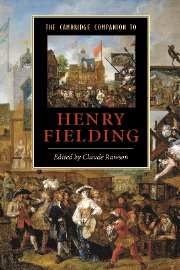
The Cambridge Companion to Henry Fielding
Now best known for three great novels - Tom Jones, Joseph Andrews and Amelia - Henry Fielding (1707–1754) was one of the most controversial figures of his time. Prominent first as a playwright, then as a novelist and political journalist, and finally as a justice of peace, Fielding made a substantial contribution to eighteenth-century culture, and was hugely influential in the development of the novel as a form, both in Britain and more widely in Europe. This collection of specially-commissioned essays by leading scholars describes and analyses the many facets of Fielding's work in theatre, fiction, journalism and politics. In addition it assesses his unique contribution to the rise of the novel as the dominant literary form, the development of the law, and the political and literary culture of eighteenth-century Britain. Including a Chronology and Guide to Further Reading, this volume offers a comprehensive account of Fielding's life and work.
eBook


Fielding's Transformation of Ballad Opera
In summarizing Henry Fielding as an author, Robert Hume remarks, \"the first thing that strikes me is that ... he does startingly little work in established forms ... Fielding's debts to earlier writers are unusually minimal ... He innovates, experiments, and takes chances.\" The truth of these assertions is apparent in the well-known circumstances that led Fielding to the novel. Inspired by his dislike of Samuel Richardson's highly popular Pamela (1740), he initially burlesqued the work in Shamela (1741) and then used it as a jumping-off point for a new \"Species of writing\" in Joseph Andrews (1742). However, if that sequence of events is well known, little known is the fact that while working as a dramatist, Fielding was in the process of doing very much the same a decade earlier. Disliking a highly popular theatrical work, he moved from parody of it toward the creation of a new dramatic form. In this case, though, his efforts were cut short as the passage of the Licensing Act forced Fielding off the stage.
Journal Article


Jonathan Wild
This essay argues from the nature of Henry Fielding’s Jonathan Wild as a miscellaneous linguistic salmagundi to a proposition that it is held together by a leitmotif of equally miscellaneous and perplexing opposites, which Fielding refers to as foils: the good-natured Heartfree being a foil to the villainous and hypocritical Wild. Fielding’s usual ethical positives are foiled not only by Wild, but also by the strangely metaleptic “Good-natured Hole” in Laetitia’s “Handkerchief,” which exposes her bosom. Mrs. Heartfree’s appeal to divine “PROVIDENCE” is foiled by the insertion of a phrase and an episode derived from the subversive philosophy of Baruch Spinoza, which gives notice of a contrary attitude to cause and effect. Anti-Walpole satirical innuendoes are accompanied by another set of winks and nudges which develop a previously unnoticed anti-Jacobite subtext with which Walpole would have been in full agreement.
Journal Article
Last Words: The Conclusions of Amelia and Sir Charles Grandison
When, in 1717, Pope suggested that the life of a writer is a warfare on earth, he could have had no idea that perhaps the greatest literary war of the century would commence in the decade of his own death and end within fifteen years, that is, from 1740 to 1754. Quite innocently, Samuel Richardson fired the first salvo, with his Pamela in 1740; Henry Fielding returned fire with Shamela and Joseph Andrews (1742); and while much can be said in defense of Richardson's first novel, Fielding, most would argue, laughed his opponent off the field. When they returned to the battle in 1747-48, both writers were at the very peak of their powers, fighting to a standoff that is still unresolved today--and need never be resolved--whether Clarissa or Tom Jones is the better work. Suffice to say, the novel tradition they initiated did not produce the equal of either until Austen started writing at the very end of the century.
Journal Article

Sham Marriages and Proper Plots: Henry Fielding's Shamela and Joseph Andrews
In Sham Marriages and Proper Plots: Henry Fielding's Shamela and Joseph Andrews, Castro-Santana argues that Shamela owes more to Fielding's work in the theater than is usually recognized. Fielding's theatrical success was based on mocking what he called in the Author's Farce \"the pleasures of the Town,\" and with the curtailment of his theatrical career after the Licensing Act, Fielding lampooned Pamela, the latest pleasure of the town, in the same way that he had satirized other popular entertainments.
Journal Article
Henry Fielding
The Critical Heritage gathers together a large body of critical sources on major figures in literature. Each volume presents contemporary responses to a writer's work, enabling students and researchers to read the material themselves.
eBook
\As the Vulgar Call It\: Henry Fielding and the Language of the Vulgar
Sorensen asserts that in the preface to his Dictionary of the English Language, in a passage tinged with pathos, Samuel Johnson reflects on the impossibility of his efforts to represent fully the sheer number of terms and their many meanings, envisioning his attempts to capture their exuberance of signification as like the first inhabitants of Arcadia, to chace [sic] the sun, which, when they had reached the hill where he seemed to rest, was still beheld at the same distance from them. Johnson's choice of the inhabitants of Arcadia to figure his lexicographic efforts is a suggestive one, for their significance extends beyond their endless pursuit and frustration. Despite acknowledging the complexity, and even impossibility, of making a nationwide range of strange terms and meanings familiar to his Dictionary readers, Johnson, of course, mounted a Herculean effort to do just that. With a coterminous rise of print and cultural nationalism, writers increasingly viewed \"true English\" as bespeaking the very character of the nation.
Journal Article