
Catalogue Search | MBRL


Are you sure you want to remove the book from the shelf?

{{itemTitle}}
30
result(s) for
"Filipino language Texts"
Sort by:

Tagalog for beginners : an introduction to Filipino, the national language of the Philippines
This is a straight-forward and user-friendly guide to the Tagalog language. Tagalog for Beginners is the book to help you learn Tagalog (Filipino) on your own, easily and accurately--whether you're traveling to the Philippines for a vacation or a business trip, or you have ties to the large Tagalog-speaking community in the U.S., or you're simply a language lover. From the fascinating history of Philippines' language to how you speak it, join skilled teacher Barrios on a guided introduction--with a practical focus. After journeying through the carefully-paced explanations, conversations, cultural info, and activities in Tagalog for Beginners, learners will be able to use Tagalog (Filipino) in a wide range of common situations. From shopping for food to asking directions, from telling time to expressing how you feel, this book gives you the communication skills you need. The MP3 audio-CD helps reinforce pronunciation and improve listening comprehension. Helpful suggestions guide heritage learners (those of Filipino descent but born outside the Philippines) on how to use the book most effectively for their needs. Key features include:: An accompanying MP3 Audio CD. Realistic dialogues to bring the language to life. Activities and exercises to help you read, write, speak and understand. Notes on the Tagalog language and history. A special section guides native (heritage) learners and instructors on how to use the book most effectively for their needs.
eBook

Translating Philippine history in America's shadow: Japanese reflections on the past and present during the Vietnam War
In the 1970s, during and right after the end of the Vietnam War, more works by Filipino writers, especially historians, were translated into Japanese than works by any other Southeast Asians. In Southeast Asia, it was in the Philippines that the Japanese and the American forces had fought their fiercest battles during the Second World War. The Japanese translators who translated prominent Filipino nationalist historians such as Gregorio Zaide, Teodoro Agoncillo and Renato Constantino, had personally experienced war, defeat, and postwar life under the US-led Allied occupation of Japan. This article compares the original texts of some of these key Filipino works and their Japanese translations, and examines the ‘noises’ produced in the process of translation. This noise includes strategies such as the deletion and addition of information, opinions, and deliberate misreadings. This article suggests that these strategies reveal the translators’ views on the past as well as their contemporary experience of postwar Japan against the background of the ongoing Vietnam War.
Journal Article
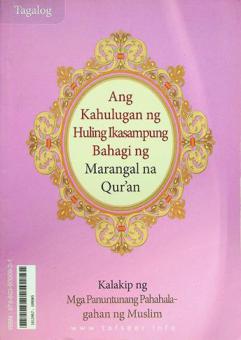
Ang kahulugan ng huling ikasampung bahagi ng marangal na Qurʼan = تفسير العشر الأخير من القرآن الكريم : kalakip ng mga panuntunang pahahalagahan ng Muslim
Selected parts of Qurʼan in Tagalog language.
Book

Learning to solve addition and subtraction word problems in English as an imported language
This paper reports an intervention phase of a design study aimed to assist second-grade Filipino children in solving addition word problems in English, a language they primarily encounter only in school. With Filipino as the medium of instruction, an out-of-school pedagogical intervention providing linguistic and representational scaffolds was implemented with 17 children. Pre-intervention, children experienced linguistic difficulties and were limited to conceptualising and solving simple additive structures. Post-intervention interviews revealed improved performance and understanding of more complex structures, but only when linguistic difficulties were minimised. The study identified socially and culturally driven barriers to learning: superficial strategies, children's engagement, and learning in an urban poor context.
Journal Article

When is similar different? When is different similar? A review of language assessment foci of selected Philippine English language textbooks
The centrality of textbooks in basic education calls for periodic assessment of their pedagogical, substantial and assessment features, thus ensuring optimum development of students?the end-users of all educational efforts. Cognizant of the fact that textbooks define the backbone of \"micro\" organizations for classroom activities (Schmidt, McKnight, & Raizen, 1997), this exploratory undertaking is aimed at identifying the dominant emphasis of a select group of Philippine textbooks in English with regards to macro skills, facets of understanding, and learning strategies. A total of 12 textbooks across four curriculum levels published from 2004 to 2006 were subjected to content analysis. Results indicate that Philippine English language textbooks put a premium on the writing and reading skills of students. There is continuing emphasis on the knowledge aspect of language assessment strategies, leaning toward behaviorism. Cognitive strategies are extensively employed alongwith memory strategies. Policy implications of the study are also discussed in this paper. [PUBLICATION ABSTRACT]
Journal Article

English Language Narratives of Filipino Children
Contact author: Elizabeth D. Peña, PhD, Department of Communication Sciences and Disorders, University of Texas at Austin, 1 University Station A1100, Austin, TX. Email: lizp{at}mail.utexas.edu
PURPOSE: The current study focuses on describing the English language narrative skills of children who have been exposed to the Filipino language.
METHOD: Eight children between the ages of 6;0 (years;months) and 7;7 who spoke primarily English but who were exposed to the Filipino language at home participated. Each child produced three narrative samples based on wordless picture books. Samples were analyzed for narrative complexity as well as measures of productivity and grammaticality.
RESULTS: The complexity of children's narratives was comparable to that reported in the literature for monolingual English-speaking children. Grammaticality measures show use of an average of 16.55% Filipino-influenced English forms across three stories. The observed patterns of Filipino-influenced English were predictable based on the comparison of English and Filipino structures. Variability in maze use was related to the amount of exposure to Filipino.
CLINICAL IMPLICATIONS: Care should be taken to evaluate grammaticality with respect to nonstandard English forms predicted by the rules of the language in contact with English. Further, maze use may be related to level of exposure to another language and should be further explored when using such information in language evaluation.
KEY WORDS: Filipino, English, narratives, complexity, grammaticality
CiteULike Connotea Del.icio.us Digg Facebook Reddit Technorati Twitter What's this?
Journal Article