
Catalogue Search | MBRL


Are you sure you want to remove the book from the shelf?

{{itemTitle}}
12,916
result(s) for
"Finance, Public Europe."
Sort by:


Political Transformations and Public Finances
How did today's rich states first establish modern fiscal systems? To answer this question, Political Transformations and Public Finances by Mark Dincecco examines the evolution of political regimes and public finances in Europe over the long term. The book argues that the emergence of efficient fiscal institutions was the result of two fundamental political transformations that resolved long-standing problems of fiscal fragmentation and absolutism. States gained tax force through fiscal centralization and restricted ruler power through parliamentary limits, which enabled them to gather large tax revenues and channel funds toward public services with positive economic benefits. Using a novel combination of descriptive, case study and statistical methods, the book pursues this argument through a systematic investigation of a new panel database that spans eleven countries and four centuries. The book's findings are significant for our understanding of economic history and have important consequences for current policy debates.
eBook


Public finance : lessons from the past and effects on the future
There are important lessons to be learned and analytical frameworks to be adapted and reused from the body of reference provided by the past history of public finance. This makes it possible to approach themes in terms of the actions of policy makers in various operating sectors of the economy: money, foreign exchange, finance, industry, labour relations, international trade, taxation and so on. One other key function carried out by the central authorities is the enactment and enforcement of rules governing competition between economic agents. Furthermore, in many countries, goods and services are produced by public sector enterprises, which emphasize that public intervention comes in many shapes and forms. In this book, attention centers on the fiscal sector, where government intervention has a crucial impact on private saving and investment, public spending decisions, taxation and government revenues, including the funding of budget deficits.
eBook

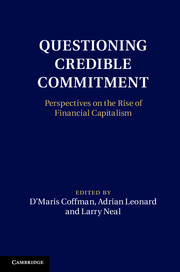
Questioning Credible Commitment
Financial capitalism emerged in a recognisably modern form in late seventeenth- and eighteenth-century Great Britain. Following the seminal work of Douglass C. North and Barry R. Weingast (1989), many scholars have concluded that the 'credible commitment' that was provided by parliamentary backing of government as a result of the Glorious Revolution of 1688 provided the key institutional underpinning on which modern public finances depend. In this book, a specially commissioned group of historians and economists examine and challenge the North and Weingast thesis to show that multiple commitment mechanisms were necessary to convince public creditors that sovereign debt constituted a relatively accessible, safe and liquid investment vehicle. Questioning Credible Commitment provides academics and practitioners with a broader understanding of the origins of financial capitalism, and, with its focus on theoretical and policy frameworks, shows the significance of the debate to current macroeconomic policy making.
eBook


War, Revenue, and State Building
In a relatively short time, the American state developed from a weak, highly decentralized confederation composed of thirteen former English colonies into the foremost global superpower. This remarkable institutional transformation would not have been possible without the revenue raised by a particularly efficient system of public finance, first crafted during the Civil War and then resurrected and perfected in the early twentieth century. That revenue financed America's participation in two global wars as well as the building of a modern system of social welfare programs.
Sheldon D. Pollack shows how war, revenue, and institutional development are inextricably linked, no less in the United States than in Europe and in the developing states of the Third World. He delineates the mechanisms of political development and reveals to us the ways in which the United States, too, once was and still may be a \"developing nation.\" Without revenue, states cannot maintain political institutions, undergo development, or exert sovereignty over their territory. Rulers and their functionaries wield the coercive powers of the state to extract that revenue from the population under their control. From this perspective, the state is seen as a highly efficient machine for extracting societal revenue that is used by the state to sustain itself.
War, Revenue, and State Buildingtraces the sources of public revenue available to the American state at specific junctures of its history (in particular, during times of war), the revenue strategies pursued by its political leaders in response to these factors, and the consequential impact of those strategies on the development of the American state.
eBook

The privatisation and nationalisation of European roads : success and failure in public-private partnerships
This distinctive and timely book examines the current state and trends in the ownership, management and financing of European high capacity roads. Offering an analysis of three pioneer countries in road privatization, Spain, France and Italy, from their origins to their recent developments, it evaluates how the design of privatisation policies may lead to their success or failure. Describing the trend in favouring public-private collaboration and road charging, Professor Daniel Albalate presents the theoretical framework of road privatisation and its relevant design issues. Exhaustively studying the national experiences in historical perspective, he aims at providing lessons on the good, the bad and the ugly of road privatisation. As a result, this excellent study shows the increasing role of private financing and ownership in Europe, a trend mainly explained by fiscal motivations and the thrust of the European Commission. Presenting an evaluation of the critical elements of the contractual and regulatory design of the public-private collaboration that determines the likelihood of success and failure, this unique book will be of special interest to academics, graduate students and policy makers interested in the public provision and financing of road infrastructure, and public finance more generally. --Publisher description.
Book

Kings, Knights and Bankers
In Kings, Knights, and Bankers, Richard Kaeuper presents a lifetime of medieval research on Italian financiers, English kingship, chivalric violence, and knightly piety. His foundational work on public finance connects Italian merchant banking with the growth of state power at the turn of the fourteenth century. Subsequent articles on law and order offer measured contributions to the continuing debate over the growth of governance and its relationship with contemporary disorder. He also convincingly proves that knights, the foremost military professionals of the medieval world, considered their prowess as both a source of honor and of sanctification. All interested in the history of medieval chivalry, governance, piety, and public finance can learn from this impressive collection of articles.
eBook