
Catalogue Search | MBRL


Are you sure you want to remove the book from the shelf?

{{itemTitle}}
34,053
result(s) for
"Finance -- Decision making"
Sort by:

Financial decision aid using multiple criteria : recent models and applications
This volume highlights recent applications of multiple-criteria decision-making (MCDM) models in the field of finance. Covering a wide range of MCDM approaches, including multiobjective optimization, goal programming, value-based models, outranking techniques, and fuzzy models, it provides researchers and practitioners with a set of MCDM methodologies and empirical results in areas such as portfolio management, investment appraisal, banking, and corporate finance, among others. The book addresses issues related to problem structuring and modeling, solution techniques, comparative analyses, as well as combinations of MCDM models with other analytical methodologies.
Book

Complex decision-making in economy and finance
Pertinent to modern industry, administration, finance and society, the most pressing issue for firms today is how to reapproach the way we think and work in business.
With topics ranging from improving productivity and coaxing economic growth after periods of market inactivity, Complex Decision-Making in Economy and Finance offers pragmatic solutions for dealing with the critical levels of disorder and chaos that have developed throughout the modern age.
This book examines how to design complex products and systems, the benefits of collective intelligence and self-organization, and the best methods for handling risks in problematic environments. It also analyzes crises and how to manage them. This book is of benefit to companies and public bodies with regards to saving assets, reviving fortunes and laying the groundwork for robust, sustainable societal dividends. Examples, case studies, practical hints and guidelines illustrate the topics, particularly in finance.
eBook


Investing in Financial Research
Every day, people around the world make financial decisions. They choose to invest in a stock, sell their holdings in a mutual fund or buy a condominium. These decisions are complex and financially tricky-even for financial professionals. But the literature available on financial research is dated and narrowly focused without any real practical application. Until now there's been a gap in the literature: a book that shows you how to conduct a step by step comprehensive financial investigation that ends in a decision.
This book gives you that how.
Investing In Financial Research is a guidebook for conducting financial investigations and lays out Cheryl Strauss Einhorn's AREA Method-a research and decision-making system that uniquely controls for bias, focuses on the incentives of others and expands knowledge while improving judgement-and applies it to investigating financial situations. AREA is applicable to all sorts of financial sleuthing, whether for investment analysis or investigative journalism. It allows you to be the expert in your own life.
The AREA Method provides you with:
-Defined tasks that guide and focus your research on your vision of success;
-A structure that isolates your sources, giving you insight into their perspectives, biases and incentives;
-Investigative resources, tips and techniques to upgrade your research and analysis beyond document-based sources;
-Exercises to foster creativity and originality in your thinking;
-A sequence and framework that brings your disparate pieces of research together to build your confidence and conviction about your financial decision.
eBook


Finding alphas : a quantitative approach to building trading strategies
Discover the ins and outs of designing predictive trading models Drawing on the expertise of WorldQuant's global network, this new edition of Finding Alphas: A Quantitative Approach to Building Trading Strategies contains significant changes and updates to the original material, with new and updated data and examples.
eBook

Applications of management science
'Applications of Management Science' focuses on the application of management science to multiple criteria decision making, data envelopment analysis, and managerial applications.
Book
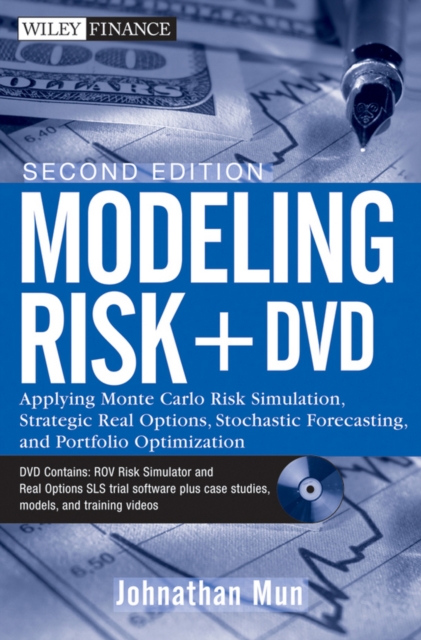
Modeling risk : applying Monte Carlo risk simulation, strategic real options, stochastic forecasting, and portfolio optimization
An updated guide to risk analysis and modeling Although risk was once seen as something that was both unpredictable and uncontrollable, the evolution of risk analysis tools and theories has changed the way we look at this important business element. In the Second Edition of Analyzing and Modeling Risk, expert Dr. Johnathan Mun provides up-to-date coverage of risk analysis as it is applied within the realms of business risk analysis and offers an intuitive feel of what risk looks like, as well as the different ways of quantifying it. This Second Edition provides professionals in all industries a more comprehensive guide on such key concepts as risk and return, the fundamentals of model building, Monte Carlo simulation, forecasting, time-series and regression analysis, optimization, real options, and more. Includes new examples, questions, and exercises as well as updates using Excel 2007 Book supported by author's proprietary risk analysis software found on the companion CD-ROM Offers both a qualitative and quantitative description of risk Filled with in-depth insights and practical advice, this reliable resource covers all of the essential tools and techniques that risk managers need to successfully conduct risk analysis. Note: CD-ROM/DVD and other supplementary materials are not included as part of eBook file.
eBook


Accidental logics : the dynamics of change in the health care arena in the United States, Britain, and Canada
Health care reform has become one of the most prevalent topics in recent policy discourse within and across nations. In the 1990s, common features of the health care arena elevated the importance of bargaining relationships among large, sophisticated entities as the dominant mode of decision-making, fundamentally challenging the traditional dominance of the medical profession, which had been grounded in individualized “agency” relationships between providers and patients. These developments have played out in varying ways around the globe. Carolyn Hughes Tuohy looks at the experiences of the United States, Britain, and Canada, offering an international comparative study of public policy systems, as well as a recent history of the evolution of each national health care system. What drives change in health care systems? Why do certain changes occur in some nations and not in others? Tuohy argues that the answer lies in understanding the “accidents” of history that have shaped national systems at critical moments and in the distinctive “logics” of these systems. Her study carefully delineates both the common logic of the health care arena, deriving from micro-economic characteristics and technological change, and the particular logics of national systems, put in place by specific episodes of policy change. She goes on to explore how in the wake of these episodes, the mixed market in the United States, hierarchical corporatism in Britain, and the single-payer system in Canada determined the subsequent direction and pace of change in all three countries. Finally, Tuohy provides suggestions to guide the strategic judgments that decision-makers must make within the health care system of each country. Accidental Logics uniquely departs from the descriptive literature currently available by presenting an extensive review of the evidence regarding the evolution of the health care arenas in the United States, Britain, and Canada, integrated within an explanatory framework. It is essential up-to-date reading for political scientists working in comparative politics and public policy, health policy analysts, government agency officials, and students in political science, health policy, and administration programs.
eBook