
Catalogue Search | MBRL


Are you sure you want to remove the book from the shelf?

{{itemTitle}}
11,656
result(s) for
"Finance Econometric models."
Sort by:


Anticipating Correlations
Financial markets respond to information virtually instantaneously. Each new piece of information influences the prices of assets and their correlations with each other, and as the system rapidly changes, so too do correlation forecasts. This fast-evolving environment presents econometricians with the challenge of forecasting dynamic correlations, which are essential inputs to risk measurement, portfolio allocation, derivative pricing, and many other critical financial activities. In Anticipating Correlations, Nobel Prize-winning economist Robert Engle introduces an important new method for estimating correlations for large systems of assets: Dynamic Conditional Correlation (DCC). Engle demonstrates the role of correlations in financial decision making, and addresses the economic underpinnings and theoretical properties of correlations and their relation to other measures of dependence. He compares DCC with other correlation estimators such as historical correlation, exponential smoothing, and multivariate GARCH, and he presents a range of important applications of DCC. Engle presents the asymmetric model and illustrates it using a multicountry equity and bond return model. He introduces the new FACTOR DCC model that blends factor models with the DCC to produce a model with the best features of both, and illustrates it using an array of U.S. large-cap equities. Engle shows how overinvestment in collateralized debt obligations, or CDOs, lies at the heart of the subprime mortgage crisis--and how the correlation models in this book could have foreseen the risks. A technical chapter of econometric results also is included.
eBook

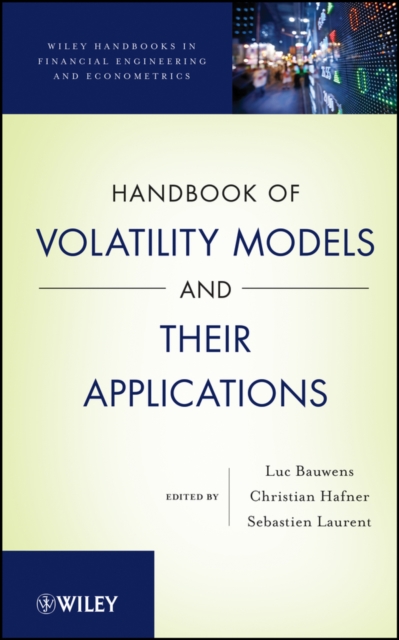
Handbook of volatility models and their applications
\"The main purpose of this handbook is to illustrate the mathematically fundamental implementation of various volatility models in the banking and financial industries, both at home and abroad, through use of real-world, time-sensitive applications. Conceived and written by over two-dozen experts in the field, the focus is to cohesively demonstrate how 'volatile' certain statistical decision-making techniques can be when solving a range of financial problems. By using examples derived from consulting projects, current research and course instruction, each chapter in the book offers a systematic understanding of the recent advances in volatility modeling related to real-world situations. Every effort is made to present a balanced treatment between theory and practice, as well as to showcase how accuracy and efficiency in implementing various methods can be used as indispensable tools in assessing volatility rates. Unique to the book is in-depth coverage of GARCH-family models, contagion, and model comparisons between different volatility models. To by-pass tedious computation, software illustrations are presented in an assortment of packages, ranging from R, C++, EXCEL-VBA, Minitab, to JMP/SAS\"--Proporcionado por la editorial.
eBook

Post-Keynesian empirical research and the debate on financial market development
\"This book integrates the concept of financial intermediaries with Post-Keynesian macroeconomic modeling to discuss the relationship between financial markets and systems and macroeconomic development by discussing key macroeconomic variables such as investment, savings, and productivity growth\"-- Provided by publisher.
Book
An introduction to analysis of financial data with R
A complete set of statistical tools for beginning financial analysts from a leading authority Written by one of the leading experts on the topic, An Introduction to Analysis of Financial Data with R explores basic concepts of visualization of financial data. Through a fundamental balance between theory and applications, the book supplies readers with an accessible approach to financial econometric models and their applications to real-world empirical research. The author supplies a hands-on introduction to the analysis of financial data using the freely available R software package and case studies to illustrate actual implementations of the discussed methods. The book begins with the basics of financial data, discussing their summary statistics and related visualization methods. Subsequent chapters explore basic time series analysis and simple econometric models for business, finance, and economics as well as related topics including: Linear time series analysis, with coverage of exponential smoothing for forecasting and methods for model comparison Different approaches to calculating asset volatility and various volatility models High-frequency financial data and simple models for price changes, trading intensity, and realized volatility Quantitative methods for risk management, including value at risk and conditional value at risk Econometric and statistical methods for risk assessment based on extreme value theory and quantile regression Throughout the book, the visual nature of the topic is showcased through graphical representations in R, and two detailed case studies demonstrate the relevance of statistics in finance. A related website features additional data sets and R scripts so readers can create their own simulations and test their comprehension of the presented techniques. An Introduction to Analysis of Financial Data with R is an excellent book for introductory courses on time series and business statistics at the upper-undergraduate and graduate level. The book is also an excellent resource for researchers and practitioners in the fields of business, finance, and economics who would like to enhance their understanding of financial data and today's financial markets.
eBook

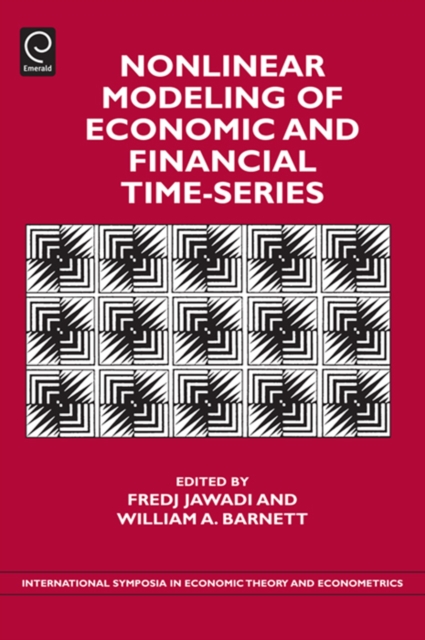
Nonlinear Modeling of Economic and Financial Time-Series
Within the subprime crisis (2007) and the recent global financial crisis of 2008-2009, we have observed significant decline, corrections and structural changes in most US and European financial markets. Furthermore, it seems that this crisis has been rapidly transmitted toward the most developed and emerging countries and has strongly affected the whole economy. This volume aims to present recent researches in linear and nonlinear modelling of economic and financial time-series. The several discussions of empirical results of its chapters clearly help to improve the understanding of the financial mechanisms inherent to this crisis. They also yield an important overview on the sources of the financial crisis and its main economic and financial consequences. The book provides the audience a comprehensive understanding of financial and economic dynamics in various aspects using modern financial econometric methods. It addresses the empirical techniques needed by economic agents to analyze the dynamics of these markets and illustrates how they can be applied to the actual data. It also presents and discusses new research findings and their implications.
eBook

The basics of financial econometrics : tools, concepts, and asset management applications
An accessible guide to the growing field of financial econometrics
As finance and financial products have become more complex, financial econometrics has emerged as a fast-growing field and necessary foundation for anyone involved in quantitative finance. The techniques of financial econometrics facilitate the development and management of new financial instruments by providing models for pricing and risk assessment. In short, financial econometrics is an indispensable component to modern finance.
The Basics of Financial Econometrics covers the commonly used techniques in the field without using unnecessary mathematical/statistical analysis. It focuses on foundational ideas and how they are applied. Topics covered include: regression models, factor analysis, volatility estimations, and time series techniques.
* Covers the basics of financial econometrics—an important topic in quantitative finance
* Contains several chapters on topics typically not covered even in basic books on econometrics such as model selection, model risk, and mitigating model risk
Geared towards both practitioners and finance students who need to understand this dynamic discipline, but may not have advanced mathematical training, this book is a valuable resource on a topic of growing importance.
eBook