
Catalogue Search | MBRL


Are you sure you want to remove the book from the shelf?

{{itemTitle}}
614
result(s) for
"Finance Social aspects Case studies."
Sort by:


Conservatives Versus Wildcats
For decades, the banking industry seemed to be a Swiss watch, quietly ticking along. But the recent financial crisis hints at the true nature of this sector. As Simone Polillo reveals inConservatives Versus Wildcats, conflict is a driving force.
Conservative bankers strive to control money by allying themselves with political elites to restrict access to credit. Barriers to credit create social resistance, so rival bankers-wildcats-attempt to subvert the status quo by using money as a tool for breaking existing boundaries. For instance, wildcats may increase the circulation of existing currencies, incorporate new actors in financial markets, or produce altogether new financial instruments to create change.
Using examples from the economic and social histories of 19th-century America and Italy, two decentralized polities where challenges to sound banking originated from above and below, this book reveals the collective tactics that conservative bankers devise to legitimize strict boundaries around credit-and the transgressive strategies that wildcat bankers employ in their challenge to this restrictive stance.
eBook


Weaponized Interdependence
Liberals claim that globalization has led to fragmentation and decentralized networks of power relations. This does not explain how states increasingly “weaponize interdependence” by leveraging global networks of informational and financial exchange for strategic advantage. The theoretical literature on network topography shows how standard models predict that many networks grow asymmetrically so that some nodes are far more connected than others. This model nicely describes several key global economic networks, centering on the United States and a few other states. Highly asymmetric networks allow states with (1) effective jurisdiction over the central economic nodes and (2) appropriate domestic institutions and norms to weaponize these structural advantages for coercive ends. In particular, two mechanisms can be identified. First, states can employ the “panopticon effect” to gather strategically valuable information. Second, they can employ the “chokepoint effect” to deny network access to adversaries. Tests of the plausibility of these arguments across two extended case studies that provide variation both in the extent of U.S. jurisdiction and in the presence of domestic institutions—the SWIFT financial messaging system and the internet—confirm the framework’s expectations. A better understanding of the policy implications of the use and potential overuse of these tools, as well as the response strategies of targeted states, will recast scholarly debates on the relationship between economic globalization and state coercion.
Journal Article

A method to evaluate equitable accessibility: combining ethical theories and accessibility-based approaches
In this paper, we present the case that traditional transport appraisal methods do not sufficiently capture the social dimensions of mobility and accessibility. However, understanding this is highly relevant for policymakers to understand the impacts of their transport decisions. These dimensions include the distribution of mobility and accessibility levels over particular areas or for specific population groups, as well as how this may affect various social outcomes, including their levels of participation, social inclusion and community cohesion. In response, we propose a method to assess the socially relevant accessibility impacts (SRAIs) of policies in some of these key dimensions. The method combines the use of underlying ethics principles, more specifically the theories of
egalitarianism
and
sufficientarianism
, in combination with accessibility-based analysis and the Lorenz curve and Gini index. We then demonstrate the method in a case study example. Our suggestion is that policymakers can use these ethical perspectives to determine the equity of their policies decisions and to set minimum standards for local transport delivery. This will help them to become more confident in the development and adoption of new decision frameworks that promote accessibility over mobility and which also disaggregate the costs and benefits of transport policies over particular areas or for specific under-served population groups.
Journal Article

Opportunities to Increase Financial Well-Being by Investing in Environmental, Social and Governance with Respect to Improving Financial Literacy under COVID-19: The Case of Latvia
The latest studies reveal that the COVID-19 pandemic has pushed investors in developed economies to focus more on the value attached to environmental and social responsibilities. Unfortunately, socially responsible investment and compliance with environmental, social and governance criteria are not given enough priority in Latvia at present. The purpose of the study is to investigate how the COVID-19 pandemic has influenced the willingness of Latvians to invest in assets that meet environmental, social and governance (ESG) criteria and factors influencing investors’ choice based on their financial literacy. Different views on sustainable investments, socially responsible investments and the relevance of environmental, social and governance criteria from private investors’ perspectives were analyzed to identify factors influencing investment decisions in favour of sustainable investments. Quantitative analysis was carried out to reveal the regularities between financial literacy, the willingness to invest to meet the ESG criteria and the level of education and income of the Latvian population, as well as their savings/investment experience. Such statistical methods as descriptive statistics and hypothesis testing were applied to perform an analysis of the results. The authors’ findings include the importance of sustainable investing to Latvian society, changes of attitude towards ESG investing in different private investors’ groups under the COVID-19 crisis, and the effects of these changes on the financial well-being of the population and, on the basis of these findings, have come to the conclusion that the willingness to invest in the assets that follow environmental, social and governance criteria depends on the level of education, savings/investment experience and income level.
Journal Article

Analyzing the situation of older family caregivers with a focus on health-related quality of life and pain: a cross-sectional cohort study
Background
For a significant proportion of the older population, increasing age is associated with health problems and worsening health. Older family caregivers are largely responsible for care of next-of-kin living at home, which impacts their own physical and mental health both positively and negatively. However, evidence is insufficient regarding the health situation of older caregivers. The aim of this study was to investigate health-related quality of life (HRQoL) and pain, and their associations, among caregivers aged ≥60 years.
Methods
The participants (
n
= 3444) were recruited from the Swedish National Study on Aging and Care-Blekinge and Good Aging in Skåne during 2001–2004. Participants aged ≥60 years were selected randomly and underwent cognitive tests, with demographic information obtained through questionnaires. The response rate was 60%. A predefined research protocol was used. HRQoL was measured with the Short-Form Health Survey, dimension mental health. Logistic regression models were used to investigate the associations between HRQoL and pain as well as control factors.
Results
Family caregiving was reported by 395 (11.5%) of the participants, and 56.7% of the caregivers reported pain. Family caregivers reported lower pain intensity on the Visual Analogue Scale and were younger, on median, than non-caregivers. Irrespective of caregiver status, pain was associated with mental HRQoL. Concerns about personal health and financial status had the strongest associations with mental HRQOL in both groups, but the levels were higher among caregivers.
Conclusion
Pain was one factor associated with low HRQoL regardless of family caregiver status and remained important when controlling for factors related to advanced age. This finding remained among family caregivers, though they reported lower pain intensity. Factors other than pain were shown to be important to mental HRQoL and should also be taken into consideration when discussing actions for family caregivers to maintain and improve health and HRQoL.
Trial registration number
Not applicable.
Journal Article

Rana Plaza collapse aftermath: are CSR compliance and auditing pressures effective?
Purpose – The purpose of this paper is to investigate the intended and unintended consequences of compliance and auditing pressures in the Bangladeshi garment industry. To explore this issue the authors draw on three medium-sized suppliers. The institutional changes that followed the Rana Plaza accident in April 2013 make Bangladesh in general and the garment industry in particular an interesting and suitable research setting for standards compliance. Design/methodology/approach – The study adopts a multiple case study approach. Face-to-face interviews have been conducted with the owners of three Bangladeshi garment manufacturing firms and several workers. Additionally, organisational documents and local newspaper articles had been collected wherever possible. Findings – The results indicate that the pressure for compliance has led the case companies to prioritise the implementation of measurable standards over the socially grounded needs and priorities of workers. As a consequence certain initiatives instead of adding new social value in fact destroyed previously existing social value. Furthermore, the pressure for compliance created the necessity to find ways to cover the sizable cost of compliance. This prompted firms to pursue process upgrading through technological advancements and increased work pressures on the labour force. These initiatives led to an increased power imbalance and the exclusion of unskilled workers from the job market. Research limitations/implications – The paper contributes to the understanding of the human rights implications of compliance and auditing pressures and initiatives. Furthermore, in order to further enrich existing knowledge in the critical accounting literature, the study draws on insights from the global value chains (GVC) and international business (IB) literatures. Originality/value – The paper contributes to the understanding of the human rights implications of compliance and auditing pressures and initiatives. Furthermore, in order to further enrich existing knowledge in the critical accounting literature, the study draws on insights from the GVC and IB literatures.
Journal Article
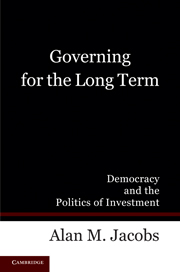
Governing for the Long Term
In Governing for the Long Term, Alan M. Jacobs investigates the conditions under which elected governments invest in long-term social benefits at short-term social cost. Jacobs contends that, along the path to adoption, investment-oriented policies must surmount three distinct hurdles to future-oriented state action: a problem of electoral risk, rooted in the scarcity of voter attention; a problem of prediction, deriving from the complexity of long-term policy effects; and a problem of institutional capacity, arising from interest groups' preferences for distributive gains over intertemporal bargains. Testing this argument through a four-country historical analysis of pension policymaking, the book illuminates crucial differences between the causal logics of distributive and intertemporal politics and makes a case for bringing trade-offs over time to the center of the study of policymaking.
eBook

Prosper or perish
The official banking institutions for rural China are Rural Credit Cooperatives (RCCs). Although these co-ops are mandated to support agricultural development among farm households, since 1980 half of RCC loans have gone to small and medium-sized industrial enterprises located in, and managed by, townships and villages. These township and village enterprises have experienced highly uneven levels of success, and by the end of the 1990s, half of all RCC loans were in or close to default, forcing China's central bank to bail out RCCs. InProsper or Perish, Lynette H. Ong examines the bias in RCC lending patterns, focusing on why the mobilization of rural savings has contributed to successful industrial development in some locales but not in others.
Interweaving insightful and theoretically informed discussions of rural credit, development, governance, and bank bailouts, Ong identifies various sources for China's uneven development. In the highly decentralized fiscal environment of the People's Republic, successful industrialization has significant implications for rural governance. Local governments depend on revenue from industrial output to provide public goods and services; unsuccessful enterprises starve local governments of revenue and result in radical cutbacks in services. High peasant burdens, land takings without adequate compensation by local governments, and other poor governance practices tend to be associated with unsuccessful industrialization. In light of the recent liberalization of the rural credit sector in China,Prosper or Perishmakes a significant contribution to debates within political science, economic development, and international banking.
eBook