
Catalogue Search | MBRL


Are you sure you want to remove the book from the shelf?

{{itemTitle}}
6,045
result(s) for
"Financial deregulation"
Sort by:


Structural causes of the global financial crisis: a critical assessment of the ‘new financial architecture’
We are in the midst of the worst financial crisis since the Great Depression. This crisis is the latest phase of the evolution of financial markets under the radical financial deregulation process that began in the late 1970s. This evolution has taken the form of cycles in which deregulation accompanied by rapid financial innovation stimulates powerful financial booms that end in crises. Governments respond to crises with bailouts that allow new expansions to begin. As a result, financial markets have become ever larger and financial crises have become more threatening to society, which forces governments to enact ever larger bailouts. This process culminated in the current global financial crisis, which is so deeply rooted that even unprecedented interventions by affected governments have, thus far, failed to contain it. In this paper we analyse the structural flaws in the financial system that helped bring on the current crisis and discuss prospects for financial reform.
Journal Article

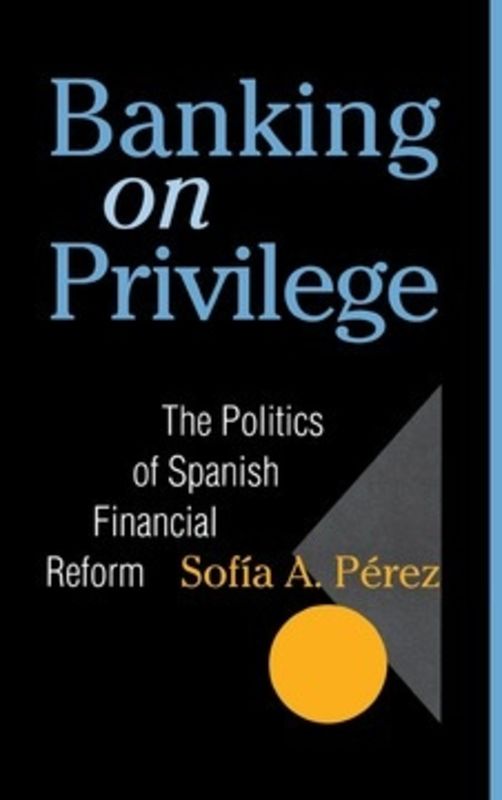
Banking on Privilege
'This is a remarkable book, engrossing and exceptionally well organized. The argument is clear, elegant, and subtle. My guess is that Banking on Privilege will quickly earn a place as one of the standards of comparative political economy.'-Peter McDonough, Arizona State University 'This wonderfully researched study of the mutual accommodation between private and central bankers in Spain offers a compelling alternative to state and market-driven conceptions of financial regulation and reform. The author's careful theoretical crafting and mastery of historical detail assures this book a place beside the works by Zysman, Loriaux, Woo, and a few others on a narrow shelf of essential texts about the comparative political economy of financial systems. No serious observer of financial and monetary reform in Europe can afford to ignore this impressive book.'-Mauro F. Guillen, The Wharton School, University of Pennsylvania
'This is a thoroughly researched and meticulously argued piece of scholarship that contributes much substance to our knowledge of finance and financial reform in other countries and brings many provocative ideas to theoretical debate.'-Michael Loriaux, Northwestern University
eBook


After the Crash: The Future of Finance
As the global economy continues to weather the effects of the recession brought on by the financial crisis of 2007-08, perhaps no sector has been more affected and more under pressure to change than the industry that was the focus of that crisis: financial services. But as policymakers, financial experts, lobbyists, and others seek to rebuild this industry, certain questions loom large. For example, should the pay of financial institution executives be regulated to control risk taking? That possibility certainly has been raised in official circles, with spirited reactions from all corners. How will stepped-up regulation affect key parts of the financial services industry? And what lies ahead for some of the key actors in both the United States and Japan?
InAfter the Crash, noted economists Yasuyuki Fuchita, Richard Herring, and Robert Litan bring together a distinguished group of experts from academia and the private sector to take a hard look at how the financial industry and some of its practices are likely to change in the years ahead. Whether or not you agree with their conclusions, the authors of this volume -the most recent collaboration between Brookings, the Wharton School, and the Nomura Institute of Capital Markets Research -provide well-grounded insights that will be helpful to financial practitioners, analysts, and policymakers.
eBook

Foreclosed
In 2007 and 2008, the United States has observed, with some horror, the explosion and collapse of entire segments of the housing market, especially those driven by subprime and alternative or \"exotic\" home mortgage lending.Foreclosedexplains the rise of high-risk lending and why these newer types of loans-and their associated regulatory infrastructure-failed in substantial ways. Dan Immergluck narrates the boom in subprime and exotic loans, recounting how financial innovations and deregulation facilitated excessive risk-taking, and how these loans have harmed different populations and communities.
Immergluck, who has been working, researching, and writing on issues tied to housing finance and neighborhood change for almost twenty years, has an intimate knowledge of the promotion of homeownership and the history of mortgages in the United States. The changes to the mortgage market over the past fifteen years-including the securitization of mortgages and the failure of regulators to maintain control over a much riskier array of mortgage products-led, he finds, inexorably to the current crisis.
After describing the development of generally stable and risk-limiting mortgage markets throughout much of the twentieth century, Foreclosed details how federal policy-makers failed to regulate the new high-risk lending markets that arose in the late 1990s and early 2000s. The book also examines federal, state, and local efforts to deal with the mortgage and foreclosure crisis of 2007 and 2008. Immergluck draws upon his wealth of experience to provide an overarching set of principles and a detailed set of policy recommendations for \"righting the ship\" of U.S. housing finance in ways that will promote affordable yet sustainable homeownership as an option for a broad set of households and communities.
The 2011 paperback edition features a new preface by the author addressing the ongoing global economic crisis and the impact of U.S. financial reform efforts on the mortgage system.
eBook

Financial deregulation and monetary policy in Australia
In recent years, the pace of financial deregulation in Australia has accelerated. Less reliance on direct controls, a floating currency and a less regulated banking system will all serve to transform the Australian financial system, but what will this imply for policymakers? The present article addresses the question from a monetary policy viewpoint and establishes some of the difficulties that policy makers are likely to face as the system evolves. Perhaps the most crucial test facing authorities is the need to strike an ‘appropriate’ balance between preserving the stability of the payments system and ensuring competitive equity between financial intermediaries, bank and non-bank. JEL: E52
Journal Article

Does Foreign Direct Investment Promote Human Capital Accumulation? The Role of Gradual Financial Liberalization
We argue that the effect of inward foreign direct investment (FDI) on domestic human capital (HC) accumulation depends on the degree of financial deregulation. Using 383 observations from provincial yearly panel data of the reform period in China, we find the following: FDI has a positive and significant interaction effect with financial deregulation on HC in both least squares dummy variable and system generalized method of moments estimations that address the endogeneity of all important explanatory variables including FDI, financial deregulation, and their interaction term. That is, a higher level of financial deregulation increases the marginal effect of inward FDI on domestic HC.
Journal Article

The Effect of Bank-firm Relationships on Sell-side Research
In this paper, I examine how the lending relationships between banks and their borrowers affect the quality of analysts’ earnings forecasts after financial deregulation in Japan. My findings show that short-term lending relationships improve the quality of analysts’ earnings forecasts and that these earnings forecasts are useful for predicting future returns. In contrast, long-term lending relationships decay the quality of forecast and are not valuable for the prediction of future returns. These empirical results indicate that the informational advantage that commercial banks acquire is short-term and that the costs of lending relationships surpass the informational benefits in the long run.
Journal Article