
Catalogue Search | MBRL


Are you sure you want to remove the book from the shelf?

{{itemTitle}}
59
result(s) for
"Finnish language Texts"
Sort by:
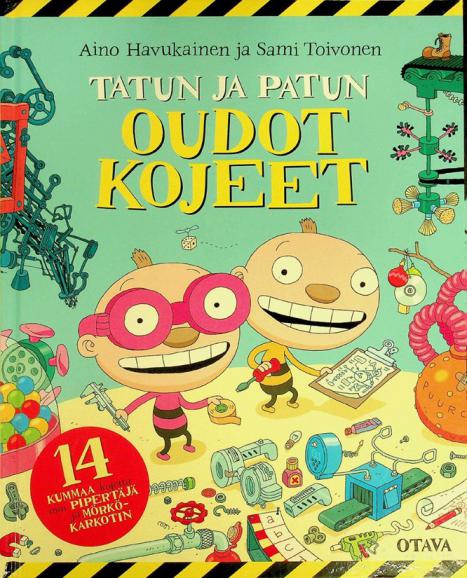
Tatun ja Patun oudot kojeet
Speedy brothers Tatu and Patu plan to build a weird but insanely useful machine, without which none of the families with children can do without.
Book

Digital communication as part of family language policy: the interplay of multimodality and language status in a Finnish context
While mobile app-mediated communication between children and members of their family represents a substantial part of contemporary family communication and language input, we still know very little about the role of these technologies in family language policy (FLP). With an explorative questionnaire survey, the current study set out to examine (1) how Finnish state and language-in-education policies intersect with how families make use of their languages in spoken and in app-mediated communication, and (2) to what extent app-mediated FL practices function as a space for spoken and literacy language development. 1002 nine to twelve year-olds in minority-language Swedish-medium schools in Finland responded to the survey. The results showed the dominance of the two national, high-status languages Swedish and Finnish in the families, with texting being the most common app practice. Languages other than Swedish and Finnish (LOTSF) were used in 17% of the families and to a great extent also in the family apps. While app-mediated family communications overall were shown to serve as significant spaces for language and literacy development, in some cases of LOTSF with a lower status and less educational support, and with linguistic and writing systems deviating from Swedish and Finnish, children refrained from texting in the apps. The findings suggest that the relationship between choice of modalities in language(s) of different status and educational support is complex and needs further attention in future FLP studies.
Journal Article

The relationship between grammatical understanding and writing skills in Finnish secondary L1 education
Previous studies have indicated that students’ writing skills benefit from contextualized L1 grammar teaching, in which language structures are observed and analyzed in authentic texts and as embedded into teaching of reading and writing. The contextualized approach is also promoted by the current Finnish curriculum for basic education. This study investigates the relationship between grammatical understanding and writing skills using statistical methods as well as a complementary qualitative analysis of student texts. The data are derived from a large cross-sectional assessment of L1 learning achievement in Finnish year 9 students (N = 6,044). Linear regression analyses indicate that grammatical understanding is a significant predictor of writing skills and correlates strongly with the syntactic, stylistic, genre-related, and orthographical quality of the students’ argumentative texts. Weaker writers use less complex vocabulary and sometimes “lose control” of syntactic structures. Learning grammar is related to metalinguistic understanding which, in turn, helps writers to analyze and control their language use, and thus produce better texts.
Journal Article

Exploring Political Mistrust in Pandemic Risk Communication: Mixed-Method Study Using Social Media Data Analysis
This research extends prior studies by the Finnish Institute for Health and Welfare on pandemic-related risk perception, concentrating on the role of trust in health authorities and its impact on public health outcomes. The paper aims to investigate variations in trust levels over time and across social media platforms, as well as to further explore 12 subcategories of political mistrust. It seeks to understand the dynamics of political trust, including mistrust accumulation, fluctuations over time, and changes in topic relevance. Additionally, the study aims to compare qualitative research findings with those obtained through computational methods. Data were gathered from a large-scale data set consisting of 13,629 Twitter and Facebook posts from 2020 to 2023 related to COVID-19. For analysis, a fine-tuned FinBERT model with an 80% accuracy rate was used for predicting political mistrust. The BERTopic model was also used for superior topic modeling performance. Our preliminary analysis identifies 43 mistrust-related topics categorized into 9 major themes. The most salient topics include COVID-19 mortality, coping strategies, polymerase chain reaction testing, and vaccine efficacy. Discourse related to mistrust in authority is associated with perceptions of disease severity, willingness to adopt health measures, and information-seeking behavior. Our findings highlight that the distinct user engagement mechanisms and platform features of Facebook and Twitter contributed to varying patterns of mistrust and susceptibility to misinformation during the pandemic. The study highlights the effectiveness of computational methods like natural language processing in managing large-scale engagement and misinformation. It underscores the critical role of trust in health authorities for effective risk communication and public compliance. The findings also emphasize the necessity for transparent communication from authorities, concluding that a holistic approach to public health communication is integral for managing health crises effectively.
Journal Article

MELHISSA: a multilingual entity linking architecture for historical press articles
Digital libraries have a key role in cultural heritage as they provide access to our culture and history by indexing books and historical documents (newspapers and letters). Digital libraries use natural language processing (NLP) tools to process these documents and enrich them with meta-information, such as named entities. Despite recent advances in these NLP models, most of them are built for specific languages and contemporary documents that are not optimized for handling historical material that may for instance contain language variations and optical character recognition (OCR) errors. In this work, we focused on the entity linking (EL) task that is fundamental to the indexation of documents in digital libraries. We developed a Multilingual Entity Linking architecture for HIstorical preSS Articles that is composed of multilingual analysis, OCR correction, and filter analysis to alleviate the impact of historical documents in the EL task. The source code is publicly available. Experimentation has been done over two historical document corpora covering five European languages (English, Finnish, French, German, and Swedish). Results have shown that our system improved the global performance for all languages and datasets by achieving an F-score@1 of up to 0.681 and an F-score@5 of up to 0.787.
Journal Article

Telecollaboration In Japanese Among Spanish And Finnish Students: Its Potential For Motivation And Mediation
The practice of telecollaboration has gained traction since the early 2000s as a means of facilitating intercultural communication across distant locations. However, its potential to enhance learning motivation and the acquisition of intercultural mediation competence remains underexplored. This study investigated the motivational components influenced by telecollaboration and examined the potential of lingua franca telecollaboration to foster mediation competence, as outlined in the CEFR Companion Volume. We conducted mixed-method analyses on data from a case study of telecollaboration in 2022 between Spanish and Finnish university students studying Japanese as a foreign language. The results from a t-test using an ARCS six-item questionnaire confirmed a significant increase in students’ sense of challenge and a decline in their self-confidence, while changes in other motivational factors were not statistically significant. Furthermore, text analysis and an in-depth descriptive analysis of students’ reflection comments revealed that the decrease in self-confidence was caused by differences in language proficiency levels. Additionally, the findings suggest that telecollaboration among students with varying language proficiency levels may facilitate the development and practice of mediation competence, contributing to the co-construction of meaning among intercultural speakers. Thus, the study provides new insights into the central role of self-confidence in motivation and suggests that telecollaboration among students with different language levels is an effective activity for training intercultural mediation strategies.
Journal Article

Analyzing the unrestricted web: The finnish corpus of online registers
This article introduces the Finnish Corpus of Online Registers (FinCORE) representing the full range of registers – situationally defined text varieties such as news and blogs – on the Finnish Internet. The extreme range of language use found online has challenged the study of registers. It has been unclear what registers the entire Internet includes, and if they can be sufficiently defined to allow for their analysis or classification, previous studies focusing on restricted sets of registers and English. FinCORE features 10,754 texts from the unrestricted web, manually annotated for their register using a scheme originally established for the Corpus of Online Registers of English (CORE). We present the FinCORE registers and compare them to CORE. Finally, we show that the FinCORE registers are sufficiently well-defined to allow for their automatic identification, thus opening novel possibilities for both linguistics and web-as-corpus research. FinCORE is published under an open license.
Journal Article

A product and process analysis of post-editor corrections on neural, statistical and rule-based machine translation output
This paper presents a comparison of post-editing (PE) changes performed on English-to-Finnish neural (NMT), rule-based (RBMT) and statistical machine translation (SMT) output, combining a product-based and a process-based approach. A total of 33 translation students acted as participants in a PE experiment providing both post-edited texts and edit process data. Our product-based analysis of the post-edited texts shows statistically significant differences in the distribution of edit types between machine translation systems. Deletions were the most common edit type for the RBMT, insertions for the SMT, and word form changes as well as word substitutions for the NMT system. The results also show significant differences in the correctness and necessity of the edits, particularly in the form of a large number of unnecessary edits in the RBMT output. Problems related to certain verb forms and ambiguity were observed for NMT and SMT, while RBMT was more likely to handle them correctly. Process-based comparison of effort indicators shows a slight increase of keystrokes per word for NMT output, and a slight decrease in average pause length for NMT compared to RBMT and SMT in specific text blocks. A statistically significant difference was observed in the number of visits per sub-segment, which is lower for NMT than for RBMT and SMT. The results suggest that although different types of edits were needed to outputs from NMT, RBMT and SMT systems, the difference is not necessarily reflected in process-based effort indicators.
Journal Article

Extracting Information from Unstructured Medical Reports Written in Minority Languages: A Case Study of Finnish
In the era of digital healthcare, electronic health records generate vast amounts of data, much of which is unstructured, and therefore, not in a usable format for conventional machine learning and artificial intelligence applications. This study investigates how to extract meaningful insights from unstructured radiology reports written in Finnish, a minority language, using machine learning techniques for text analysis. With this approach, unstructured information could be transformed into a structured format. The results of this research show that relevant information can be effectively extracted from Finnish medical reports using classification algorithms with default parameter values. For the detection of breast tumour mentions from medical texts, classifiers achieved high accuracy, almost 90%. Detection of metastasis mentions, however, proved more challenging, with the best-performing models Support Vector Machine (SVM) and logistic regression achieving an F1-score of 81%. The lower performance in metastasis detection is likely due to the more complex problem, ambiguous labeling, and the smaller dataset size. The results of classical classifiers were also compared with FinBERT, a domain-adapted Finnish BERT model. However, classical classifiers outperformed FinBERT. This highlights the challenge of medical language processing when working with minority languages. Moreover, it was noted that parameter tuning based on translated English reports did not significantly improve the detection rates, likely due to linguistic differences between the datasets. This larger translated dataset used for tuning comes from a different clinical domain and employs noticeably simpler, less nuanced language than the Finnish breast cancer reports, which are written by native Finnish-speaking medical experts. This underscores the need for localised datasets and models, particularly for minority languages with unique grammatical structures.
Journal Article