
Catalogue Search | MBRL


Are you sure you want to remove the book from the shelf?

{{itemTitle}}
15
result(s) for
"Firefly (Television program)"
Sort by:


Buffy, ballads, and bad guys who sing
When writer and director Joss Whedon created the character Buffy the Vampire Slayer, he could hardly have expected the resulting academic interest in his work. Yet almost six years after the end of Buffy on television, Buffy studies—and academic work on Whedon's expanding oeuvre—continue to grow. Now with three hugely popular television shows, Buffy the Vampire Slayer, Angel, and Firefly, and the film Serenity all available on DVD, scholars are evaluating countless aspects of the Whedon universe (or \"Whedonverse\"). Buffy, Ballads, and Bad Guys Who Sing: Music in the Worlds of Joss Whedon studies the significant role that music plays in these works, from Buffy the Vampire Slayer to the internet musical Dr. Horrible's Sing-Along Blog. Kendra Preston Leonard has collected a varying selection of essays that explore music and sound in Joss Whedon's works. The essays investigate both diegetic and non-diegetic music, considering music from various sources, including the shows' original scores, music performed by the characters themselves, and music contributed by such artists as Michelle Branch, The Sex Pistols, and Sarah McLachlan, as well as classical composers like Camille Saint-Saëns and Johannes Brahms. The approaches incorporate historical and theoretical musicology, feminist and queer musicology, media studies, cultural history, and interdisciplinary readings. The book also explores the compositions written by Whedon himself: the theme music for Firefly, and two fully integrated musicals, the Buffy episode \"Once More, With Feeling\" and Dr. Horrible's Sing-Along Blog. With several musical examples, a table with a full breakdown of the Danse Macabre scene from the acclaimed Buffy episode \"Hush,\" and an index, this volume will be fascinating to students and scholars of science-fiction, television, film, and popular culture.
eBook

Serenity
Joss Whedon's Serenity is at once a symbol of failure and a triumphan success of fan activism. The cult television icon's feature directorial debut functions as an extension of his cancelled FOX series, Firefly. Mourning their loss, fans of the show fought for more, making Serenity not just a cult film but a monument to cultdom. A minor box-office success upon first release, Serenity continues to be a sci-fi favourite, attracting fans, cosplayers, fan fiction authors and more to conventions and charity screenings internationally. This study examines the relationship between the film and its peculiar cult following, largely established before a cult object even existed, and situates the film in relation to the series and its other transmedia continuations to plumb the status of different media texts and their platforms. Additionally, it explores those cult features of Serenity - a playful engagement with genre, high and low culture, and gender roles - that predisposed it to such a fierce following, one that would follow Whedon into future series and blockbuster projects like The Avengers.
Book

The Big Bang materials theory
While evolution (including human evolution), the safety and effectiveness of vaccines, global climate change, and cosmology featuring a universe that has billions of years of existence are all well established scientifically, many people don’t believe in them. [...]I can imagine guest appearances by Andre Geim, Konstantin Novoselov, Isamu Akasaki, Hiroshi Amano, Shuji Nakamura, F. Duncan M. Haldane, and J. Michael Kosterlitz, among Nobel Prize winners in Physics.5 I can also see them interacting with Nobel Prize winners in Chemistry such as Robert F. Curl Jr., Alan J. Heeger, Hideki Shirakawa, Gerhard Ertl, Dan Shechtman, Jean-Pierre Sauvage, Sir J. Fraser Stoddart, and Bernard L. Feringa.6 We could also co-opt Bill Nye, The Science Guy, for our program. TBBT also had an ongoing relationship with various characters from Star Trek, Star Wars, Battlestar Galactica, and Firefly.1 Following my theme of shameless imitation, we could have cameos by actors from the various Stargate franchises,7 as well as from Deep Space Nine8 and Star Trek: Voyager.9 TBBT also had ongoing references to Doctor Who,10 as well as characters from DC Comics11 and the Marvel Universe.12 Stan Lee, the creative brain behind the Marvel Universe, also had a cameo.13 Both the DC and Marvel universes have ongoing plot lines that involve exotic materials, whether involving various forms of kryptonite,14 the wonderful technologies used by Batman15 and the Flash,16 or the materials adamantium and vibranium, as well as the exotic materials in the infinity stones used by Iron Man, Captain America, Nick Fury, and others.12 Our characters would be fascinated by materials such as naquadah, naquadria, neutronium, and trinium from the Stargate franchises.17 I can visualize the interactions, discussions, and arguments among our characters about these fictitious materials.
Journal Article
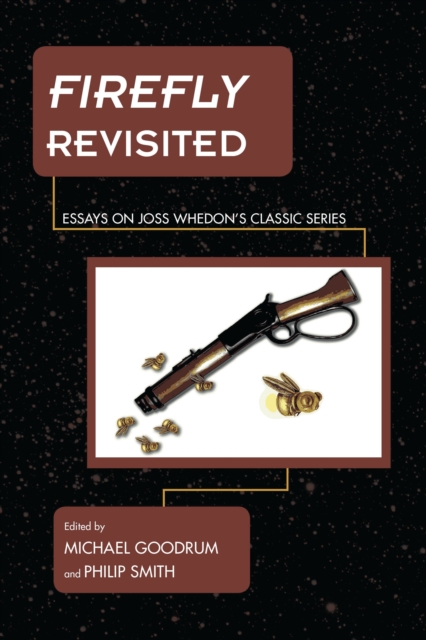
Firefly revisited
A short lived series created by Joss Whedon, Firefly nonetheless developed such a loyal following that Whedon was compelled to write and direct a big screen sequel in 2005. The show continues to generate a life of its own in books and comic books. This collection of twelve essays focuses on a number of themes including colonialism, race, gender, and politics.
eBook

TELEVISION PREMIERES: GALACTIC COWBOYS Hitmaker explores a new universe in 'Firefly'
Occasionally they run afoul of Alliance patriots and get into old- fashioned saloon fights, like the one that starts tonight's show. In fine Western tradition, Mal gets tossed out a window --- though in this case, it's composed of an energy field, not glass. The cavalry that comes to his rescue is his crew, including tough first mate Zoe (Gina Torres), her pilot husband Wash (Alan Tudyk), the mercenary Jayne (Adam Baldwin), engineer Kaylee (Jewel Staite), a preacher named Book (Ron Glass), and a young doctor named Simon (Sean Maher) whose primary patient is his disturbed sister River (Summer Glau), survivor of some mysterious experiments. Oh yeah, also on board is Inara (Morena Baccarin), a \"companion,\" aka prostitute, a legal and revered occupation in this futurescape.
Newspaper Article

Be sure to catch this 'Firefly' ; It's 'Stagecoach' meets 'Star Trek'
There you have it: Joss Whedon's one-line description for his latest series, Firefly, and seldom has a new series had a more accurately succinct summation. Then again, seldom has a series had a creator/producer as outrageously talented as Whedon, which is why Firefly is one of the season's most highly anticipated series. It's an unusual ride, to say the least. Somewhere in Firefly's 500-years-ahead galaxy there are no doubt fabulous cities and wildly advanced civilizations (no aliens, though -- it's a Whedon rule). But on the fringe planets visited by the crew of the Firefly- class transport ship Serenity, life is a hardscrabble fight, and the tools used to survive are a cobbled-together mix of high-tech and low. A wild sci-fi ride: [Adam Baldwin], left, [Nathan Fillion] and [Gina Torres] are part of the crew of the Serenity, traveling the frontier in Firefly. The show premieres Friday night on Fox.
Newspaper Article
The Serenity Logo: Otherness and Inauthenticity
Introduction This paper explores and critiques the typographic and design decisions made in the creation of the logo and brand for the 2oo5 film Serenity by Joss Whedon and how the choice of the Papyrus-inspired typeface used in the logo perpetuates the potential for orientalist, racialized stereotypes, and material dishonesty previously seen in the film's casting, props, and story critiqued prior in Serenity scholarly literature. [...]the Serenity logo takes on six different forms (Fig. i): 1. The American Marketing Association describes a brand as a \"name, term, sign, symbol, or design, or a combination of them, intended to identify the goods and services of one seller or group of sellers and to differentiate them from those of competition\" (American Marketing Association). The Serenity logo has succeeded in creating strong brand equity as 20 years later many Browncoats still adore the TV show, film, comics, books, and merchandise as much as ever.
Magazine Article


FAR-OUT `FIREFLY' MAY TAKE WING
The adventure is set 500 years from now on Serenity, a hulking transport spaceship that looks like a giant firefly. Occupied by a motley collection of young rebels, Serenity cruises the fringes of the galaxy, dodging the totalitarian Alliance of planets in the name of individuality. The captain is Malcolm Reynolds ([Nathan Fillion]), a dashing and jokey hero; Zoe ([Gina Torres]) is his tough second-in- command; Simon ([Sean Maher]) is the uptight doctor with secrets; and Book ([Ron Glass]) is the wise elder. The tone is often wry, as these and other crew members evade over-the-top villains, but there are also a few of the bitter angst attacks and flirtations that \"Buffy\" fans have come to expect from Whedon.
Newspaper Article