
Catalogue Search | MBRL


Are you sure you want to remove the book from the shelf?

{{itemTitle}}
5,866
result(s) for
"Fires Social aspects."
Sort by:

Fire : nature and culture
\"Fire has been an integral feature of our planet for over 400 million years. It has defined human culture from the beginning; it is something without which we cannot survive. For while fire is among the most destructive forces on earth, it has equally tremendous powers of cleansing renewal and controlled energy. In this book the author delivers a masterclass history of fire and its use by humanity, explaining how fire has always been at the core of how people have made their world habitable, whether hunting, foraging, farming, herding or urbanizing, and of course in managing nature reserves. Fire was deployed in the bast by aboriginal communities, and early agricultural societies began to control and contain fire and fuel. But our mastery of the science and art of fire has not given us absolute power: fire disasters have altered the course of history, and unexpected fires that begin as the result of other disasters can have shocking efffects. In addition, wildfires are a crucial component of natural regeneration. The past 200 years has also seen the growth of a massive new role of combustibles in the form of fossil biomass: 'people burn fuels from the geological past and release their effluents into the geological future. The present they overload with noxious emissions and greenhouse gases.' New combustion practices have radically changed the world's ecological balance.
Book

The Real Disaster Is Above Ground
In the 1950s Centralia was a small town, like many others in the anthracite region of Pennsylvania. But since the 1960s, it has been consumed, outwardly and inwardly by a fire that has inexorably spread in the abandoned mines beneath it. The earth smokes, subsides, and breathes poisonous gases. No less destructive has been the spread of dissension and enmity among the townspeople.The Real Disaster Above Groundtells the story of the fire and the tragic failure of all efforts to counter it.
This study of the Centralia fire represents the most thorough canvass of the documentary materials and the community that has appeared. The authors report on the futile efforts of residents to reach a common understanding of an underground threat that was not readily visible and invited multiple interpretations. They trace the hazard management strategies of government agencies that, ironically, all too often created additional threats to the welfare of Centralians. They report on the birth and demise of community organizations, each with its own solution to the problem and its diehard partisans. The final solution, now being put into effect, is to abandon the town and relocate its people.
Centralia's environmental disaster, the authors argue, is not a local or isolated phenomenon. It warns of the danger lurking in our own technology when safeguards fail and disaster management policy is not in place to respond to failure, as the examples of Chernobyl and Bhopal have clearly demonstrated.
The lessons in this study of the fate of a small town in Pennsylvania are indeed sobering. They should be pondered by a variety of social scientists and planners, by all those dealing with the behavior of people under stress and those responsible for the welfare of the public.
eBook

City on fire : technology, social change, and the hazards of progress in Mexico City, 1860-1910
\"City on Fire is a chronicle of progress and danger, that integrates urban environmental history with histories of technology, science, and medicine to reveal how Mexico City changed in response to the growing threat of fire in the urban center\"-- Provided by publisher.
Book

Melbourne
Sophie Cunningham writes a year in the city’s life, a year that takes us from the heatwave that culminated on Black Saturday when temperatures soared to 47 degrees to the destructive deluge of a hailstorm. She walks through Melbourne’s oldest suburb to its largest market, she goes to the footy and to the comedy festival, she talks publishing and learns how to use a letterpress. Along the way she journeys deep into her own recollections of the city she grew up in, and tells stories from its history: the theft of Picasso’s Weeping Woman, the Hoddle Street massacre, William Barak’s trek from Healesville, the Westgate Bridge Disaster, the high drama of the 1970 and 2009 AFL grand finals and the Market Murders of the sixties. She strolls by Melbourne’s rivers and creeks while considering the history of the wetlands and river that sit at Melbourne’s heart. She clambers through the drains that lie beneath. For it is water – the corralling of it, the excess of it, the squandering of it, the lack of it – that defi nes Melbourne’s history, its present and its future.
eBook

American Gun Culture
Taylor's neutral account of U.S. gun culture never loses sight of the fact that guns are all around us. With millions of guns and gun owners, it is imperative that policy and future research pertaining to guns consider the relative cultural and symbolic value that gun owners place on their guns. Taylor's candid, emotional and occasionally funny research explores the symbolic meaning of guns and the ways in which the meaning assigned to guns influences gun ownership and use. Some of his more interesting findings center around conversations with gun collectors and enthusiasts about a series of interaction rituals; rituals pertaining to being a gun owner, a gun user, and possibly even the gun as an object of near-worship. Gun owners also recognize a unique stigma, and respond through a complex series of stigma management techniques. And much, much more.
eBook


Modernity at Gunpoint
2019 Best Book in the Humanities (Mexico section) of the Latin American Studies Association
Modernity at Gunpoint provides the first study of the political and cultural significance of weaponry in the context of major armed conflicts in Mexico and Central America. In this highly original study, Sophie Esch approaches political violence through its most direct but also most symbolic tool: the firearm. In novels, songs, and photos of insurgency, firearms appear as artifacts, tropes, and props, through which artists negotiate conceptions of modernity, citizenship, and militancy. Esch grounds her analysis in important re-readings of canonical texts by Martín Luis Guzman, Nellie Campobello, Omar Cabezas, Gioconda Belli, Sergio Ramirez, Horacio Castellanos Moya, and others. Through the lens of the iconic firearm, Esch relates the story of the peasant insurgencies of the Mexican Revolution, the guerrilla warfare of the Sandinista Revolution, and the ongoing drug-related wars in Mexico and Central America, to highlight the historical, cultural, gendered, and political significance of weapons in this volatile region.
eBook

Fire Dancers in Thailand's Tourism Industry
Fire Dancers in Thailand's Tourism
Industry explores the evolution of fire
dancing from informal community jam sessions into the iconic,
tourist-oriented performances at beach parties and bars, through a
close consideration of the role of affect in the lives of fire
dancers in the ever-changing scene.
Rather than pursuing the common notion that tourism industries
are exploitative enterprises that oppress workers, Tiffany Rae
Pollock centers the perspectives of fire artists themselves, who
view the industry as simultaneously generative and destructive.
Dancers reveal how they employ affect to navigate their lives, art,
and labor in this context, showcasing how affect is not only a
force that acts on people but also is used and shaped by social
actors toward their own ends. Fire Dancers in Thailand's
Tourism Industry highlights men as affective laborers,
investigating how they manage the eroticization of their identities
and the intersections of art and labor in tourist economies.
Exploring moments of performance and everyday life, Pollock
examines how fire artists reimagine their labor, lives, and
communities in Thailand's tourism industry.
eBook

British Columbia in Flames
Like many British Columbians in 2017, Claudia Cornwall found herself glued to the news about the disastrous wildfires across the province. Her worry was personal: her cabin at Sheridan Lake had been in the family for sixty years and was now in danger of destruction. Cornwall, a long-time writer, was stricken not just by her own experience, but by the many moving stories she came across about the fires—so she began collecting them. She met with people from the communities of Sheridan Lake, Ashcroft, Cache Creek, 16 Mile House, Lac La Hache, Quesnel, Williams Lake, Hanceville-Riske Creek and Clinton. She hoped to be a conduit for the voices she heard—for those who fought the fires raging around them, those who were evacuated and displaced, and those who could do nothing but watch as their homes burned. She conducted over fifty hours of interviews with ranchers, cottagers, Indigenous residents, RCMP officers, evacuees, store and resort owners, search and rescue volunteers, firefighters and local government officials. Presented in British Columbia in Flames are stories that illustrate the importance of community. During the 2017 wildfires, people looked after strangers who had no place to go. They shared information. They helped each other rescue and shelter animals. They kept stores open day and night to supply gas, food and comfort to evacuees. This memoir, at once journalistic and deeply personal, highlights the strength with which BC communities can and will come together to face a terrifying force of nature.
eBook
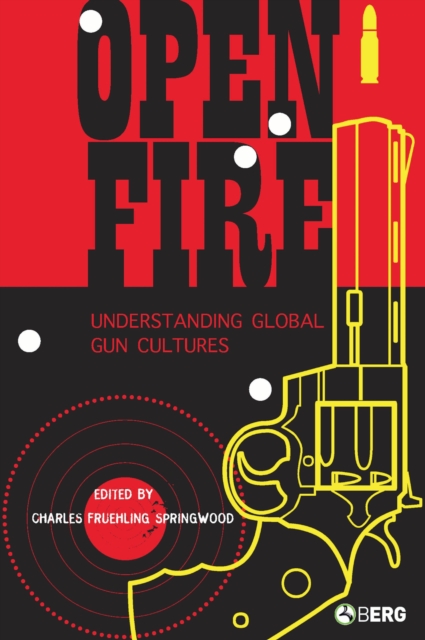
Open fire : understanding global gun cultures
Guns are everywhere: three quarters of a billion guns - from pistols to machine guns - exist in the world today. And guns are everything: a hard-won symbol of individual freedom, an index of crime and disorder, a whole industry legitimately contributing to an economy, a popular piece of sports equipment, and an object of desire, endlessly duplicated by toys, video games and films. Open Fire presents a broad analysis of the social, cultural and political significance of firearms and the worlds they create. Illustrated with a wide range of case material - from North and South America, Europe, Asia and Africa - Open Fire explores and questions this global icon of our times. Why do guns proliferate? What does it mean to shoot or to be shot? Who owns guns and who does not? How is a firearm, a manufactured thing, very different from any other object? Is there such a thing as a \"gun psychology\"? How are firearms regarded in places where they are largely non-existent? Is a gun a different thing when held by a white man?
eBook