
Catalogue Search | MBRL


Are you sure you want to remove the book from the shelf?

{{itemTitle}}
17,148
result(s) for
"Flint"
Sort by:


Tainted Tap
After a cascade of failures left residents of Flint, Michigan,
without a reliable and affordable supply of safe drinking water,
citizens spent years demanding action from their city and state
officials. Complaints from the city's predominantly African
American residents were ignored until independent researchers
confirmed dangerously elevated blood lead levels among Flint
children and in the city's tap water. Despite a 2017 federal court
ruling in favor of Flint residents who had demanded mitigation,
those efforts have been incomplete at best. Assessing the
challenges that community groups faced in their attempts to
advocate for improved living conditions, Tainted Tap
offers a rich analysis of conditions and constraints that created
the Flint water crisis. Katrinell Davis contextualizes the crisis
in Flint's long and troubled history of delivering essential
services, the consequences of regional water-management politics,
and other forms of systemic neglect that impacted the working-class
community's health and well-being. Using ethnographic and empirical
evidence from a range of sources, Davis also sheds light on the
forms of community action that have brought needed changes to this
underserved community.
eBook



Semi-pro
Jackie Moon, the owner-coach-player of the American Basketball Association's Flint Michigan Tropics, rallies his teammates to make their NBA dreams come true.
DVD

Determining The Lens Aberations on Positive Lenses Through Science Process Skill
This research aims to determine aberrations or image distortions in a positive lens using an optics experiment kit for image distortions. The experimental tool consists of a diaphragm, a positive lens, a light source, lens path, an image capture screen, and a flint glass used to reduce lens distortions. The main tool is made of acrylic, which is durable and easy to use. The lens used is a strong positive lens (+100). The diaphragms used vary, including a slit diaphragm with five slits and a four-ring diaphragm. These diaphragms are used to produce image shapes and observe the distortions that occur. The work process refers to the skills of scientific processes such as observation, classification, measurement, prediction, communication, and conclusion, which are implemented in the work instructions for creating aberrations or image distortions by placing the positive lens parallel to the light source and the image capture screen. Then, the distortions that occur are observed, and a flint glass is placed in front of the light source to reduce the distortions that are formed. By observing the resulting image, it can be seen that the distortions that occur on the positive lens and how the flint glass works to reduce these aberrations. This is in line with the theory that aberrations on a positive lens occur due to imperfect light bias, either because of the different refractive index biases from different media in the lens, or because of the lens shape not being ideal. Flint glass is one of the methods used to reduce these aberrations.
Journal Article

The poisoned city : Flint's water and the American urban tragedy /
\"Recounts the gripping story of Flint's poisoned water through the people who caused it, suffered from it, and exposed it. It is a chronicle of one town, but could also be about any American city, all made precarious by the neglect of infrastructure\"-- Provided by publisher.
Book

The life of Charles Stewart Mott : industrialist, philanthropist, Mr. Flint
The name Charles Stewart Mott is today most widely recognizable when used in connection with the word Foundation . Established by the General Motors mogul in 1926, the Charles Stewart Mott Foundation has made grants in excess of $3 billion over the past nine decades, both in Mott's adopted hometown of Flint, Michigan, and around the world. But philanthropy is only one reason the life of Mott--entrepreneur, industrialist, banker, mayor, and sometimes even cowboy--is worth knowing about today. Mott was born ten years after the death of Abraham Lincoln and one year before the 1876 centennial of the founding of the United States. He not only lived through the most dramatic technological shift and period of economic growth that had yet been known, but he actively participated in and contributed to these events as a major innovator and leader at General Motors, as a public official, and as a philanthropist who in many ways reinvented the nonprofit model. Known widely as Mr. Flint, Mott was elected three times as the city's mayor and played a central role in modernizing and expanding its infrastructure and institutions. In office, Mott helped transform Flint from a town capable of efficiently accommodating a population of roughly thirteen thousand in the first decade of the twentieth century to a modern metropolis capable of hosting an industrial middle class of more than one hundred thousand. This vivid biography portrays a complex, brilliant, often contradictory, and ultimately fascinating man. His life--both as a record of himself and as a reflection of his times--makes for a good and important story that will be enjoyed by readers interested in Michigan history and politics, the automotive industry, and global philanthropy.
Book
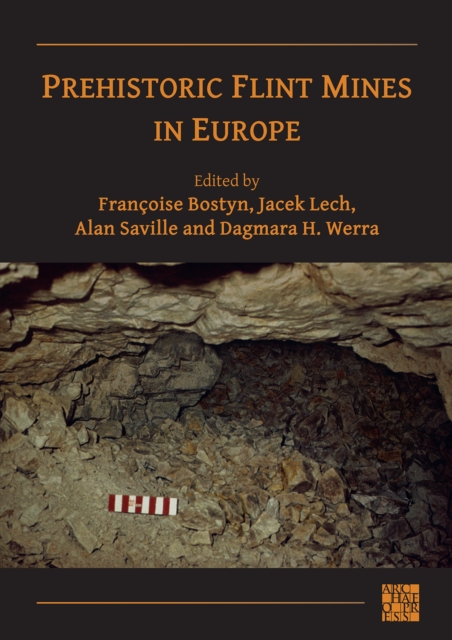
Prehistoric Flint Mines in Europe
Prehistoric Flint Mines in Europe presents the results of
the UISPP Commission, Flint Mining in Pre- and Protohistoric
Europe. It offers a review of major flint mines dating from the
Neolithic to the Bronze Age. The eighteen articles were contributed
by archaeologists from ten countries - Belgium, France, Germany,
Great Britain, Hungary, Italy, the Netherlands, Poland, Spain and
Sweden - using the same framework in order to propose a uniform
view of the mining phenomenon. At the same time the book reflects
various research methods and traditions. Each article deals
successively with the geographical and geological context, mining
zone topography, research history, methods of exploitation of raw
material, dating of archaeological features and structures,
characteristics of lithic production, organization of labour,
miners' settlements, distribution of products and symbolic aspects
of mining activity. Part I includes the well-known flint mines at
Spiennes in Belgium, Grime's Graves in England and Rijckholt-Sint
Geertruid in the Netherlands, as well as the equally fascinating
Defensola mine from Italy. Part II contains presentations of other
European flint mines. The book is abundantly illustrated with
large, colour photographs and drawings, and is aimed not only at
archaeologists, who will find valuable data and further literature,
but also at any reader seeking up-to-date information on
prehistoric flint mining communities in Europe.
eBook