
Catalogue Search | MBRL


Are you sure you want to remove the book from the shelf?

{{itemTitle}}
116
result(s) for
"Folk music United States History and criticism."
Sort by:


The Beautiful Music All Around Us
The Beautiful Music All Around Us presents the extraordinarily rich backstories of thirteen performances captured on Library of Congress field recordings between 1934 and 1942 in locations reaching from Southern Appalachia to the Mississippi Delta and the Great Plains. Including the children's play song \"Shortenin' Bread,\" the fiddle tune \"Bonaparte's Retreat,\" the blues song \"Another Man Done Gone,\" and the spiritual \"Ain't No Grave Can Hold My Body Down,\" these performances were recorded in kitchens and churches, on porches and in prisons, in hotel rooms and school auditoriums. Documented during the golden age of the Library of Congress recordings, they capture not only the words and tunes of traditional songs but also the sounds of life in which the performances were embedded: children laugh, neighbors comment, trucks pass by._x000B__x000B_Musician and researcher Stephen Wade sought out the performers on these recordings, their families, fellow musicians, and others who remembered them. He reconstructs the sights and sounds of the recording sessions themselves and how the music worked in all their lives. Some of these performers developed musical reputations beyond these field recordings, but for many, these tracks represent their only appearances on record: prisoners at the Arkansas State Penitentiary jumping on \"the Library's recording machine\" in a rendering of \"Rock Island Line\"; Ora Dell Graham being called away from the schoolyard to sing the jump-rope rhyme \"Pullin' the Skiff\"; Luther Strong shaking off a hungover night in jail and borrowing a fiddle to rip into \"Glory in the Meetinghouse.\"_x000B__x000B_Alongside loving and expert profiles of these performers and their locales and communities, Wade also untangles the histories of these iconic songs and tunes, tracing them through slave songs and spirituals, British and homegrown ballads, fiddle contests, gospel quartets, and labor laments. By exploring how these singers and instrumentalists exerted their own creativity on inherited forms, \"amplifying tradition's gifts,\" Wade shows how a single artist can make a difference within a democracy. _x000B__x000B_Reflecting decades of research and detective work, the profiles and abundant photos in The Beautiful Music All Around Us bring to life largely unheralded individuals--domestics, farm laborers, state prisoners, schoolchildren, cowboys, housewives and mothers, loggers and miners--whose music has become part of the wider American musical soundscape. The book also includes an accompanying CD that presents these thirteen performances, songs and sounds of America in the 1930s and '40s._x000B__x000B_
eBook


Roots of the Revival
In Roots of the Revival: American and British Folk Music in the 1950s , Ronald D. Cohen and Rachel Clare Donaldson present a transatlantic history of folk's midcentury resurgence that juxtaposes the related but distinct revivals that took place in the United States and Great Britain. After setting the stage with the work of music collectors in the nineteenth century, the authors explore the so-called recovery of folk music practices and performers by Alan Lomax and others, including journeys to and within the British Isles that allowed artists and folk music advocates to absorb native forms and facilitate the music's transatlantic exchange. Cohen and Donaldson place the musical and cultural connections of the twin revivals within the decade's social and musical milieu and grapple with the performers' leftist political agendas and artistic challenges, including the fierce debates over \"authenticity\" in practice and repertoire that erupted when artists like Harry Belafonte and the Kingston Trio carried folk into the popular music mainstream. From mountain ballets to skiffle, from the Weavers in Greenwich Village to Burl Ives on the BBC, Roots of the Revival offers a frank and wide-ranging consideration of a time, a movement, and a transformative period in American and British pop culture.
eBook

Right to the juke joint : a personal history of American music
\"The cowboy songs and dusty Texas car rides of his youth set Patrick B. Mullen on a lifelong journey into the sprawling Arcadia of American music. That music fused so-called civilized elements with native forms to produce everything from Zydeco to Conjunto to jazz to Woody Guthrie. The civilized/native idea, meanwhile, helped develop Mullen's critical perspective, guide his love of music, and steer his life's work. Part scholar's musings and part fan's memoir, Right to the Juke Joint follows Mullen from his early embrace of country and folk to the full flowering of an idiosyncratic, omnivorous interest in music. Personal memory merges with a lifetime of fieldwork in folklore and anthropology to provide readers with a deeply informed analysis of American roots music. Mullen opens up on the world of ideas and his own tireless fandom to explore how his cultural identity--and ours--relates to concepts like authenticity and folkness. The result is a charming musical map drawn by a gifted storyteller whose boots have traveled a thousand tuneful roads.\"--Provided by publisher.
Book
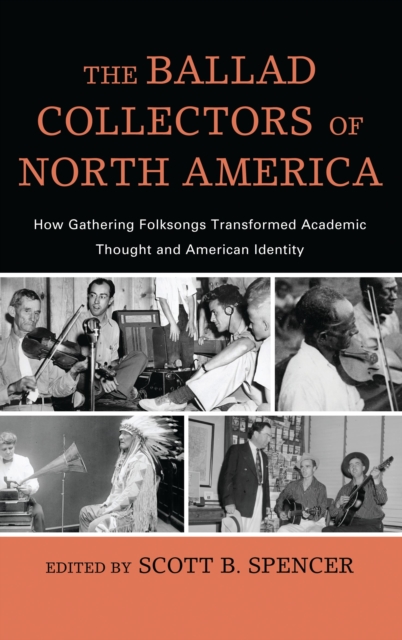
The ballad collectors of North America
Much has been written about the songs gathered in North America in the first half of the 20th century. However, there is scant information on those individuals responsible for gathering these songs. The Ballad Collectors of North America: How Gathering Folksongs Transformed Academic Thought and American Identity fills this gap, documenting the efforts of those who transcribed and recorded North American folk songs. Both biographical and topical, this book chronicles not only the most influential of these “song catchers” but also examines the main schools of thought on the collection process, the leading proponents of those schools, and the projects that they shaped. Contributors also consider the role of technology—especially the phonograph—in the collection efforts. Chapters organized by region cover such areas as Appalachia, the West, and Canada, while others devoted to specialized topics from the cowboy tune and occupational song to the commercialization of folk music through song collections and anthologies. Ballad Collectors investigates the larger role of the ballad in the development of American identity, from the national appreciation of cowboy songs in popular culture to the use of Appalachian song forms in radio broadcasts to the role of dustbowl ballads in the urban folk revival of the 1950s and 1960s. Finally, this collection assesses the changing role of songs and song texts in the academic fields of folklore, anthropology, musicology, and ethnomusicology. Scholars and students of American cultural and social history, as well as fans of North American folk and popular music, will find The Ballad Collectors of North America a fascinating story of how the American folk tradition gained greater visibility, fueling the revolutions that would follow in the writing and performance of American music.
eBook


In It for the Long Run
Inspired by the Hank Williams and Leadbelly recordings he heard as a teenager growing up outside of Boston, Jim Rooney began a musical journey that intersected with some of the biggest names in American music including Bob Dylan, James Taylor, Bill Monroe, Muddy Waters, and Alison Krauss. In It for the Long Run: A Musical Odyssey is Rooney's kaleidoscopic first-hand account of more than five decades of success as a performer, concert promoter, songwriter, music publisher, engineer, and record producer. As witness to and participant in over a half century of music history, Rooney provides a sophisticated window into American vernacular music. Following his stint as a \"Hayloft Jamboree\" hillbilly singer in the mid-1950s, Rooney managed Cambridge's Club 47, a catalyst of the 60's folk music boom. He soon moved to the Newport Folk Festival as talent coordinator and director where he had a front row seat to Dylan \"going electric.\" In the 1970s Rooney's odyssey continued in Nashville where he began engineering and producing records. His work helped alternative country music gain a foothold in Music City and culminated in Grammy nominations for singer-songwriters John Prine, Iris Dement, and Nanci Griffith. Later in his career he was a key link connecting Nashville to Ireland's folk music scene. Writing songs or writing his memoir, Jim Rooney is the consummate storyteller. In It for the Long Run: A Musical Odyssey is his singular chronicle from the heart of Americana.
eBook


Right to the Juke Joint
The cowboy songs and dusty Texas car rides of his youth set Patrick B. Mullen on a lifelong journey into the sprawling Arcadia of American music. That music fused so-called civilized elements with native forms to produce everything from Zydeco to Conjunto to jazz to Woody Guthrie. The civilized/native idea, meanwhile, helped develop Mullen's critical perspective, guide his love of music, and steer his life's work. Part scholar's musings and part fan's memoir, Right to the Juke Joint follows Mullen from his early embrace of country and folk to the full flowering of an idiosyncratic, omnivorous interest in music. Personal memory merges with a lifetime of fieldwork in folklore and anthropology to provide readers with a deeply informed analysis of American roots music. Mullen opens up on the world of ideas and his own tireless fandom to explore how his cultural identity--and ours--relates to concepts like authenticity and \"folkness.\" The result is a charming musical map drawn by a gifted storyteller whose boots have traveled a thousand tuneful roads.
eBook